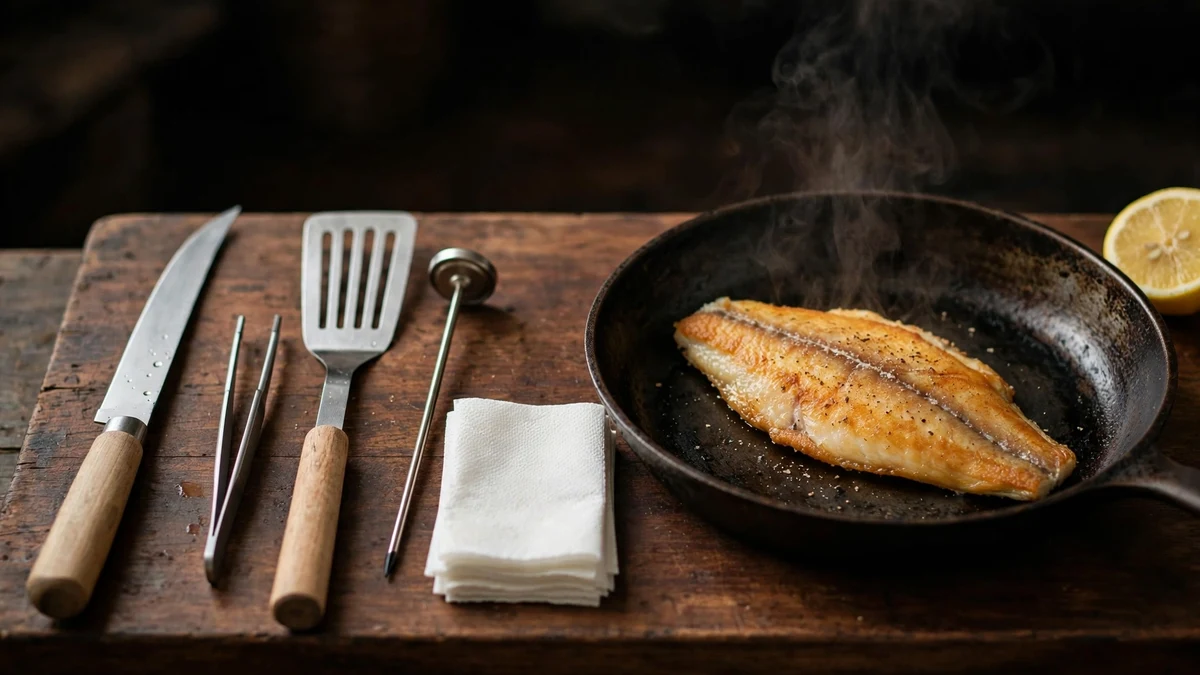
Essential Tools Every Fish Cook Needs (Starter Kit)
When I started cooking fish seriously, I thought skill lived in a drawer full of gadgets. It does not. The dinners that taught me the most came from a sharp knife, one honest pan, and fish I had dried properly. Meanwhile I have watched new cooks spend heavily on specialty tools, then still serve fish that stuck, broke, and dried out, because the basics were never covered.
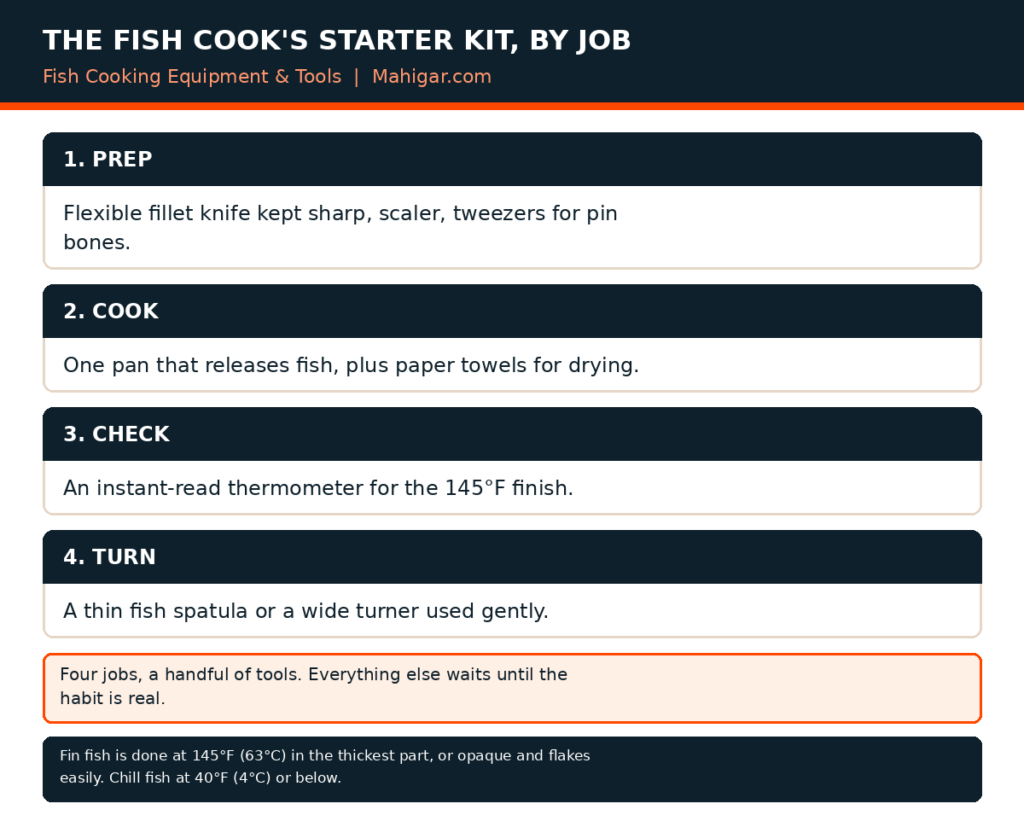
So here is the starter kit I hand to anyone who asks me, in the order I would buy it: cover four jobs, prep, cook, check, and turn, with a handful of honest tools, and stop there. This list rolls up everything in Essential Equipment for Cooking Fish at Home into one short checklist. Everything else is a later, maybe, and in my experience most of it is a later, never.
Table of Contents
Table of Contents
First: Four Jobs, Not Forty Products
Every fish dinner asks the same four questions, no matter the recipe. Who preps this fish? What does it cook in? How do I know it is done? What lifts it out in one piece?
Notice what is not asked: which gadget smokes it, poaches it, or air-fries it. Those are methods, and in my kitchen methods come after the basics are calm. A kit that answers the four honest jobs will cook almost every fish dinner you meet. Buy in this order, and let the list stay short.
Prep: A Flexible Fillet Knife, a Scaler, and Tweezers
Prep needs three tools: a flexible fillet knife kept sharp, a simple scaler, and a pair of tweezers.
The one knife fish truly needs is a fillet knife, long, thin, and flexible. The flex is the point for me: the blade bends along ribs and backbone, slides between skin and flesh, and takes clean slices where a stiff knife saws and tears. A dull fillet knife is worse than none, because it pushes me into forcing cuts. Sharp matters more than expensive. I look for a blade that bends without feeling flimsy and a handle that stays grippable with wet hands.
A scaler is the second prep tool, and it can be as simple as a dedicated scaler or the back of a sturdy knife used with respect. Scales must come off without gouging the flesh beneath; that is the whole job description.
Tweezers are the smallest tool on this page and the one I would fight to keep. Pin bones hide along a fillet’s centre line, invisible to the eye and rude at the table. My fingertips find them; tweezers pull them. Wide, flat-tipped tweezers grip better than pointed ones, and they cost less than the fish they protect. Add one sturdy kitchen knife for heavier work and a board that does not slide, and every whole fish that enters my kitchen can be scaled, gutted, filleted, skinned, and portioned without drama.
Cook: One Pan That Lets Go, and Paper Towels
Cooking needs one pan that releases fish, plus the cheapest tool on this page: paper towels.
One pan. Not a set, not a collection, one pan that gets properly hot, holds its heat when a fillet lands, and lets the fish release when its surface has firmed. Which material honestly does that for the way you cook is a real question with real trade-offs, and it is answered pan by pan in Best Pans for Cooking Fish Without Sticking. For the starter kit, my rule is simpler: one good pan, learned deeply, beats three pans used hopefully.
Beside it, paper towels. I pat fish dry before it meets heat, every time, or the surface water turns to steam and the fish poaches itself grey instead of searing. More equipment problems die on a paper towel in my kitchen than on any purchase. Add a tray for resting and ordinary tongs for sturdy pieces, and the cooking job is covered. I choose a pan by weight in the hand, a safe handle, and a size that fits my most-cooked fish without crowding.
Check: An Instant-Read Thermometer
Checking needs one small thermometer, and it ends the guessing that dries fish out.
Fish travels from not yet to too far in a blink, and guessing is how it dries. An instant-read thermometer is the one true gadget in my starter kit, and I urge it on every fish cook without embarrassment. I probe the thickest part, away from bone and pan, and the guessing ends: fin fish is done at 145°F (63°C), or opaque and flaking easily, the number and the visual cue together.
It ends the nervous five more minutes habit that dries more fish than any other mistake I know, and it makes serving fish to guests calm instead of theatrical. I look for a thin tip, a clear reading, and a body I can rinse and dry without ceremony. The fuller buying guidance is in Best Meat Thermometers for Fish. The same tool also guards the cold end: fish waits chilled at 40°F (4°C) or below, from market to pan.
Turn: A Thin Spatula or a Wide Turner
Turning needs one thin, flexible turner that slides under the whole fillet instead of shoving at its edge.
Fish breaks at the flip more often than anywhere else in my cooking. The dedicated fish spatula, thin angled edge, gentle flex, slots that let oil fall away, exists for exactly this job, and whether it beats a wide turner you already own is a fair question with an honest, habit-based answer in Do You Need a Fish Spatula? A Buyer’s Guide.
My verdict for a starter is plain: if delicate fillets pass through your pan most weeks, buy the fish spatula early and never regret it. If your fish is sturdy and occasional, a wide, thin turner from your drawer, used gently, is enough to begin. Either way, I buy the turner after the knife, the pan, and the thermometer, because turning matters only once the fish is worth turning. Two spoons or a bench scraper for lifting portions support the job, and that is the turn job done.
The Honest Buy Later, Maybe List
Every tool below serves one real habit well and an imagined habit badly. None belongs in a starter kit.
A fish poacher serves the cook who poaches whole fish for guests often; a lidded pan or deep tray does the job honestly for everyone else, me included on most weeks. A grill basket serves the weekly griller tired of losing fish to the grates; the occasional griller can start with a clean, hot, well-oiled grate. A home smoker is a commitment, not an accessory, bought for the second and third time you will smoke fish, not the first inspired weekend. An air fryer cooks coated fillets and small batches respectably, but it will never give you a pan sauce or true pan crisp skin.
Notice the pattern I live by: every tool here is bought after the cooking, not before it. The habit buys the tool. The tool never buys the habit.
What I Would Skip Entirely
Skip unitaskers, oversized knife blocks, and duplicates. Tools do not make the cook; habits do.
I skip any gadget that does one tiny job a knife, spoon, or fingertips already do. I skip the enormous knife block bought to house two knives’ worth of work. I skip duplicate turners, single-use novelty gadgets, and anything whose claim is that it will make you a fish cook. A sharp knife, a dry fillet, one hot pan, a true thermometer reading, and patience make the cook at my stove. Equipment just removes excuses, which is why my honest starter kit fits on one board, and why your first four purchases should be boring, sturdy, and used every single week.
Frequently Asked Questions
What are the absolute essentials for cooking fish at home?
Four jobs, a handful of tools: a flexible fillet knife kept sharp, a scaler and tweezers for prep; one pan that releases fish and paper towels for drying; an instant-read thermometer for the 145°F (63°C) finish; and a thin spatula or wide turner for gentle flips. That kit cooks almost every fish dinner a home kitchen will ever meet, in my experience.
What should I buy first if I can only afford one tool?
The fillet knife, but only if you buy whole or skin-on fish. If you buy ready fillets, I would buy the thermometer first instead, because it ends the dry-fish guessing at once. Either way, buy for the job your kitchen actually does weekly, not the job a catalogue imagines for you.
Do I need a fish spatula in my starter kit?
Only if delicate fillets and crisp skin pass through your pan most weeks, then its thin, flexible edge genuinely earns its place. For sturdy fish cooked occasionally, a wide, thin turner you already own is an honest start. In my order it is a fourth purchase, never a first.
Which popular fish gadgets can I skip?
Poachers, smokers, grill baskets, and air fryers are all later, maybe tools: good servants to a real habit, expensive storage without one. I buy each only when the cooking habit already exists. And I skip unitaskers entirely: if a knife, a spoon, or your fingertips already do the job, the gadget is a drawer tenant, not a tool.
What to Check Next
Tonight, lay out what you own against the four jobs: prep, cook, check, turn. Most kitchens I see discover they are one honest purchase away from a complete starter kit, usually the thermometer, sometimes the turner. Buy that one tool, cook fish with it all month, and only then let the next habit introduce itself. Your kit is complete when every tool in it works every week.
