Is Your Catch Safe to Eat? Water Quality and Local Advisories
A fish can look perfect and still be the wrong fish to eat. I have turned down clean, bright eyed fish in my own kitchen for a simpler reason than smell or looks. I did not know enough about the water it came from. That question, where the fish lived and what was in that water, matters as much as how fresh the fish is.
Fish is the central subject of my kitchen, and a fresh catch is the best reason to cook it. But a river, lake, or canal is not a market counter. There is no label on the water. Some waters carry pollutants that build up in fish over time, and you cannot see, smell, or taste most of them.
This explainer belongs to my Catch to Kitchen: How to Handle and Cook Fish You Catch Yourself pillar, where the full journey from catch to plate is covered. Here I stay on one question only: how I judge whether a catch is safe to eat, using official guidance from the EPA and the FDA, and the kitchen checks I already use for any fish that comes into my home. I do not claim local knowledge I do not have about your water. Your local advisory is the final word for your river or lake, and this article shows you how to find it and use it.
Table of Contents
The Short Answer: Check the Water, Check the Advisory, Then Decide
A catch is safe to eat only when the water is suitable, the local advisory allows that species and size, and the fish is handled and cooked properly.
That is my whole rule in one line. I check three things, in this order. First, the water. Second, the advisory for that exact water, species, and size. Third, the fish itself, its freshness, how it was kept cold, and how I trim and cook it. If the first two checks fail, the third check does not save the fish. Freshness cannot remove mercury or other pollutants that have built up in the flesh over the life of the fish. Good cooking cannot do that either. Cooking makes fish safe from bacteria and parasites when it is done properly, but it does not clean polluted flesh.
If I cannot check the advisory, I do not guess. I find the information before the next trip or I choose not to eat that catch.
Why Water Quality Matters More Than the Fish Itself
Water quality decides the long term safety of a catch, because many pollutants collect in fish slowly over months and years.
A fish lives in its water every hour of its life. It feeds there, and small amounts of pollutants in the water, in mud, and in the smaller creatures it eats can build up in its body over time. Mercury is the best known example. It builds up more in older, larger fish that have eaten many smaller fish. Other pollutants, such as PCBs, tend to collect in the fatty parts of the fish. The EPA explains this build up in its fish consumption advisory guidance, and it is the reason two fish of the same species can be very different to eat. One came from clean water and is a fine meal. The other came from polluted water and carries a load you cannot detect at the table.
This is also why my normal freshness checks have a limit. I check eyes, gills, smell, and firmness for every fish, and those checks tell me about freshness. A dull fish with a sour smell goes out, whatever its source. But a fresh smelling fish can still carry pollutants from its water. Freshness is about time since the catch. Safety from pollutants is about the life of the fish before the catch. You need good answers to both.
How to Check Local Advisories Before You Fish
Check the local fish consumption advisory for your exact water, species, and fish size before you fish, not after the fish is already in your kitchen.
The EPA and FDA advise anyone who eats fish they catch to check local fish consumption advisories first. In the United States, state, tribal, and local health and environmental agencies issue these advisories, and the EPA keeps links and guidance to help you find them. An advisory may limit how often you eat a species, set a size limit, or advise against eating fish from that water at all. Some waters have no advisory because they have not been tested, and the EPA guidance treats untested water with caution.
I read an advisory in a set order so I do not miss the detail that matters. First, I confirm I have the right water, because similar place names cause real mistakes. Second, I find my species, because advice for one fish does not transfer to another fish from the same water. Third, I check the size and meal advice, because many advisories allow smaller fish of a species but warn against the large ones, and they often give different advice for children and for women who are pregnant or breastfeeding. Fourth, I check the date, because advisories change when new testing is done.
If you fish outside the United States, use the same order with your own local health or environment authority. The names of the offices differ, but the questions do not. Which water, which species, which size, how often, and for whom. If I cannot answer those questions from a current local source, I treat the catch as unknown, and unknown is not good enough for my table. I would rather release a fish or give the day to another water than serve a meal I am unsure about.
Make the check part of the trip itself. I check before I pack, the same way I check my tackle. It takes a few minutes and is much easier than standing in the kitchen later trying to justify eating a fish.
Which Fish Are Safer Choices From the Same Water
Smaller, younger fish are usually the safer choice from any water, because they have had less time to build up pollutants.
The EPA and FDA give the same practical advice here. Choose younger and smaller fish when you eat a catch. A small fish has lived a shorter life, eaten less, and collected less mercury and fewer other pollutants than a large old fish of the same species from the same water. The large trophy fish makes the better photograph. The smaller fish often makes the better meal, for safety as well as for texture. When I have a choice at the water, I keep the modest sized fish for the table and let the big old ones go.
Species matters as much as size. Fish that eat other fish sit higher in the food chain and tend to carry more mercury. My guide to Mercury in Fish: Safe Levels by Species sets out those levels by species in detail, and I use the same thinking for a catch as I do for market fish. Know where your species sits before you decide how much of it to eat and how often.
Some fish should not be eaten at all, whatever the water. My list in Fish You Should Not Eat: Toxic and Poor-Eating Species to Know covers species that are toxic or poor eating by nature. That is a separate filter from water quality, and both filters apply. A safe species from bad water is still a bad choice. A risky species from clean water is still a risky species. I run every catch through both questions, species and water, before freshness even enters the decision.
How often you eat a catch matters too. Advisories usually limit meals per month, especially for larger fish. In my kitchen, variety protects me. I rotate species and sources instead of eating large amounts of one fish from one water again and again.
What Trimming and Cooking Can and Cannot Fix
Trimming skin and fat and cooking so fat drips away can reduce some pollutants, but no kitchen method removes mercury or makes fish from polluted water safe.
This is where my kitchen habits genuinely help, and I want to be precise about what they can do. The EPA advises trimming away the skin and fatty areas of a catch where many pollutants collect, including the belly fat, the fat along the back and sides, and the dark fatty flesh. It also advises removing the internal organs before cooking, and cooking the fish in a way that lets fat drip away, such as grilling or broiling on a rack, rather than frying it in its own fat or using the drippings in a sauce. Followed properly, those steps can lower your exposure to pollutants that collect in fat, such as PCBs.
My own trimming practice transfers directly here. I already trim skin, belly fat, and dark flesh from strong flavoured fish in my kitchen for taste, and I clean every fish early. Those same habits, done for the EPA reasons above, are part of eating a catch more safely.
Now the limit, and it is important. Mercury sits in the flesh itself, not only in the fat, so trimming and grilling do not remove it. No marinade, soak, or cooking method pulls pollutants out of polluted flesh. If the advisory says do not eat that species from that water, my answer is simple. I do not eat it, and I do not try to cook my way around the advice. Trimming reduces a permitted risk. It does not cancel a warning.
Cooking still has its own safety job, and I never relax it. I cook fish to 145°F (63°C), until the flesh is opaque and flakes cleanly. That heat deals with bacteria and parasites. Keep the two jobs separate in your mind. Advisory and trimming manage pollutants. Proper cooking manages germs and parasites. A safe plate needs both.
Freshness Still Matters: Handling From Catch to Kitchen
A catch from clean water still becomes unsafe if it warms up, sits too long, or is handled badly on the way home.
Pollutants are the slow risk. Spoilage is the fast one, and it is in your control. From the moment a fish is caught, the clock runs. I get a fish I plan to eat cleaned and onto ice as soon as I reasonably can, and I keep it cold all the way home. If a fish has been warm and neglected for hours, it does not reach my table.
Timing is covered in full in my guide to How Long After Catching Can You Eat Fish?, and I follow its discipline for every catch. At home, my fridge stays at or below 40°F (4°C), and fresh fish gets 1 to 2 days in the fridge at most. In practice I cook a catch the same day or the next day. If I cannot, I freeze it properly rather than letting it drift past its best days in the fridge.
Clean hands, clean boards, and separation from ready to eat foods matter just as much. Raw fish juices carry bacteria, and cross contact spreads them. The symptoms and causes are set out plainly in Fish Food Poisoning: Symptoms, Causes, and Prevention. Most cases come from ordinary carelessness: warm storage, slow chilling, dirty surfaces, and leftovers kept too long.
My freshness checks close the loop when the fish reaches my board. Clear eyes, red gills, a clean sea or river smell, and firm flesh that springs back are the signs I trust. A fish that fails those checks is finished, whatever the advisory said about its water. The advisory judges the water. My senses judge this fish, today. I need a pass on both.
Who Should Be Extra Careful
Women who are pregnant or breastfeeding, young children, and anyone eating catch often should follow the stricter advisory limits for their group.
The EPA and FDA advice is clear that the same fish does not carry the same risk for every person. Developing babies and young children are more sensitive to mercury, so advisories usually set lower meal limits and smaller portions for them, and some species are advised against for them entirely. If you cook for your family, read the advisory rows for children and for pregnancy, not only the general row. In my kitchen, when children will eat a catch, I choose the smallest fish of a lower mercury species from water with a clear advisory, I trim it carefully, and I keep portions modest. If any of that is uncertain, the children eat a different fish that day. That is not fear. It is proportion.
Frequent anglers should watch total intake too. Eating a catch weekly builds exposure meal by meal, even when each single meal looks acceptable. Rotating waters and species and respecting meal limits keep that total sensible.
None of this means catch should be feared as food. Fish brings real nutrition, including protein and omega 3 fats, and my pillar guide to Fish Nutrition and Health: The Complete Guide covers those benefits in full. The point of the advisory system is to help you eat your catch in the right amounts, from the right waters, so the benefits stay benefits.
My Kitchen Checks When a Catch Comes Home
When a catch reaches my kitchen, I run the same short sequence every time: confirm the advisory, check freshness, clean and trim fully, keep it cold, and cook it through.
First, the advisory confirmation. I make sure the check I did before the trip still matches the fish in front of me. Mixed catches happen, and a fish from a second spot needs its own check. Second, the freshness check, eyes, gills, smell, and flesh. A fail here ends the process, and the fish is discarded without debate.
Third, cleaning and trimming. I clean the fish fully, remove the organs, and trim skin and fatty parts where the dish allows, following the EPA guidance above. For grilling, I let fat drip away during cooking. For curries and frying, I trim more closely before the fish meets the heat. The direction is always the same: less skin and surface fat on the plate.
Fourth, cold discipline. Anything not being cooked at once goes straight into the fridge at or below 40°F (4°C), covered, and it is cooked within 1 to 2 days. Fifth, cooking. I cook to 145°F (63°C) and check the thickest part, because a thick steak from a large fish can look done on the surface while the centre lags behind. Then the fish rests briefly and goes to the table.
This is the tested process I use for market fish, transferred honestly to a catch, with the advisory check added at the front. Water first, advisory second, fish third, cooking last.
Frequently Asked Questions
Is fish from a river safe to eat?
It can be, when the water is suitable and the local advisory allows that species and size. Check the advisory for your exact water before you fish, choose smaller and younger fish, trim skin and fat, and cook the fish to 145°F (63°C). If the advisory says not to eat it, freshness and cooking do not change that answer.
How do I check if my local water is safe for eating fish?
Look up the fish consumption advisory from your local health or environmental agency for that exact river or lake, and in the United States you can start from the EPA advisory guidance. Read the advice for your species, the size and meal limits, the separate limits for children and pregnancy, and the date of the advisory before you decide.
Does cooking fish remove mercury or other pollutants?
No. Cooking to 145°F (63°C) kills bacteria and parasites, and grilling so fat drips away plus trimming skin and fat can reduce pollutants that collect in fat, such as PCBs. Mercury sits in the flesh itself and is not removed by trimming, soaking, or cooking, which is why the advisory decision comes first.
Which caught fish are the safest to eat?
Smaller, younger fish of lower mercury species from water with a clear, current advisory are the safest choice. They have had less time to build up pollutants than large, old fish. Avoid any species your advisory warns against, and avoid species that are toxic or poor eating by nature, whatever the water.
My Closing Advice on Eating Your Catch
Eat your catch with confidence when the water, the advisory, and your kitchen checks all agree, and walk away without regret when any one of them says no.
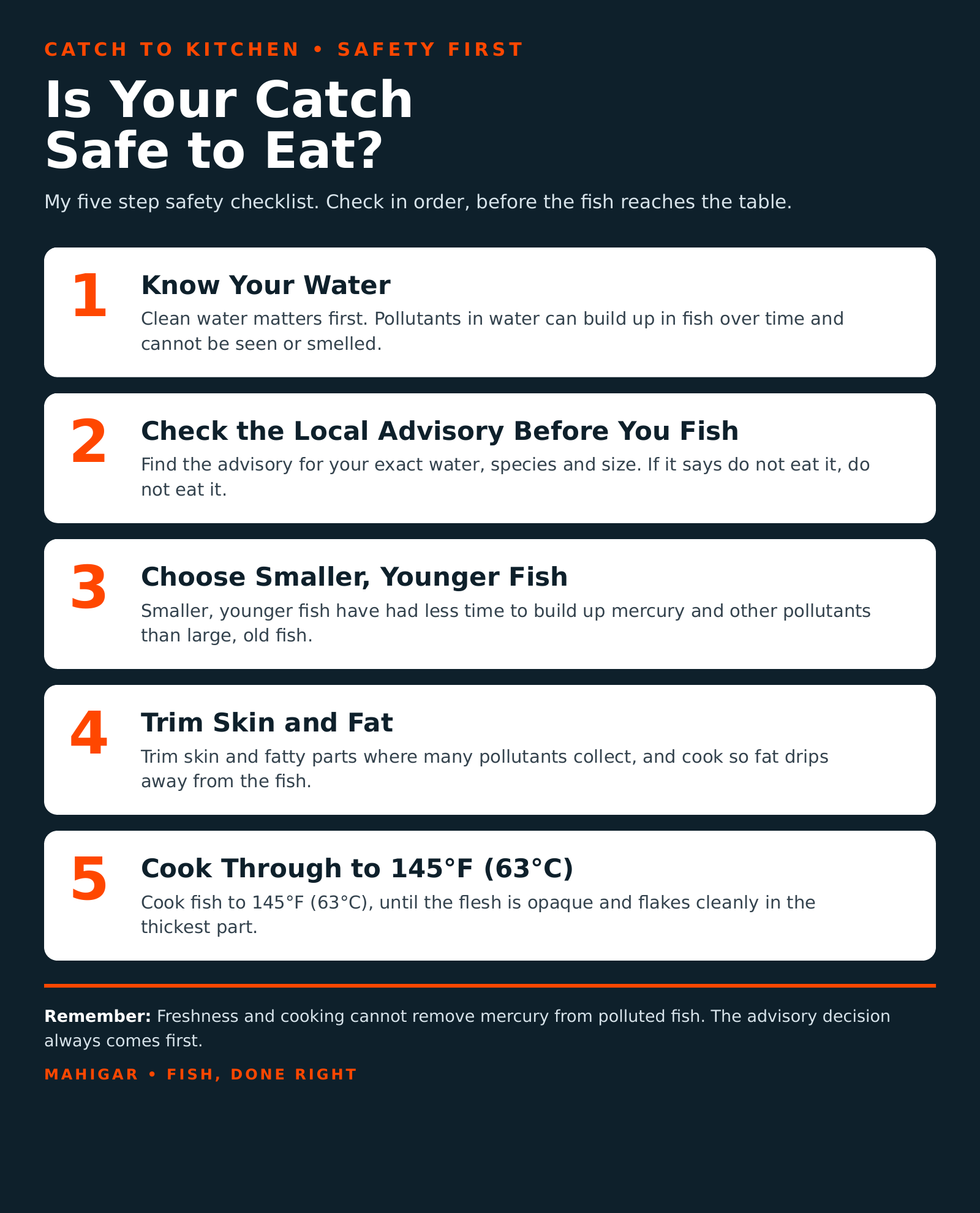
Check the water before the trip. Check the advisory for the species and size. Choose the smaller fish. Trim with the official guidance in mind, keep the fish cold, and cook it to 145°F (63°C).
And when the day brings more fish than one meal needs, good storage decides whether the rest eats well later, which is why the full method in Preserving, Leftovers and Using the Whole Fish: The Complete Guide matters so much to a catch cook. Use the whole fish, waste little, and let good information, not hope, decide what reaches your plate.

One Comment