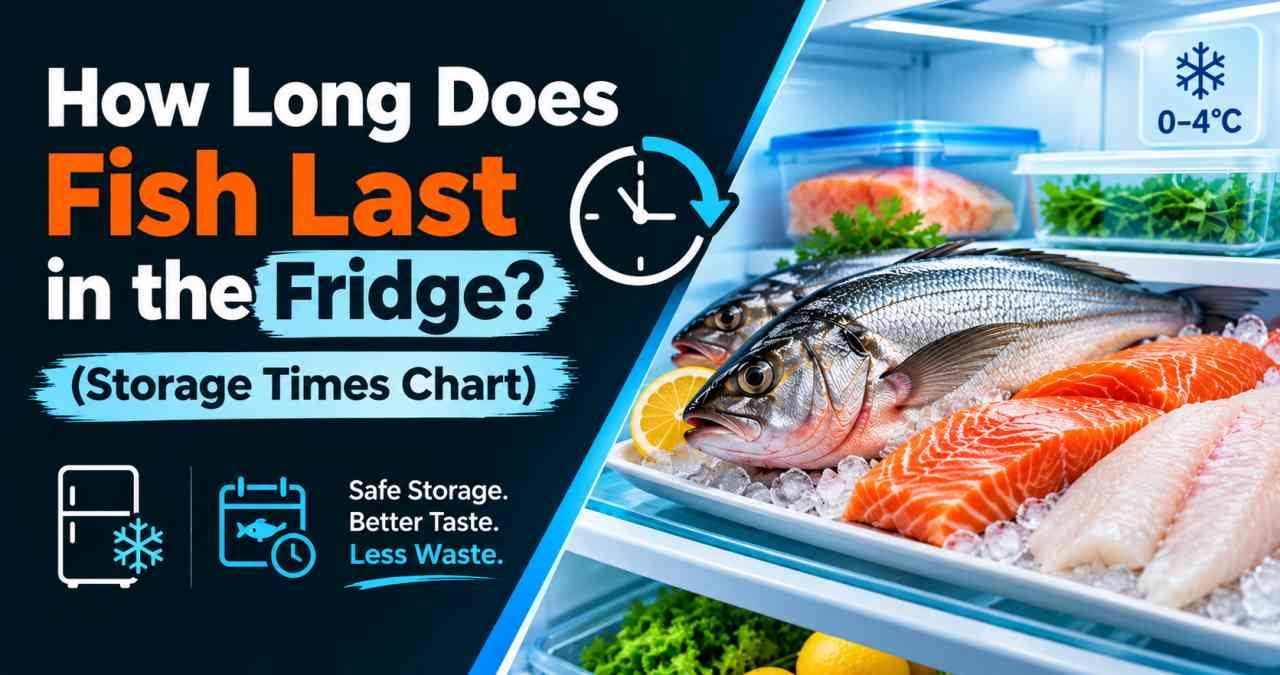
How Long Does Fish Last in the Fridge? (Storage Times Chart)
Plan on 1 to 2 days for raw fish and shellfish in the refrigerator, 3 to 4 days once it’s cooked, and check the chart below for exactly how long everything else keeps. The USDA is specific about this: raw seafood belongs in the fridge for only a day or two before it needs to be cooked or frozen, no matter how good it looked at the counter.
That short window surprises people used to thinking of the fridge as a general holding pattern. Fish isn’t like most other groceries. It’s one of the most perishable things you’ll bring home, and treating the real numbers as a hard limit, not a rough guess, is what actually keeps a good piece of fish from becoming a wasted one.
Table of Contents
The Complete Storage Times Chart
Here’s the full breakdown, sourced to USDA guidance. Refrigerator times are about safety. Freezer times are about quality, since fish held at 0°F or below stays safe to eat indefinitely, even though texture and flavor decline slowly the longer it sits.
| Type | Refrigerator (40°F or below) | Freezer (0°F or below, for best quality) |
| Raw fish, fillets or whole | 1 to 2 days | 3 to 8 months |
| Raw shellfish (shrimp, scallops, shucked) | 1 to 2 days | 3 to 12 months |
| Live shellfish in the shell | 1 to 2 days, stored differently (see below) | Not recommended live |
| Cooked fish or shellfish | 3 to 4 days | Up to 3 months |
Why Does Raw Fish Have Such a Short Window?
Fish starts breaking down faster than red meat or poultry once it’s caught. Its natural enzymes and the bacteria already present in its flesh are adapted to cold water, not cold air, so refrigeration slows that process without fully stopping it.
This is also why the 40°F threshold matters so precisely. Every degree above that gives bacteria more room to multiply, and fish sitting in a fridge that runs slightly warm loses its safe window faster than the calendar alone would suggest. A refrigerator thermometer, not the dial’s built-in guess, is the only real way to know where your fridge actually sits.
Does the Type of Fish Change How Long It Lasts?
Somewhat, though not enough to stretch the 1 to 2 day window meaningfully. Leaner, delicate fish tends to show spoilage signs slightly sooner than a firmer, fattier fish. A whole fish, with skin and bones still intact, can sometimes hold up a touch longer than a cut fillet, since less of its surface has been exposed to air.
None of these differences are large enough to justify pushing past 2 days as a general rule. Treat the variation as a reason some fish might go bad on day 2 rather than day 3, not as permission to extend the window in the other direction.
How Should You Store Live Shellfish?
Different from everything else on this list, and it’s a detail most people get wrong. Live clams, mussels, and oysters need to breathe, so they belong in a bowl or container covered loosely with a damp cloth. Never seal them in a plastic bag, and never submerge them in fresh water. Both can suffocate or kill them well before you’re ready to cook.
Use them within 1 to 2 days, and discard anything that’s open and doesn’t close when you tap it, since that’s a sign it’s already dead. The storage method matters here as much as the timeline. Getting it wrong can shorten a shellfish’s life far more than the clock alone would.
Does Cooking Extend How Long Fish Lasts?
Yes, meaningfully. Cooked fish and shellfish hold for 3 to 4 days in the refrigerator, roughly double the raw window, since cooking kills much of what was driving spoilage in the first place. That’s a genuinely useful fact for meal planning: a larger batch cooked at once holds up fine as leftovers for several days, even though the raw fish it started from wouldn’t have.
What About Canned Fish?
An entirely different category. Commercially canned fish, tuna and salmon especially, is shelf-stable in the pantry and safe for up to 5 years unopened, thanks to the sealed can and the canning process itself rather than refrigeration. Home-canned fish is far more limited, generally safe for only about a year, since home canning doesn’t reach the same guaranteed processing standards a commercial cannery does.
Once opened, though, canned fish behaves like any other cooked seafood. Refrigerate it and use it within 3 to 4 days, not the years-long window the unopened can suggested.
What If You’re Not Sure How Long It’s Been?
Don’t rely on memory alone. If you can’t confidently say whether raw fish has been in the fridge for 1 day or 4, check it the way you’d check anything you suspect might be past its window: smell, texture, and color, not the calendar. The complete signs to look for are in How to Tell If Fish Has Gone Bad.
Frequently Asked Questions
Does the 2-day rule apply to frozen fish that’s been thawed?
Yes. Once thawed, treat it like fresh fish and use it within 1 to 2 days, not the original freezer timeline.
Is it safe to eat fish on exactly day 2?
Generally yes, if it’s been stored properly at 40°F or below the whole time. Checking for spoilage signs first is still worth the extra few seconds.
Why do some packages list a much longer date than 1 to 2 days?
A printed date is often about quality or a store’s sell-by point, not a safety guarantee once the package is in your fridge. The 1 to 2 day guidance applies regardless of what’s printed.
Does vacuum-sealed fresh fish last longer in the fridge?
Slightly, since less air reaches the surface. It’s still safest to treat it with the same 1 to 2 day window rather than assuming the packaging extends it meaningfully.
What to Check Next
For the fuller picture of everything covered here alongside thawing, refreezing, cooking temperature, and more, see Fish Storage and Food Safety: The Complete Guide. And whatever you’re storing, checking freshness before you buy it in the first place starts with How to Tell if Fish Is Fresh: The Buyer’s Checklist.
