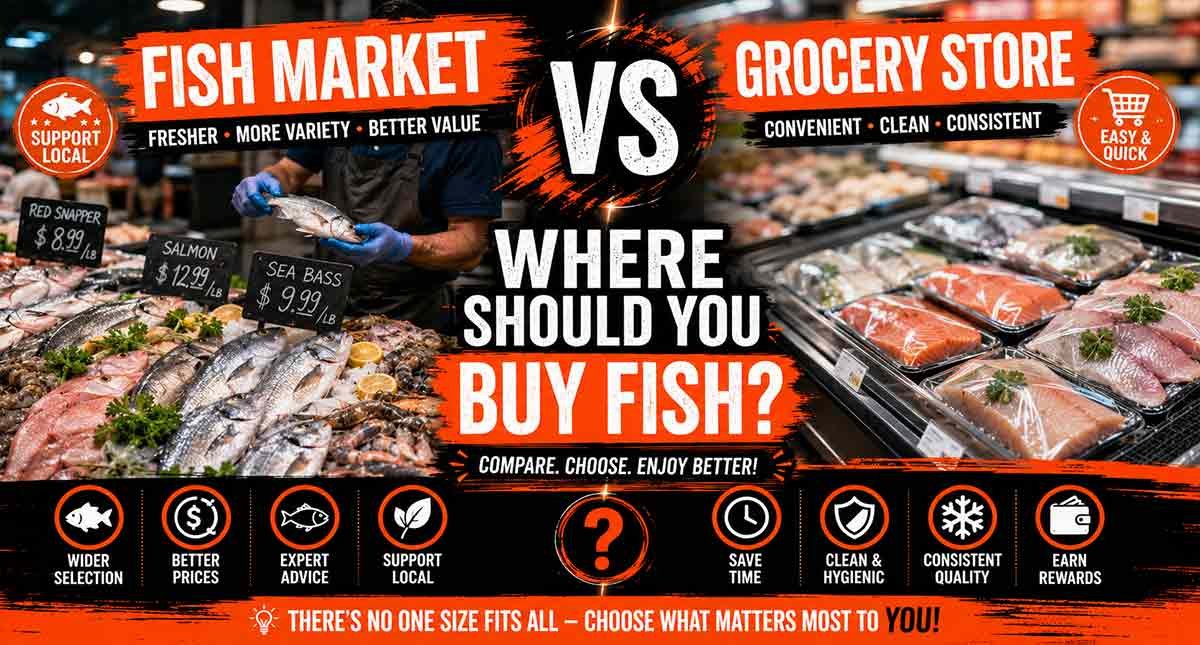
Fish Market vs Grocery Store: Where Should You Buy Fish?
Both can work well; the real difference isn’t the venue itself; it’s turnover, staff knowledge, and how much you’re able to inspect before you buy. A dedicated fish market or full-service counter usually wins on all three. A grocery store usually wins on convenience and, more often than people assume, on price.
I shop at both, depending on what I’m cooking and how much time I have. The short version: for a fish that’s the whole point of the meal, I go out of my way for a market. For something going into a curry or a dish with a lot of other flavor doing the work, a decent grocery store does the job fine. Here’s the actual reasoning behind that, not just the rule.
Table of Contents
What Do You Actually Gain at a Dedicated Fish Market?
The biggest advantage is turnover: a real fish market or counter sells enough volume that stock doesn’t sit for days, and staff who handle fish all day tend to notice quality in a way that’s hard to fake. You can usually ask to see or smell a specific piece before it’s wrapped, ask what came in that morning, and get a straight answer instead of a shrug.
Selection is the other real win. Markets are far more likely to carry whole fish, less common species, and whatever’s actually in season locally, rather than the same five or six species every grocery store carries year-round.
The trade-off is convenience: a dedicated market usually means a separate trip, often on its own schedule, and sometimes a higher price for the same species compared to a big grocery chain buying in bulk.
What Do You Actually Gain at a Grocery Store?
Convenience, mainly one stop for the whole shopping list, longer and more predictable hours, and often a lower price on the same species, since larger chains buy in volume most independent markets can’t match. For fish that’s playing a supporting role in a dish rather than being the star, this is usually enough.
The real risk is time in transit and time on display. Fish at a grocery store has typically passed through more hands and more steps before it reaches the case, and it can sit displayed longer if a store doesn’t move much seafood volume. That’s not automatic: a busy grocery store with real seafood turnover can be perfectly good, but it’s the thing to actually check, rather than assume either way.
Which Is Actually Cheaper?
It depends more on format than venue. Whole fish is usually cheaper at a market than pre-cut fillets at a grocery store, simply because you’re not paying someone else to do the butchery. But for popular species bought as fillets, a large grocery chain’s buying power often beats a small market on price for the exact same cut.
Where markets usually win on value isn’t the popular species; it’s the ones nobody’s asking for. A market is far more likely to sell an excellent, less-marketed fish at a genuinely low price than a grocery store is, since grocery stores tend to stock only what reliably sells to a broad audience.
How Do You Spot a Grocery Store With a Genuinely Good Seafood Section?
Look for a real service counter, not just pre-packaged trays. A store willing to staff a counter is usually a store that takes its seafood volume seriously. Ask the same three questions you’d ask any fishmonger: what came in freshest today, is it wild or farmed, and can you smell it before buying? A grocery store confident in its seafood will answer all three the same way a market would.
I treat a grocery store’s seafood counter exactly like I’d treat a market stall I didn’t already know: same checks, same questions, no automatic trust just because it’s a bigger store.
How Do You Spot a Market or Counter That’s Actually Worth the Trip?
Not every market automatically beats every grocery store; the same turnover problem can exist anywhere stock doesn’t move fast enough. Look for ice that’s actually being replenished, displays that get restocked rather than topped up, and a genuine willingness to answer specific questions rather than a generic sales pitch.
A market that’s busy, even if it’s small, is almost always a better bet than a quiet one with an impressive-looking display case. Volume is the real signal, not appearance.
Does the Venue Matter for Every Dish?
Less than people assume. For a simply prepared fish that’s the entire point of the plate pan-seared, grilled, or roasted with minimal seasoning venue and freshness matter enormously, and I’ll make the trip for it. For a curry, a gravy, a fry-up, or anything built around a real spice blend, good technique and good seasoning matter more than which counter the fish came from, as long as the basic freshness checks still pass.
This is genuinely how I decide where to shop on a given day: what’s the dish, and how much is the fish itself actually going to be tasted on its own.
What If You Don’t Have Access to a Dedicated Fish Market?
A well-run grocery store seafood section is a completely legitimate primary source; plenty of people cook great fish their whole lives without ever setting foot in a dedicated market. The checks that matter (freshness signs, asking questions, checking turnover) apply exactly the same way regardless of which kind of store you’re standing in.
Don’t treat a market as a requirement for good fish. Treat the checks in this guide as the requirement, and apply them wherever you actually shop.
Frequently Asked Questions
Is it rude to ask to smell fish before buying it?
No, it’s standard practice, and a seller confident in their product expects the question. Hesitation or discouragement is more telling than the smell itself.
Do fish markets always have better quality than grocery stores?
No. Turnover and handling matter more than the type of store; a quiet, slow-moving market can be worse than a busy grocery store’s seafood counter.
Is it worth a special trip to a market for an ordinary weeknight dinner?
Not usually, if the fish is going into a well-seasoned dish. Save the extra trip for when the fish itself is going to be the star of the plate.
What to Check Next
Once you’ve picked where to buy, the questions you ask matter just as much as where you’re standing. The exact checklist I use every time, at a market or a grocery counter alike, is in Questions to Ask Your Fishmonger Before You Buy. Whatever you bring home, run it through How to Tell if Fish Is Fresh: The Buyer’s Checklist before it goes in your basket. And for the complete buying process this comparison is one part of, start with The Complete Guide to Buying Fish and Seafood.
