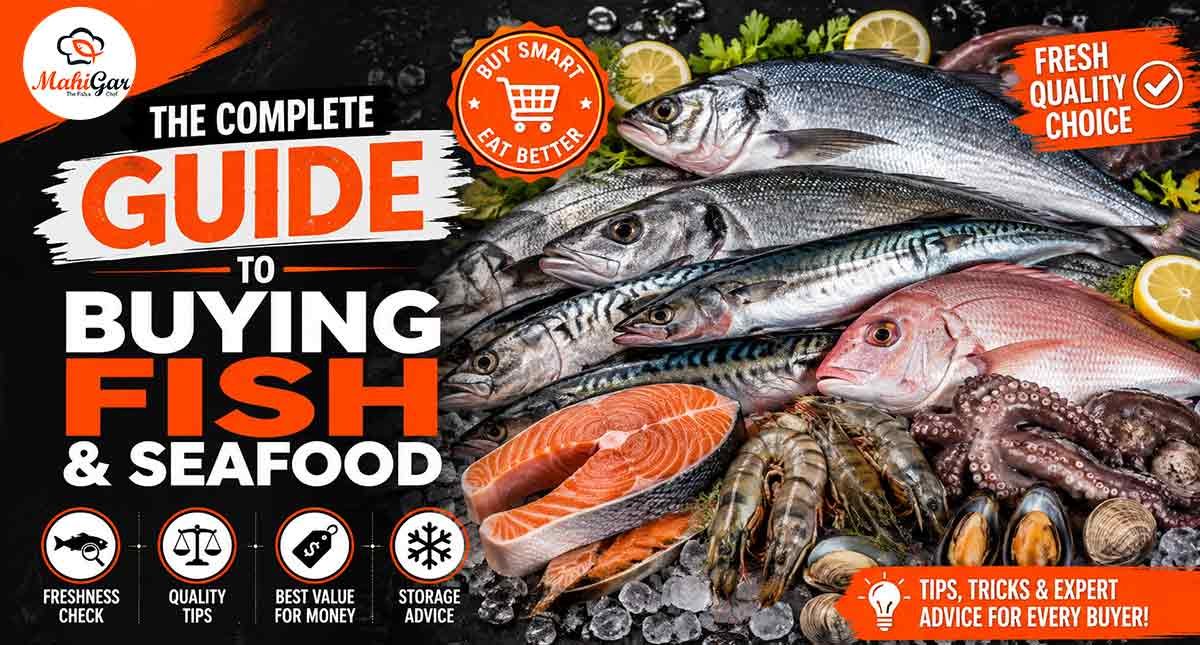
The Complete Guide to Buying Fish and Seafood
Buying good fish is where every great fish dinner actually starts, and it’s also where most home cooks lose confidence before they’ve even turned on the stove. I’ve spent more than twenty years buying fish for my own kitchen, and the truth is that most of what determines whether a piece of fish turns out well happens before you ever touch a pan: what you bought, how fresh it actually was, and whether it was even the right cut for what you’re cooking.
This guide walks through everything that decision involves: freshness, fresh versus frozen, where to buy, whole fish versus fillets, wild versus farmed, sustainability labels, portioning, budget, seasonality, what to ask the person selling it to you, and what to do when a recipe calls for a fish you simply can’t find. Each section below covers the essentials; where a topic deserves a full deep dive, I’ve pointed to the complete guide.
Table of Contents
How Can You Tell If Fish Is Fresh?
Fresh fish should smell like clean ocean or river water, never “fishy,” sour, or like ammonia. Beyond smell, check the eyes (clear and slightly bulging, not cloudy or sunken), the flesh (firm, and it should spring back when pressed rather than leaving a dent), and the gills if you can see them (bright red or pink, not brown or gray).
I check fish the same way whether I’m at a market stall or standing at a grocery counter: I look before I smell, and I always ask to smell it directly rather than trusting the case. A fishmonger who’s confident in their fish will let you. If a whole fish’s scales look dull instead of slightly shiny, or the belly looks sunken instead of firm, I move on to the next one, no matter how good the price looks.
For the full sensory checklist including exactly what to check on fillets versus whole fish, and the specific red flags for shrimp and shellfish, see How to Tell if Fish Is Fresh: The Buyer’s Checklist.
Should You Buy Fresh or Frozen Fish?
For most home cooks, properly frozen fish is just as good as fresh, sometimes better. Fish that’s flash-frozen at sea within hours of being caught is often fresher, in real terms, than “fresh” fish that’s spent several days in transit before it reaches a counter.
The catch is in the word “properly.” Fish that’s been thawed and refrozen, or frozen slowly instead of flash-frozen, loses texture- the mushy, watery result people associate with “frozen fish” and blame on freezing itself, when it’s really about how it was frozen and handled. I keep a stock of good flash-frozen fillets in my own freezer for exactly this reason; it’s rarely the compromise people assume.
The full comparison, including how to spot a properly flash-frozen fillet at the store and when fresh genuinely does win, is in Fresh vs Frozen Fish: Which Is Actually Better?
Fish Market or Grocery Store: Where Should You Buy?
Both work; the real difference is control. A dedicated fish market or a proper seafood counter usually means fresher turnover, staff who can answer real questions, and fish you can inspect and ask to smell before buying. A grocery store’s seafood section is more convenient and often cheaper, but the fish has typically moved through more hands and more time before it reaches the case.
My rule is simple: for a fish that’s the centerpiece of the meal, I go out of my way for a proper market or counter. For something going into a curry or a dish with a lot of other flavors doing the work, a good grocery store is completely fine.
For a full breakdown of what to look for in each setting, plus how to spot a seafood counter that’s actually turning over stock quickly, see Fish Market vs Grocery Store: Where to Buy Fish
Whole Fish or Fillets: Which Should You Buy?
Buy whole fish when you want maximum freshness and don’t mind the prep work; buy fillets when you want convenience and predictable portions. A whole fish is harder for a seller to fake; the freshness of the eyes, gills, and skin all tell you something a pre-cut fillet can’t. It’s usually cheaper per pound of edible meat too, once you’re comfortable filleting it yourself.
Fillets cost more per pound but save real time, and they’re the easier starting point if you’re still building knife confidence. I buy whole fish constantly for species I know well, and fillets for anything I want on the table in twenty minutes flat.
For the specific pros and cons of each, see Whole Fish vs Fillets: Which Should You Buy? and if you want the knife skills that make whole fish the easy choice, that’s covered in the Fish Prep and Butchery Skills guide.
Wild-Caught or Farm-Raised: What’s the Real Difference?
Neither is automatically better it depends on the specific fishery or farm, not the label alone. Wild-caught fish generally has a firmer texture and more variable fat content depending on season and diet; farm-raised fish is typically more consistent in size and availability year-round, and is often the more sustainable choice for species where wild stocks are under real pressure.
The most useful thing you can actually check at the point of purchase isn’t “wild” or “farmed” on its own; it’s whether the product carries independent certification. The Marine Stewardship Council’s blue label marks wild-caught seafood from an independently verified, sustainable fishery, while the Aquaculture Stewardship Council’s green label and the Best Aquaculture Practices certification cover farmed seafood produced and processed to verified environmental and safety standards. A label doesn’t guarantee better flavor, but it does mean someone independent actually checked the claim.
I buy both, depending on species and what’s genuinely available. For salmon, I lean toward looking for a certification label since farming practices vary enormously by region. For local species I catch or source myself, this question doesn’t really apply; I already know exactly where they came from.
The complete breakdown, species by species, is in Wild-Caught vs Farm-Raised Fish: A Buyer’s Guide
How Much Fish Should You Buy?
Plan on 6 to 8 ounces (roughly 170 to 225 grams) of raw, boneless fillet per person for a standard main course. If you’re buying whole fish or bone-in steaks instead, double that to around a pound per person, since roughly half the weight is lost to bones, skin, and trimming during cleaning.
Lean, mild fish like cod or tilapia tend to sit at the higher end of that range since they’re often served in slightly larger portions; a rich, fatty fish like salmon can feel just as satisfying at the lower end.
I always buy a little over the estimate rather than exactly to it; fish shrinks more than people expect during cooking, and there’s rarely a good way to stretch a main course that’s come up short.
For a full portion calculator by fish type and whether you’re serving a main course, appetizer, or a crowd, see How Much Fish to Buy Per Person: A Portion Guide
What Do Sustainability Labels Actually Mean?
The three labels you’ll see most often are MSC, ASC, and BAP. MSC (Marine Stewardship Council) certifies wild fisheries against criteria like minimizing environmental impact and keeping fish stocks sustainable; ASC (Aquaculture Stewardship Council) certifies responsibly farmed seafood; and BAP (Best Aquaculture Practices) certifies farmed seafood across the whole supply chain, from hatchery to processing.
None of these labels guarantee flavor or quality; they guarantee that an independent body actually checked the sourcing claim, rather than you having to take a package’s word for it. I treat them as one useful input, not the only thing that matters; plenty of excellent, responsibly caught fish never carries a label at all, especially from small-scale or local sources like the fishermen I buy from directly.
For what each logo actually looks like, and how to tell a real certification from marketing language that just sounds sustainable, see Understanding Seafood Labels and Sustainability Certifications
How Do You Buy Fish on a Budget?
The most reliable way to cut your fish budget without cutting quality is to buy whole fish instead of fillets, and to build meals around whichever species is genuinely abundant that week rather than one specific fish you had in mind. Frozen fish is also almost always cheaper than “fresh” fish of the same species, often with no real difference in your finished dish.
Some of the best value in any fish market is the fish nobody’s asking for often perfectly good species that just haven’t been marketed as well as salmon or cod. I grew up cooking with exactly these kinds of overlooked, affordable species, and it’s shaped how I think about value in general: price has very little to do with how good a fish can taste once you know what to do with it.
The full list of consistently good-value species, and how to spot them, is in Budget Fish Buying Guide: Best Value Species
Does Fish Have a Season?
Yes, wild fish especially has real peaks in flavor, price, and availability tied to its natural life cycle, even though most stores now stock the same species year-round thanks to farming and imports. Buying in season generally means better flavor, a lower price, and a smaller environmental footprint, since the fish traveled less distance and needed less intervention to be available.
What’s in season depends heavily on where you live, so I’d rather point you to the logic than a fixed calendar: ask what’s being caught locally right now, and treat anything flown in from far away, out of its natural season, as the exception rather than the default.
For a fuller guide to thinking through seasonality wherever you’re shopping, see Seasonal Fish Buying Calendar
What Should You Ask Your Fishmonger?
Three questions get you almost everything you need: “What came in freshest today?” “Is this wild or farmed, and where’s it from?”, and “Can I smell it before I buy?” A fishmonger who answers all three easily, without hesitation, is one you can trust with the rest of your questions too.
I still ask these same three questions out of habit, even with sellers I’ve bought from for years; prices and sourcing change week to week, and a good fishmonger expects the question rather than being bothered by it.
For the complete list I actually use, including what to ask when you’re buying shellfish specifically, see Questions to Ask Your Fishmonger Before You Buy
What If a Recipe Calls for a Fish You Can’t Find?
Substitute based on texture and fat content, not species similarity. A firm, meaty fish like halibut can usually stand in for another firm fish like mahi mahi or swordfish; a delicate, flaky fish like sole can usually swap with another delicate fish like flounder or tilapia, but the two groups don’t swap well with each other.
This is one of the most useful skills I’ve built over the years, mostly because it had to be: several of the species called for in international recipes simply aren’t available where I live, so substitution isn’t an occasional workaround for me; it’s a constant, practical part of how I cook and how I test recipes for this site.
For the complete substitution logic, organized by texture and fat content, see How to Substitute One Fish for Another in Any Recipe
Once You’ve Bought Your Fish
Buying well is the first decision; what happens in the next few hours matters just as much. Fish is more perishable than almost anything else in your kitchen, and how you store it between the counter and the pan can undo a good purchase quickly. The full guide to that next step, including exactly how long fish keeps and the safest way to thaw it, is in the Fish Storage and Food Safety guide.
If you already know which species you’re working with and want cooking-specific detail, the Fish Species Buying and Cooking Profiles hub covers buying and cooking notes for individual species, from tilapia to rohu. And once the fish is in your kitchen, the Fish Prep and Butchery Skills guide covers everything from filleting to removing pin bones.
Frequently Asked Questions
Is it normal for fish to smell a little “fishy”?
A very faint ocean smell is normal; anything sour, ammonia-like, or strongly “fishy” is a sign the fish is past its best and shouldn’t be bought. Trust your nose over the sell-by date; freshness varies more than a printed date can capture.
How long can fish safely sit out after you buy it?
Fish shouldn’t sit at room temperature for more than 2 hours, or 1 hour if it’s above 90°F (32°C), per FDA and FoodSafety.gov guidance. Get it into a fridge or a cooler with ice as soon as you can after buying fish spoils faster than most other proteins, so this matters more here than almost anywhere else in the kitchen.
Is farmed salmon less healthy than wild salmon?
Not inherently; both can be nutritious, and the bigger factor is the specific farm or fishery’s practices rather than “farmed” versus “wild” as categories. A credible certification label is a more useful health-and-sustainability check than the wild-versus-farmed label alone.
Can you safely buy fish online?
Yes, from a reputable seller that ships with proper insulation and ice packs and guarantees arrival within a set delivery window. This has become a genuinely reliable option, especially for species that simply aren’t available locally.

3 Comments