Understanding Seafood Labels and Sustainability Certifications
A real sustainability label means an independent organization actually checked a specific fishery or farm against a defined standard; it’s not the fishery or the brand grading its own homework. That’s the whole point of a certification, and it’s also exactly what fake or vague “sustainable” claims are missing.
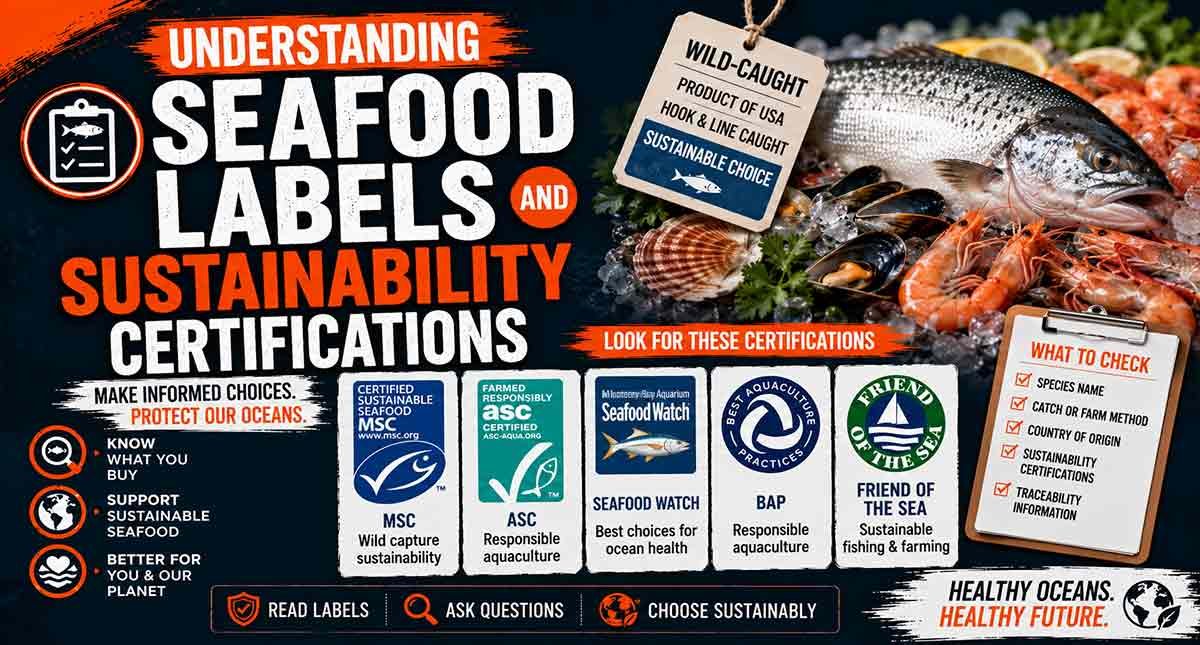
The three labels you’ll see most often are MSC, ASC, and BAP, and knowing what each one actually verifies, and how to tell a genuine label from marketing language that just sounds sustainable, takes the guesswork out of a claim that’s otherwise very easy to fake.
Table of Contents
What Are MSC, ASC, and BAP, Specifically?
The Marine Stewardship Council (MSC) is a nonprofit founded in 1996 that certifies wild fisheries against a standard covering fish stock health, environmental impact, and fishery management. Its blue label appears on wild-caught seafood.
The Aquaculture Stewardship Council (ASC) is a nonprofit founded in 2010 by WWF and the Dutch Sustainable Trade Initiative, and it certifies farmed seafood against environmental and social standards. Its green label appears on farmed seafood.
Best Aquaculture Practices (BAP) is a separate certification program covering farmed seafood across the entire supply chain, from hatchery through processing, run by the Global Seafood Alliance.
All three exist for the same basic reason: an independent, named organization with a public standard is a genuinely different thing from a company simply describing its own product as sustainable.
How Do You Know a Certification Label Is Actually Real?
Look for a Chain of Custody code printed alongside the logo, something like MSC-C-##### or ASC-C-#####. This code is effectively a traceable serial number: MSC’s own guidelines require every product carrying its label to display this code alongside the logo and a specific approved claim, not just the blue fish symbol on its own.
A logo with no code, a vague version of the symbol, or wording that doesn’t match the certifier’s approved language are all signs worth a second look. Genuine certifiers publish strict rules about exactly how their logo can be used and don’t allow companies to modify it or apply it without a licensing agreement.
If you want to go a step further, both organizations maintain supplier and certificate directories you can search, which is more reassurance than most shoppers ever think to look for.
How Does the Certification Process Actually Work?
A fishery or farm is assessed by an independent third-party auditor, not by MSC or ASC themselves. Organizations like DNV, Intertek, SGS, and NSF conduct the actual audits and are separately accredited to do so. This matters because it means the certifying body isn’t grading its own work.
Once a fishery or farm is certified, everyone else who touches that product before it reaches you processors, distributors, and the store or restaurant selling it has to be separately certified to a Chain of Custody standard too. That’s what physically keeps certified product segregated from non-certified product all the way through the supply chain, rather than the two getting mixed together at some point and sold under the same label.
That layered structure independent audit plus a verified chain all the way to the shelf is what actually makes the label mean something.
What Sustainability Language Isn’t a Real Certification?
Phrases like “eco-friendly,” “ocean-friendly,” “responsibly sourced,” or “sustainably caught,” used on their own without naming a specific certifying body, are marketing language, not verified claims. They might be entirely true, but nothing has independently checked them the way an MSC or ASC label has.
The test is simple: does the package name an actual organization, and can you find that organization’s standard and directory online? If a claim can’t point to who checked it, treat it as a nice sentence, not a certification.
What Other Legitimate Labels Might You See?
A few other labels are worth recognizing. Seafood Watch, from the Monterey Bay Aquarium, isn’t an on-package logo but a separate rating system (green, yellow, or red) you can look up by species and origin, and it’s a genuinely useful second opinion alongside a certification label. Dolphin Safe applies specifically to tuna and verifies it wasn’t caught using methods known to harm dolphins. Fair Trade Certified and Global G.A.P. both appear on some seafood too, though their focus is broader than environmental sustainability alone, covering labor and social standards as well.
None of these replace MSC, ASC, or BAP; they’re complementary checks, not substitutes.
Can a Product Carry Both MSC and ASC Labels?
Yes, when a product genuinely contains both certified wild-caught and certified farmed seafood, it can display both labels together under specific co-labeling rules both organizations publish. Seeing both isn’t a red flag or a sign of confusion; it’s actually a sign that whoever labeled the product understood the distinction well enough to apply it correctly to a mixed product.
What If There’s No Label at All?
A missing label doesn’t automatically mean a fish isn’t sustainably sourced. Plenty of small-scale and local fisheries are managed responsibly but never pursue a formal certification, since the process has a real cost that makes more sense for large-scale operations. If you’re buying directly from a fisherman, a small local market, or a source you can ask questions of directly, a label was never really the mechanism you’d rely on anyway.
In that situation, asking directly where and how something was caught or farmed is the more relevant check than looking for a logo that was never going to be there.
Frequently Asked Questions
Does a sustainability label mean the fish is fresher or tastes better?
No. Certification verifies sourcing practices, not freshness or flavor, which still need to be checked separately using the usual freshness signs.
Are MSC and ASC the same organization?
No, they’re separate nonprofits. MSC covers wild fisheries; ASC covers farmed seafood, though they share some infrastructure, including using the same Chain of Custody standard.
Is BAP the same as ASC?
No. They’re two separate certification programs for farmed seafood run by different organizations, though they cover similar ground. A product could carry either, both, or neither.
Can a certification be revoked?
Yes. Certifications are tied to ongoing audits, not a one-time check, and can be suspended or revoked if a fishery or farm stops meeting the standard.
What to Check Next
For the fuller picture on wild-caught versus farmed seafood generally, including the real environmental trade-offs each one carries, see Wild-Caught vs Farm-Raised Fish: A Buyer’s Guide. And for the complete buying process this fits into, start with The Complete Guide to Buying Fish and Seafood.
