Fish Recipes for Every Diet and Lifestyle
Almost every diet trend of the last twenty years has arrived in my kitchen wearing the same question: can I still eat fish? Keto readers, pregnant mothers, parents of picky children, people stretching every rupee, they all ask it, and they all ask it the wrong way round. The right question is never whether fish fits your pattern. Fish is the most adaptable protein in the market. The right question is which fish, cooked how, with what beside it. Answer those three, in that order, and almost every pattern in this pillar resolves itself.
That is the problem this page solves. Diet advice usually hands you a list of rules and leaves you standing at the fish counter, confused. I do the opposite. I give you a way of choosing that works for every pattern below, and then I walk each pattern myself: high-protein, keto, heart-conscious, gluten-free, pregnancy, picky kids, busy weeks, tight budgets, meal prep, Whole30 and Paleo, and weight-conscious eating. One method, eleven patterns, zero fear.
This page is Mahigar’s diet and lifestyle hub. It builds directly on Fish Nutrition and Health: The Complete Guide, where the wider question, is fish healthy, is answered from AHA, FDA/EPA, and USDA guidance. That pillar publishes first on purpose: when the guides below talk about protein, omega-3s, or mercury, they stand on its answers, not on invented ones.
One note before anything else: this is general information, not medical advice. Diet programmes change their rules, and your doctor, dietitian, or programme’s current guidance always outranks a food blog, including this one.
Table of Contents
Table of Contents
First, the Safety Base: Every Diet Stands on the Same Floor
Whatever pattern you follow, the fish still has to be safe fish. Three facts sit under every guide in this pillar, and no diet rule changes them.
Mercury is chosen at the counter, not in the kitchen. Mercury collects in big, long-lived predators, and I cannot wash it out, trim it away, or cook it out. The FDA and EPA sort fish into Best Choices (two to three times a week), Good Choices (once a week), and Choices to Avoid, and the full chart, including pregnancy and child servings, lives in Mercury in Fish: Safe Levels by Species. Every recipe guide below is built inside those categories.
Done is done. I finish fin fish at 145°F (63°C) in the thickest part, or when it turns opaque and flakes. A gentle diet cooking method still has to reach that finish. The full temperature chart is in Safe Internal Cooking Temperatures for Every Type of Fish.
Cold, fresh, and honest about time. I keep fish at 40°F (4°C) or below, use raw fish within one to two days and cooked fish within three to four, and throw out fish that smells sour, feels slimy, or stays dented when pressed. And one discipline specific to this pillar: I never chase a diet claim with unsafe fish. A recipe that asks for undercooked or long-kept fish is a bad recipe, whatever pattern it wears.
How to Choose: Let Your Pattern Pick the Fish
Here is the method I teach, and it is the whole pillar in one idea: the constraint decides the species, the method, and the side, in that order.
Most people choose a recipe first and then squeeze their diet around it. Turn it around. Take your pattern’s one real constraint and let it answer three questions.
Which species? A pattern watching mercury or feeding children points to lower-mercury, mild fish. A pattern built on protein or omega-3s points to specific species for that job. A pattern on a budget points to the fish that are cheap because they are plentiful near you. Near the canals I fish, that has always meant the local freshwater fish I grew up with, and every region has its own honest answer.
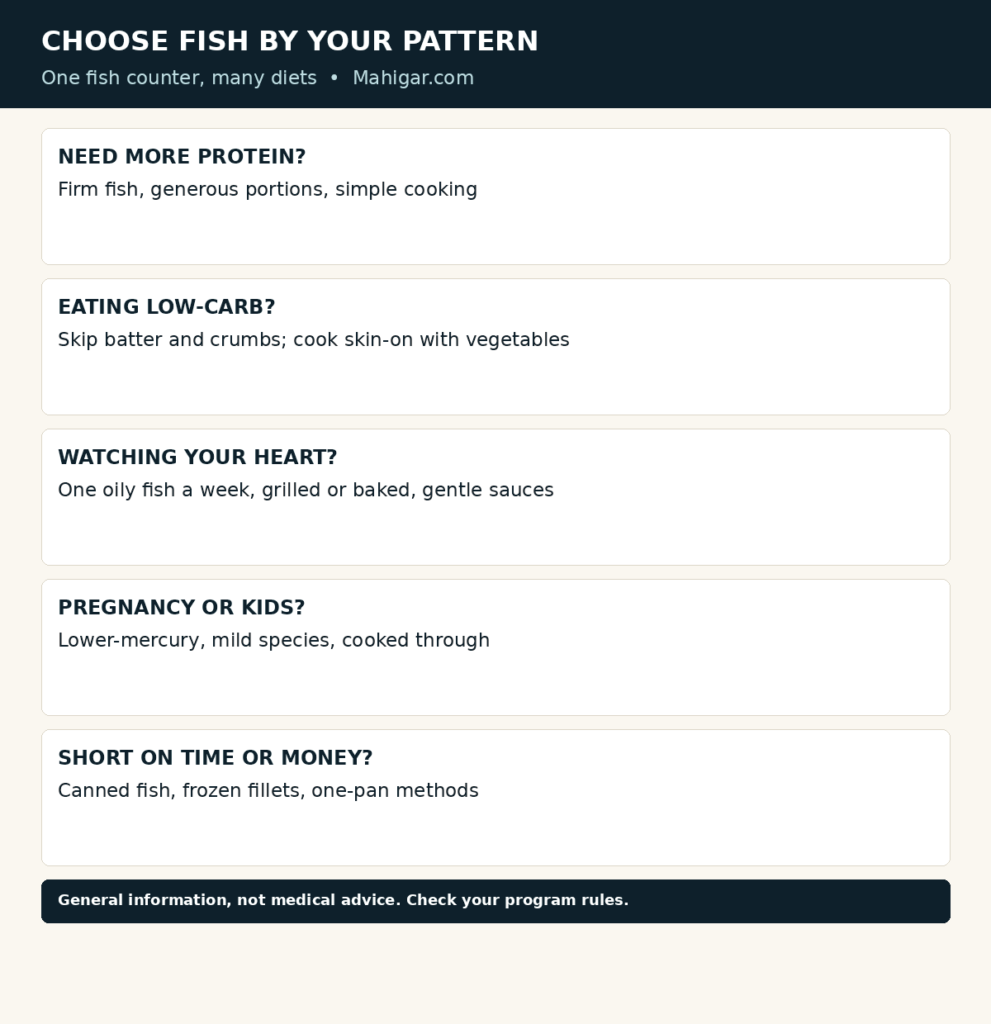
Which method? Most diet friction is method friction. Batter, breadcrumbs, sugary glazes, and rich sauces are where patterns are won and lost. Plain grilling, baking, steaming, and pan-frying keep fish itself almost universally welcome. The prep skills behind clean fillets, skin, and portions live in Fish Prep and Butchery: Every Skill You Need.
What beside it? Half of every diet plate is the company: the rice, potatoes, bread, sauces, and salads around the fish. When a dish “breaks” a pattern, it is usually the side or the sauce that did it, not the fish. Choose the side last, on purpose, and most family favourites survive.
Watch it work on one example. Say the pattern is keto and the household loves fish curry. The constraint is the carbs, so the species stays whatever the family likes, the method stays a curry, and the change lands on the company: the sugary base and the rice beside it. Same fish, same spices, different plate. That is the whole method, and it runs through all eleven guides below.
One Fish, Two Plates: When the Table Disagrees
Real households rarely follow one pattern. One person is eating keto, the children are picky, and grandmother wants her curry the traditional way. Cooking three separate dinners is how people give up on fish entirely, so I cook one fish and split the plates at the side.
Here is how it looks in my kitchen. I grill or bake a tray of one mild, firm fish, enough for everyone, seasoned simply with salt, lemon, and spices the whole table accepts. Then the plates diverge: the keto eater takes fish with vegetables and a butter-lemon spoon; the children take the same fish with rice and a mild dip they trust; grandmother takes hers with the curry sauce she loves, served beside the fish instead of cooked into it. One cooking session, three satisfied patterns.
The principle is simple: cook the shared protein plain, then let each pattern dress its own plate. Once you see it, weeknight cooking for a mixed table stops feeling like a negotiation.
High-Protein Eating: Fish That Earns Its Place
Protein is the job fish does most quietly and most completely. It is high-quality protein, and in the American Heart Association’s simple framing, unlike fatty meat products it is not high in saturated fat. For a household cooking for muscle, appetite control, or simply staying full between meals, the question is rarely whether fish fits. It is which species give the most protein per plate, and how to cook them so nobody gets bored by Wednesday.
My kitchen answer is portion and rotation: firm fish that holds a generous serving without falling apart, cooked by rotation, grilled one night, curry the next, pan-fried with a proper crust the third. The mistake I see is eating the same fillet the same way until the whole household rebels. Rotation is the seasoning of a high-protein week.
What this pillar will not do is print protein grams from memory. Exact per-species figures belong to a sourced table, and Mahigar’s is already built in the Nutrition pillar. The full guide is High-Protein Fish Recipes.
Keto and Low-Carb Eating: The Batter Is the Problem, Not the Fish
Ask me whether fish suits low-carb eating and I will ask what you were planning to put on it. Fish itself, plainly cooked, asks almost nothing of a low-carb plate. It is the battered crusts, crumb coatings, sweet glazes, and the pile of rice or chips under it that make a “fish dinner” stop fitting. The same fish that fails breaded and fried fits beautifully skin-on, pan-fried, with vegetables beside it.
That is genuinely good news for low-carb households, because the satisfying parts survive: crisp skin, rich oily species, butter-and-lemon style sauces at kitchen-principle level, eggs and fish on the same table. What a cook must watch is the hidden company: marinades, sauces, and sides chosen on autopilot. Read the label on the bottle before it touches your fish, and most problems never start.
The full guide is Keto and Low-Carb Fish Recipes.
Heart-Conscious Eating: One Oily Fish Does Heavy Lifting
Of all the patterns in this pillar, this one stands on the firmest official ground. The American Heart Association recommends two servings of fish, particularly fatty fish, per week, and guidance carried by the EPA and FDA notes strong evidence that eating fish as part of a healthy eating pattern may have heart-health benefits.
The cook’s translation: one oily fish in the week, cooked gently, grilled, baked, or steamed, and fish regularly replacing fattier meats rather than competing with them. Where heart-conscious cooking fails people is not the fish; it is heavy salt, rich sauces, and frying by default. My own test is the plate test: if the fish needs a rich sauce to be enjoyable, the cooking method is wrong, not the fish.
Sodium and fat framing need official figures before any recipe page prints them, so this pillar keeps it at principle level and lets the cluster do the sourced work. The full guide is Heart-Healthy Fish Recipes (Low Sodium and Low Fat).
Gluten-Free Tables: The Hidden Gluten Is Not in the Fish
Plain fish is one of the easiest proteins to serve at a gluten-free table, and one of the easiest to trip up by habit. The fish itself is not the problem. The batter and breadcrumbs are, obviously, but so are the quiet ones: soy-sauce-based marinades, bottled sauces and thickeners, spice mixes with fillers, and the shared oil or flour-dusted board in a busy kitchen. Cross-contact is a kitchen-management question, and kitchens are my department.
My rule at a mixed table: cook the gluten-free plate with clean tools, a clean pan, and coatings everyone can eat, or no coating at all, and the whole table eats the same dinner. Nobody should get the sad separate plate when the fix is mostly habit. When I am unsure about a bottled sauce, I skip it and make a lemon-herb spoon in two minutes. Certainty beats convenience at a gluten-free table.
The full guide is Gluten-Free Fish Recipes.
Pregnancy: The Right Fish, On Purpose
If one section of this pillar deserves slow reading, it is this one, and its message is kinder than the internet usually allows. The official advice is not “avoid fish in pregnancy.” The FDA/EPA advice is to eat fish deliberately: eight to twelve ounces a week of lower-mercury seafood during pregnancy and breastfeeding, precisely because fish brings the nutrients, DHA among them, that support a baby’s development. The answer is the right fish, not no fish.
In kitchen terms: build the week from the Best Choices list, treat a Good Choice as that week’s only fish, and let the Choices to Avoid stay avoided. Mild species, properly cooked through, every single time. Pregnancy is when “cooked through” stops being a preference and becomes the rule, no exceptions for a favourite half-done preparation. The species-by-species chart sits in the Mercury guide linked in the safety base above, and the Nutrition pillar covers the why behind it.
And one personal note, because this section is read by anxious mothers: your obstetrician or midwife outranks every food blog, including this one. Bring them your questions. The full guide is Pregnancy-Safe Fish Recipes (Low-Mercury Picks).
Kids and Picky Eaters: Mild Fish, Honest Victories
I have fed cautious children fish at my own table, and I will tell you the secret nobody prints: it is rarely the fish they refuse, it is the smell, the bones, and the surprise. Mild species smell mild. Careful filleting removes the bone anxiety. And a child served a small, honest piece of the family’s fish, not a separate “kids’ menu” apology, learns the taste the way the rest of us did: gradually, at a table where nobody made it a battle.
The practical tools are portion size (small first, seconds offered freely), gentle cooking that keeps fish moist, and flavours the child already trusts. Strong fishy flavours have kitchen fixes, and freshness is the biggest one: truly fresh mild fish barely smells of anything. Never force a second bite. A child who leaves the table unpressured comes back to fish faster than one who was made to finish it.
The full guide is Kid-Friendly Fish Recipes for Picky Eaters.
Busy Weeks: Fish Is the Fast Protein, Not the Slow One
The rumour that fish is weekend cooking survives mostly among people who have never timed it. Fish is naturally fast. Thin fillets and small fish cook in minutes, and even a whole fish asks little beyond seasoning and heat. The households that struggle to eat fish twice a week are rarely short of appetite; they are short of a plan that survives a tired Tuesday.
My standing answer: keep two frozen or canned options in the house, one pan you trust, and three methods you can do without reading anything. The prep skills pillar exists so that portioning and skinning stop being friction. And here is the discipline that makes it real: the freezer-to-pan path has to be shorter than the takeaway phone call, or the takeaway wins. Keep the canned fish where you can see it.
The full guide is 20-Minute Weeknight Fish Dinners.
Budget Tables: Cheap Fish Is a Local Knowledge Problem
The most expensive sentence in fish cooking is “only salmon counts.” Near the canals I fish, the honest budget fish are the local freshwater species, hardy, plentiful, and cooked with respect for generations, and every coastline and market town has its own version of that list. Add canned fish, which carries real nutrition at pantry prices, and frozen fish, which is often fresher than the “fresh” fish that travelled badly, and a budget week stops looking like a compromise.
The recipe work is substitution and respect: buy the plentiful fish whole, learn its bones honestly (fine-boned river fish reward patience and punish haste), and cook the expensive species when it is cheap, not when the recipe demands it. My own rule: I buy what the market is proud of that day. A fishmonger selling today’s catch cheap is telling you what to cook.
The full guide is Budget-Friendly Fish Recipes.
Meal Prep: Cook Once, Respect the Reheat
Fish meal prep fails in one famous way: it is wonderful on Sunday and tired by Wednesday, because fish reheats differently from other proteins. That is fixable, honestly. Firm fish and formed dishes, cakes, curries, fish in sauce, carry through the week far better than a delicate plain fillet, and gentle reheating matters more than elaborate cooking. The storage clock from the safety base runs the whole system: cooked fish, three to four days in a cold fridge, no exceptions for good intentions.
Texture is the real expertise here: which dishes improve overnight (curries almost always do), which must be eaten first (anything crisp), and which should be cooked fresh while the base waits ready. My practical split: I prep the components that hold, grains, sauces, chopped vegetables, and cook the plain fillets fresh in ten minutes. Less Sunday work, better Wednesday fish.
The full guide is Fish Meal Prep Recipes for the Week.
Whole30 and Paleo Plates: Plain Fish Already Speaks the Language
Of every modern programme, these two ask the least of a fish cook, and that is worth saying plainly. Fish cooked plainly, with vegetables and simple fats, sits close to the centre of both plates. The watch-points are again the company: sweetened sauces, bottled marinades, dips, and coatings are where a compliant fish becomes a non-compliant plate, and programme rules themselves change over time in their official versions.
So this pillar gives the principle and the warning, not the rulebook. Before any recipe page uses a programme’s name, its current official rules get checked at drafting time, by the cluster, not assumed by the pillar. My advice to readers on these programmes: cook the fish simply and spend your label-reading energy on the sauces and sides, where the rules actually bite.
The full guide is Whole30 and Paleo Fish Recipes.
Weight-Conscious Eating: Satisfaction Is the Strategy
Diets die of hunger and boredom, not of one rich meal, which is why the fish counter is such a good place for a weight-conscious household to shop. Fish gives complete protein in portions that are easy to size honestly, and the rotation, lean white fish one day, a richer oily fish the next, keeps a lighter plate from feeling like a punishment. Calmer, simpler cooking methods and vegetables with real presence do the rest.
What you will not find here or in its guide: promises. No food blog can honestly tell you what a recipe will do to your weight, and any numbers, calories or protein, get printed only when they come from sourced data, as Mahigar’s protein comparison already demonstrates. The honest pitch is satisfaction: food cooked well enough that you do not go looking for the snack drawer at ten o’clock. A plate that leaves you satisfied is a strategy. A plate that leaves you hunting is a failure, whatever it weighed.
The full guide is Fish Recipes for Weight Loss.
Adapt First, Replace Last: Your Family Dishes Can Stay
Here is the advice I give most often and print least: do not throw out your family’s fish dishes when a pattern arrives. Adapt them. Most beloved fish dinners become pattern-friendly by changing one element instead of being replaced.
The pattern is always the same. Take the dish apart into fish, method, coating, sauce, and side. Keep the fish and the method, and change the one element your pattern argues with. A keto household keeps the fish curry and changes the rice. A gluten-free table keeps the fried fish and changes the coating. A heart-conscious cook keeps the weekly fish fry and changes the frying to baking, keeping the spice rub that made it beloved. A budget table keeps the celebration dish and changes the species to the plentiful one.
One element, not five. Change the coating, the sauce, or the side, and leave the rest of the dish alone. The guides below show those swaps pattern by pattern, but the principle is yours now, and it works on dishes I have never seen.
A Week at My Table: How the Method Looks in Real Life
Theory is useful; a real week is convincing. Here is how the three-question method runs a fish week in my house.
Monday is the oily fish, usually baked, because the omega-3 job gets done early and I stop thinking about it. Wednesday is the lean fish, whatever was fresh and fairly priced, grilled or pan-fried, with whatever vegetables are in the house. Friday is the flexible slot: canned fish when the week ran me over, a family curry when it did not. All of it from the Best Choices list, all of it cooked to 145°F, all of it chosen by the same three questions.
The patterns sit inside ordinary cooking, because the constraint chose the fish and the side, and the cooking stayed simple. Steal the rhythm. Change the species to your market’s honest fish, and it is your week too.
Where Each Diet Question Lives: The Recipe Hub
Eleven guides, one question each. Start where your table is, and each guide below takes its question the full distance:
Cooking for protein? High-Protein Fish Recipes ranks the highest-protein species and shows the cooking methods that keep every gram on the plate.
Eating keto or low-carb? Keto and Low-Carb Fish Recipes lays out which fish fit the frame and how to cook them so the carbs never creep back in.
Cooking with your heart in mind? Heart-Healthy Fish Recipes (Low Sodium and Low Fat) keeps the flavour while the salt and fat stay low.
Feeding a gluten-free table? Gluten-Free Fish Recipes proves the crunch and the coating never needed wheat in the first place.
Pregnant, and missing fish? Pregnancy-Safe Fish Recipes (Low-Mercury Picks) lists the low-mercury species worth your appetite and the ones to skip.
Feeding a picky child? Kid-Friendly Fish Recipes for Picky Eaters starts with the mildest fish and the small, checked, cooked-through pieces children actually eat.
Tired, hungry, and out of time? 20-Minute Weeknight Fish Dinners gets fish on the table in twenty minutes without a single shortcut you will regret.
Feeding a family on a budget? Budget-Friendly Fish Recipes stretches affordable fish into dinners that taste like they cost more.
Cooking once for the week? Fish Meal Prep Recipes for the Week shows which fish reheats well and how to portion it so Friday’s lunch is as good as Monday’s.
Following Whole30 or Paleo? Whole30 and Paleo Fish Recipes keeps every plate inside the rules without making fish boring.
Eating lighter without going hungry? Fish Recipes for Weight Loss builds the satisfying lean-fish plate: grilled, baked, steamed or poached, with vegetables doing the heavy lifting.
Every guide links back to this page and leans on the Nutrition pillar for its health claims. Claims here are tied to the specific guides that actually meet them, never asserted loosely.
Frequently Asked Questions
Can I eat fish on almost any diet?
Usually, yes. Fish plainly cooked fits most eating patterns because you choose the species, the method, and the side. Patterns are most often broken by coatings, batter, sweet glazes, sauces, and sides, not by the fish itself. Programme rules change, so check yours; medical diets follow your clinician first.
Which fish should I start with on a new diet?
The safest universal start is a mild, lower-mercury fish from the FDA/EPA Best Choices, a fish like tilapia, catla, or cod, grilled or baked, with vegetables you already enjoy. It satisfies nearly every pattern in this pillar, builds confidence, and costs little.
How often should fish appear in a diet-based week?
Guidance reflected in the Nutrition pillar points to about two servings of fish a week, with Best Choices filling two to three servings and a Good Choice taking one. Pregnancy aims for eight to twelve ounces of lower-mercury fish. Your pattern chooses which species fill the slots; the categories keep it safe.
Do I need special recipes, or can I adapt family favourites?
Adapt first. Most family fish dishes become pattern-friendly by changing one element, the coating, the sauce, or the side, rather than being replaced. The guides on this page exist to show those swaps pattern by pattern.
What to Check Next
This week, audit one fish dinner you already cook through the three questions: which species, which method, which side? Change the one element your pattern argues with, and leave the rest of the dish alone. Then follow your pattern into its full guide above as each one publishes.
