Home Fish Smokers: A Buying Guide
Smoked fish has a way of making people dream big. I have watched friends taste one piece of hot-smoked fish, still warm and rich, and by the weekend they are measuring their patio for a smoker the size of a wardrobe. I understand the feeling completely. I also know how that story usually ends: one inspired session, then a large box gathering dust while the family walks around it.
So let me save you money before I help you spend it. A home smoker is a wonderful tool for a habit you already have, and a poor purchase for a habit you are only imagining. This guide is part of Essential Equipment for Cooking Fish at Home, and I judge the three smoker types by habit and space, not by the shop shelf. If smoked fish is already a taste you chase, read on and choose well. If it is not, I will show you an honest way to test the taste first, with tools you already own.
Table of Contents
Table of Contents
First: What Smoking Fish Actually Is
Smoking means cooking fish slowly in warm, wood-scented air instead of over direct fierce heat.
The smoke flavours the fish as it goes, the gentle heat cooks it through, and the flesh comes out soft and rich. For whole fish and oily fish especially, it is one of the great pleasures at my table, the kind of cooking that makes everyone go quiet for the first bite.
Two honest warnings before any shopping starts. First, this guide is about hot-smoking: fish cooked through in the smoke, never served raw or glassy. Cold-smoked fish, the silky ready-sliced kind, is a different craft with different risks, and I do not treat it as a beginner’s Sunday project. Second, the method matters more than the machine. Mahigar’s existing smoking cooking-method guide covers how the method itself runs, and until its exact title is confirmed in WordPress I name it here in bold as the Smoking cooking-method cluster. A smoker simply gives that method a dedicated home.
The Three Types, Honestly Judged
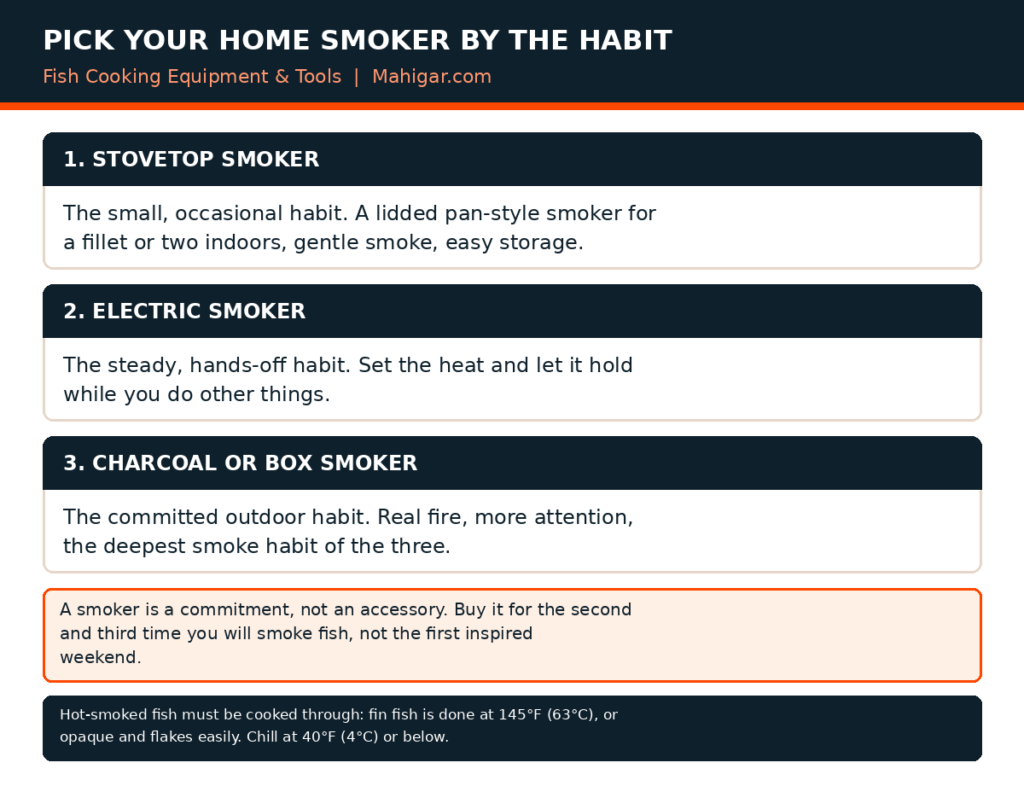
Stovetop smoker, the small, occasional habit. A lidded, pan-style smoker that works on your stove with a little wood dust or fine chips inside. In my judgement it suits a fillet or two at a time, keeps the smoke mostly indoors friendly, and stores like a pan because it nearly is one. Its limits are honest: small capacity, gentle smoke flavour rather than deep smoke, and it asks you to stay nearby. For the cook who wants smoked fish now and then without rearranging the garden, this is the sensible door into the method.
Electric smoker, the steady, hands-off habit. A cabinet-style smoker that holds a gentle heat while wood chips smoulder. Its gift is calm: I set it, load the fish, and I am not feeding a fire every little while. It suits whole fish and batches, and it is kind to beginners because the heat behaves. Its costs are space, a power point in a suitable spot, and one more appliance that must justify its corner month after month.
Charcoal or box smoker, the committed outdoor habit. Real fire, real smoke, real attention. This gives the deepest smoke and follows the oldest method, and for a cook who loves tending a fire it is half the pleasure. It is also the most demanding: heat rises and falls with the fuel and the weather, sessions become longer affairs, and the box itself is furniture. I would buy this one only when the habit has already proved itself. It rewards commitment and punishes hope.
Who Genuinely Enjoys One, and Who Can Honestly Skip It
Buy a smoker when smoked fish is already a taste you return to. Skip it when the idea arrived from a shop display.
If you have eaten hot-smoked fish and thought, I want this at home, if whole or oily fish pass through your kitchen often, and if a slow session sounds like pleasure rather than a chore, you will use any of the three types happily, matched to your space and patience. That is the cook I am really writing for in this section.
Everyone else can test the taste first, without shame and without spending. A grill with the fish set away from the fiercest heat, a lidded pan arrangement, or a gentle oven can all give a first, mild taste of the method with equipment you already own. If that taste turns into a monthly habit, you have earned the dedicated box and you will know which type fits your life. If not, you have saved the money and the storage in one move. And respect one plain truth: a smoker bought for one inspired weekend becomes the largest storage item you own. I measure the cupboard or the patio corner before I measure the fish.
Food Safety: The Part Nobody Should Skip
Hot-smoked fish must be cooked through, kept cold before and after, and never rescued by smoke. The rules are the same as for any cooked fish.
The finish rule comes first: fin fish is done at 145°F (63°C) in the thickest part, or when the flesh is opaque and flakes easily. A thermometer earns its keep here more than anywhere, because smoke darkens flesh and makes the eye a poor judge. The buying side of that tool is covered in Best Meat Thermometers for Fish, and the full chart lives in Safe Internal Cooking Temperatures for Every Type of Fish.
Around the session, I keep the same discipline as any fish day. Raw fish stays chilled at 40°F (4°C) or below, bought fresh and smoked within the usual raw-fish window of 1 to 2 days in the fridge. Finished smoked fish is treated like other cooked fish: 3 to 4 days refrigerated, served promptly, and discarded if it has sat out more than 2 hours, or more than 1 hour above 90°F (32°C).
I am deliberately not printing cure recipes, salt ratios, or per-fish smoking times here. Those belong to a tested method guide with recorded numbers, not to a buying guide, and guessing them would be the opposite of honest. Learn the method properly, cook the fish through, chill it right, and never let anyone tell you that smoke alone makes doubtful fish safe. It does not.
What to Look For, and What to Skip
Look for a good seal, racks that lift whole fish out cleanly, and a size matched to your real habit. Skip wardrobe-sized boxes for a two-fillet life.
When I judge a smoker, I want one that seals well enough to hold gentle smoke, racks that let me lift whole fish out without tearing them, and a size matched to the fish I will honestly smoke, a whole medium fish or a few fillets, not the biggest catch I ever hope to meet. It should clean without a ceremony, because a smoker that is miserable to wash quietly stops being used. For charcoal and box styles, steady heat control matters more to me than decoration.
I skip the theatre: gadget extras I cannot explain, and any best smoker ranking I cannot verify. I will not rank brands or quote capacities I have not measured myself. Match the type to your habit and space, keep the fish cold before and cooked through during, and a plain, well-made smoker will serve you for years.
Frequently Asked Questions
Is a home fish smoker worth buying?
Only if the habit is real. If you already love hot-smoked fish and will smoke it again next month, yes, matched to your space and patience. If the idea is one inspired weekend, I would try the method first with a grill, a lidded pan, or a gentle oven using what you own. A smoker bought for hope becomes storage.
Which smoker type is best for a beginner?
The stovetop smoker for a small, occasional start, or the electric smoker if you want calm, steady heat for whole fish without tending a fire. Both forgive a beginner better than charcoal does. Whichever you choose, cook the fish through to 145°F (63°C) and judge by the thermometer, not by the smoke colour.
Can I smoke fish without a smoker?
Yes, at a gentle first-taste level. A grill with the fish kept away from the fiercest heat, a lidded pan arrangement, or a kind oven session can all introduce the method honestly. What they will not give you is the depth of a dedicated box, which is exactly the honest reason to buy one later, once the habit proves itself.
Is hot-smoked fish safe to eat?
Yes, when it is treated as cooked fish, because it is. The fish must be cooked through to 145°F (63°C) or opaque and flaking, kept chilled at 40°F (4°C) or below before and after, eaten within the usual cooked-fish window of 3 to 4 days, and discarded after more than 2 hours out. Smoke is flavour; it is not a safety shortcut, and it never rescues fish that was doubtful to begin with.
What to Check Next
Tonight, before buying anything, ask yourself one honest question: is smoked fish a taste you already chase, or a weekend you are imagining? If it is real, choose the smallest honest tool for it, stovetop for occasional fillets, electric for steady whole fish, charcoal for the committed outdoor cook. If it is imagined, borrow the method with the grill or pan you own and let the habit make the decision. Either way, chill the fish cold, cook it through, and let the tool earn its corner.
