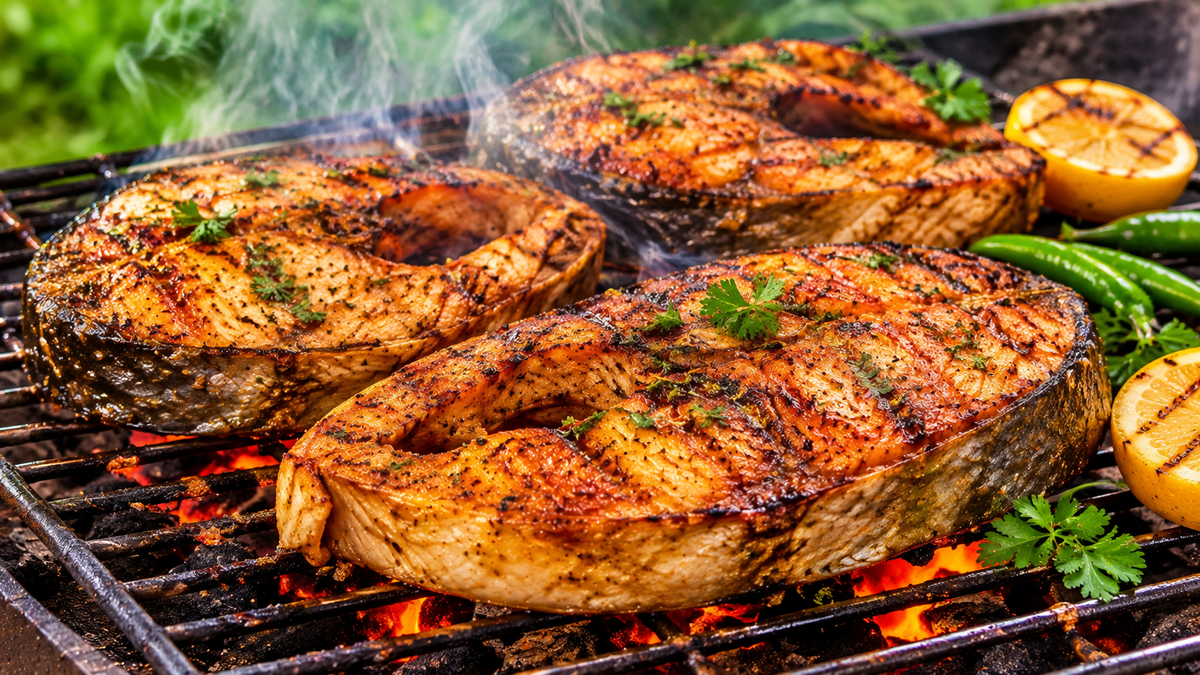
Cooking Large River Fish: Steaks, Cuts and Timing for Big Fish
A large river fish on my board used to worry me. Not the cooking, the cutting. I would stand there with a carp or a catla longer than my forearm, a good fish in every way, and know that one careless cut would give me a tray of mismatched pieces, some thin and ready to dry out, some thick and still raw in the middle when the rest was done.
That is where most big fish meals go wrong, long before the pan gets hot. The fish is blamed for being dry or uneven when the real fault was on the board. My answer, learned over many river fish in my own kitchen, is in this guide: cut the fish to the dish, keep the cuts even, and cook by thickness and temperature, not by the clock alone.
This how to guide belongs to my Freshwater Fish Cooking: Carp, Catla, Catfish & River Fish pillar, where fish from rivers is the central subject from buying to serving. Everything here is hands on practice from my board and my stove, written for the cook who has a big fish and wants every part of it to eat well.
Table of Contents
The Short Answer: Cut to the Dish, Cook by Thickness
Cut the fish to the dish, cook by thickness and temperature, and a large river fish becomes easier than a small one.
That is the whole method in one line, and the rest of this guide is me showing you how I do it. Cut to the dish means I decide the meal before the knife moves. Curry pieces, frying steaks, and a frame for stock all come from the same fish, but they are cut differently and on purpose. Cook by thickness means the thickest part of the piece sets the cooking, not a timer I copied from a different fish on a different day. Cook by temperature means I finish on a clear doneness rule, not on hope.
Breaking a Large River Fish Down
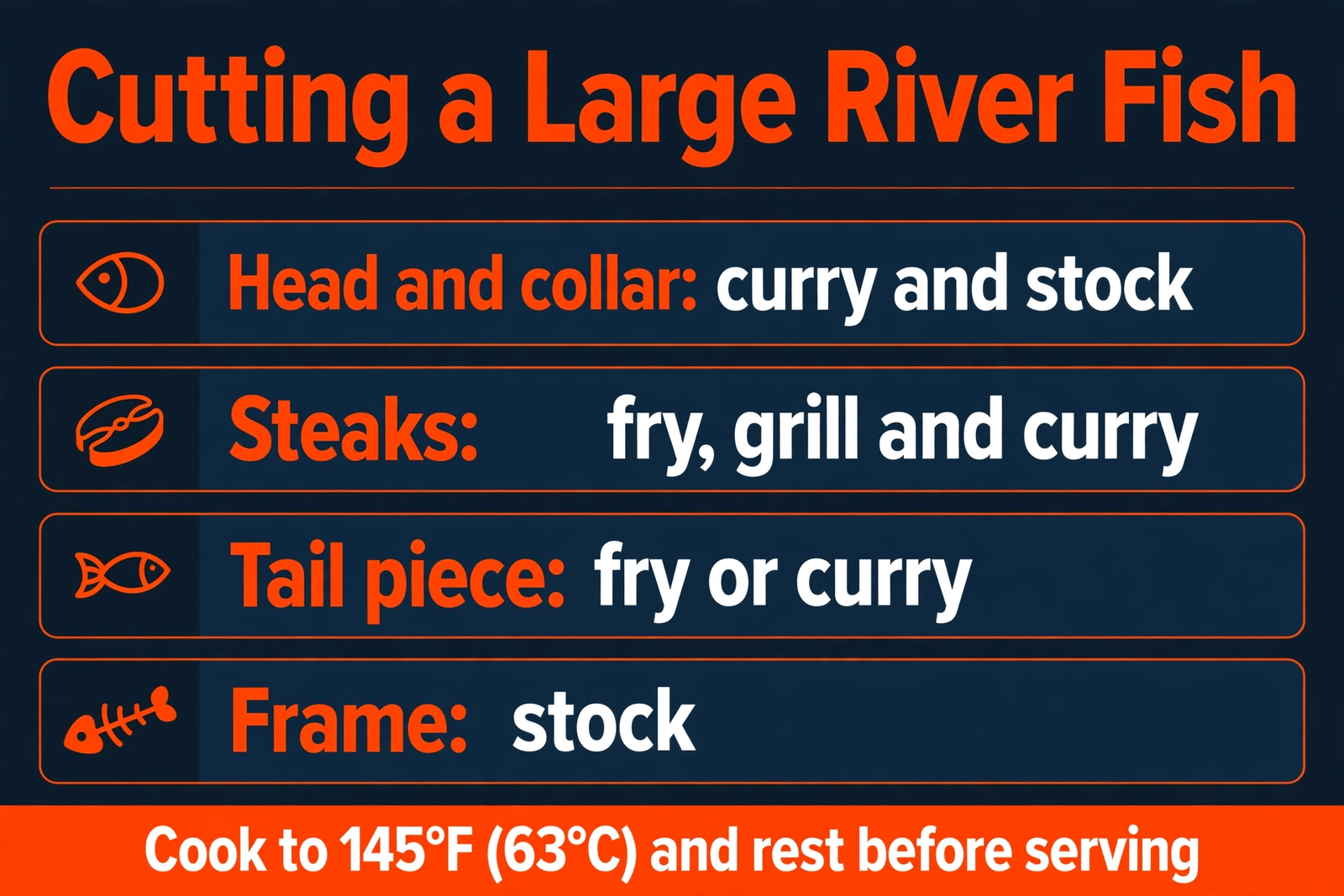
Break a large river fish down into head, collar, steaks across the body, tail piece, and frame, and every part has a clear job.
I start with a cleaned fish and a dry board that does not slide. If the fish still needs cleaning, my guide to How to Clean Catfish covers the catfish method in full, and the same calm, clean habits apply to carp, catla, and other big river fish before the breakdown begins. I lay the fish on its side, look at its length, and decide my cuts before I make them, marking the lines with the tip of the knife so I am not guessing halfway through a cut.
The head comes off first, behind the gills, in one firm cut. I do not throw the head away and neither should you. In my kitchen the head and the collar, the rich part just behind the head where the flesh is full of flavour, go to curry or to the stock pot. That collar meat is some of the tastiest on the whole fish, and cooks who cut it away with the head are leaving the best bite behind.
Then I cut steaks straight across the body, working from the head end toward the tail. Each cut goes down through the backbone in one confident motion with a heavy, sharp knife, not a sawing struggle that tears the flesh. A fish like Wallago Attu (Mallee/Malli): The Giant River Catfish Guide rewards you here, because its soft, rich flesh cuts cleanly when the knife is sharp and the hand is steady.
The tail piece I keep separate. It is thinner, it has a different bone pattern, and it cooks faster than the body steaks, so it gets its own job, usually a quick fry or a place in the curry where it will not be left behind while thicker pieces finish. The frame, what is left after any filleting or trimming, and the clean trimmings go to stock. A large fish gives you a stock frame that small fish never can, and that stock becomes the base of the next curry or soup in my kitchen. Nothing with flavour leaves my board unused.
Steak Thickness and Even Cuts
Even thickness matters more than any exact size, because pieces of the same thickness cook at the same rate and finish together.
From my own practice, I cut body steaks about as thick as my thumb to two fingers held together, depending on the dish. For a gentle fry I stay at the slimmer end of that range so the outside can crisp while the centre finishes. For curry and oven cooking I cut a little thicker, because the sauce or the steady oven heat protects the flesh and a thicker steak stays moist and satisfying. The big fish I have handled ran longer than my forearm, and on a fish of that scale this thickness gives steaks that feel generous without becoming a struggle to cook through.
The exact habit that changed my results was measuring with my hand, not my eye. My eye lies when a fish tapers, because a steak cut by eye near the tail looks the same width as one near the head while being much thinner in the flesh. My fingers do not lie. I check each steak against my thumb as it comes off the fish, and I set aside any piece that is clearly thinner to cook separately or for a shorter time.
Even cuts are also why I care about the ideas in How to Portion Fish Fillets Evenly, even though that guide works with fillets rather than steaks on the bone. The principle is identical. Portions of equal thickness are the only portions a cook can time honestly. If your steaks came out uneven despite your care, do not force them into one pan and one timing. Cook the thin ones first or give them a head start in reverse, thick ones first, thin ones after. Sorting the tray is a small act that saves the meal.
Timing by Thickness, Finished by Temperature
Judge the timing by the thickness of the steak, start checking early, and always finish on the 145°F (63°C) rule or the flake test.
I do not cook big steaks by the clock alone, and I advise you not to either. A clock cannot see your pan, your stove, or the true thickness of the fish in front of you. What I do in my kitchen is use thickness as my guide and time as my reminder. A thicker steak runs longer, a thinner steak finishes sooner, and the thickest steak on the tray is the one I watch and test. When that one is ready, the rest are ready. When I am unsure, I check the thickest part with a thermometer, away from the bone, because bone misleads the reading and the outside of a big steak always looks done before the centre is.
My finishing rule never changes: cook fish to 145°F (63°C). At that point the flesh is opaque, moist, and flakes cleanly. If you cook without a thermometer, use the signs I trust and set out in How to Tell When Fish Is Done Without a Thermometer: the flesh turns opaque all the way to the centre, it flakes with gentle pressure from a fork or spoon, and it comes away from the bone cleanly. With big steaks, make a small check in the thickest part rather than guessing from the surface.
Start checking earlier than you think you need to, because you can always add heat, but you cannot undo overcooking.
The Best Methods for Large Steaks
Pan frying, curry, grilling with support, and the oven all cook large river fish steaks well, as long as each method respects the thickness and softness of the cut.
Pan frying is my everyday method for body steaks of carp, catla, and wallago. I dry the surface well, season simply, and use a wide pan with enough hot oil to do clean work without drowning the fish. The steak goes in and stays in. I turn it once, with a wide spatula that supports the whole piece, and I let the second side finish the job. A light coating helps steaks that will be handled, especially softer catfish steaks, and a screaming cold pan is the enemy, because the fish will stick, tear, and lose its coating before it browns.
Curry is the most forgiving method for a mixed tray of cuts. I build the sauce fully first, then lay the thickest pieces in first and the tail piece in last, letting everything poach gently in the sauce with the lid on. I do not boil a fish curry hard and I do not stir it with a spoon once the fish is in. A gentle shake of the pot moves the sauce without breaking the flesh. The collar and head pieces shine here, giving the sauce a depth that plain fillet curry never reaches.
Grilling needs support for big steaks. My rule for fragile or soft steaks is a grill basket or a foil bed, well oiled, so I can turn the fish in one movement. I oil the fish and the surface, leave the steak alone until it releases, and never force a turn. If it sticks, it is not ready to turn.
The oven is my choice for the thickest cuts and for feeding a group without standing over a pan. Steady oven heat cooks a thick steak evenly from all sides at once, and a covering of sauce, seasoned crumbs, or simply a lid or foil for part of the time keeps the surface from drying while the centre catches up. For a very thick steak, the oven followed by a short rest gives me the most even result of any method in my kitchen.
Keeping Big Steaks Moist
Big steaks stay moist when you do not overcook them, rest them before serving, and let sauce or pan juices do the final work.
Moisture is lost in the last push of cooking more than anywhere else, so my first protection is the doneness rule above: out at the right temperature, not later. My second protection is resting. I rest cooked steaks briefly before serving, loosely covered, so the juices settle back through the flesh instead of running out on the board or the plate with the first cut. That short rest is written on my own kitchen habit, not as fussiness, but because I have compared rested and unrested steaks from the same fish and the rested one eats better.
Sauce is the third protection. A curry sauce, a spoon of pan juices, or a simple seasoned butter or oil over the hot steak keeps the surface moist and adds back what the heat took. I time the meal so the fish is the last thing ready.
Dry surface, confident heat, correct finish, short rest. That sequence keeps my big steaks moist more reliably than any marinade I have tried.
Serving a Whole Large Fish, Briefly
A whole large fish can be served at the table when it is cooked gently, rested, and carried on a support, but that full method belongs to its own guide.
I will keep this brief, because serving a whole fish well is a subject of its own and it is covered in How to Serve Whole Fish at the Table. In short, from my table: cook the whole fish by a method that supports it, such as the oven on a sturdy tray, rest it, and take it to the table on the tray or a platter it can be lifted onto in one movement, never by dragging or rolling it. At the table, work calmly from the top side down, lifting the flesh away from the bones in large pieces and serving the collar and cheek meat to the people who will appreciate them most. A big fish at the table is a celebration, and it deserves a calm hand rather than a performance.
Leftovers and Storage
Keep raw large fish cold and brief, and chill cooked leftovers promptly, covered, in a fridge at or below 40°F (4°C).
My storage rules for big river fish are the same firm rules I use for all fish. Keep your fridge at or below 40°F (4°C). Raw fish keeps for 1 to 2 days in the fridge, and with a large fish I plan the cooking so most of it is cooked on the first day rather than sitting raw. Cooked fish keeps for 3 to 4 days in the fridge, in clean covered containers, and large steaks store best in their sauce when they were curried, because the sauce protects the flesh from drying.
Cutting a big fish with the meals in mind helps here. On the day of cooking I serve the fried steaks fresh, because fried fish is at its best straight from the pan, and I let the curry carry the leftovers, because curried fish reheats gently and honestly improves as the flavours settle. Reheat leftovers once, gently, until hot all the way through, and do not keep cycling the same container in and out of the fridge.
The Mistakes I See With Big Fish
The mistakes I see most are uneven cuts, cooking by the clock alone, turning fragile steaks too often, and throwing away the head, collar, and frame.
Uneven cuts come first because they cause so many of the others. A tray of mixed thicknesses cannot share one timing, so something is always overcooked or undercooked, and the cook blames the fish. Cooking by the clock alone is the twin mistake. The clock is a reminder, never the judge. Thickness and temperature judge.
Turning too often breaks soft steaks and tears coatings, and forcing a steak that has not released from the pan or grill does the same damage faster. Impatience at the turn has ruined more good river fish in kitchens I have visited than any bad recipe. Close behind it is waste: the head tossed, the collar cut away, the frame binned before it made stock. A large fish asks for more work than a small one, and it pays that work back in more meals, if the cook uses the whole fish.
Frequently Asked Questions
How thick should I cut large fish steaks?
Cut them evenly, about as thick as your thumb to two fingers held together in my practice, slimmer for a gentle fry and a little thicker for curry or the oven. Evenness matters more than the exact size, because pieces of the same thickness finish together.
How do I know a large fish steak is done?
Cook it to 145°F (63°C), checking the thickest part away from the bone. Without a thermometer, look for flesh that is opaque to the centre, flakes with gentle pressure, and lifts cleanly from the bone. Start checking early, because you can add heat but you cannot undo overcooking.
What is the best method for cooking large river fish steaks?
Pan frying suits even body steaks, curry is the most forgiving for mixed cuts, a grill basket or foil supports fragile steaks on the grill, and the oven gives the most even result for the thickest cuts. In my kitchen the dish decides the method, and the thickness decides the timing.
How long do large fish leftovers keep?
Keep your fridge at or below 40°F (4°C). Raw fish keeps for 1 to 2 days and cooked fish keeps for 3 to 4 days in the fridge, covered and chilled promptly. Curried leftovers store and reheat best, because the sauce protects the flesh.
My Closing Advice on Big River Fish
A large river fish is not a problem to solve. It is several good meals travelling together, and your knife decides whether they arrive well.
Decide the dishes first, cut even steaks with your fingers as your measure, use the head, collar, tail, and frame with respect, and finish every piece on temperature or the flake test, with a rest before serving. Do that and carp, catla, or wallago will feed your table generously and well. And when that big fish turns out to have travelled to your market under a different local name, the guide in Fish Names Around the World: What to Buy Where You Live will help you place it, because a good cook should know the fish in front of them, whatever the market calls it.
One Comment