
How to Clean Catfish: Removing Slime, Skin and Whiskers
A whole catfish on my board defeats more home cooks than any other fish I know, and the reason is simple: it slides. Fish with scales give your hands something to hold. A catfish has smooth skin, a thick coat of slime, and sharp spines waiting where your fingers want to land, so the job feels hard before the knife even comes out. It is not hard. It only needs the right order. In my kitchen I rinse the fish, firm up my grip with salt, cut a ring behind the gills, pull the skin off in one steady pull with pliers, then head, gut and wash. That order has carried me through years of canal catfish at home, and it will work on your board too. This guide sits inside my Freshwater Fish Cooking pillar, and here I slow down for the one job readers ask me about most: how to clean catfish properly, from slippery whole fish to clean flesh ready for the pan.
Table of Contents
Why Catfish Wear That Slippery Coat
The slime is not dirt, and it is not a fault in the fish. It is a living coat that protects the skin.
A catfish has no scales, so its skin needs another guard. The slime coat covers the skin like a wet shield. It helps protect the fish from scrapes, from bacteria in the water, and from the rough banks and stones of the river and canal bottoms where catfish feed. When you lift a fresh catfish and it feels very slippery, that is usually a good sign. A dull fish with dry, patchy skin has often been handled a lot or kept too long.
My rule is simple: I do not fight the slime, I manage it. Before any cutting, I rinse the whole fish under cold running water to wash off loose slime and any mud from the market or the bank. Then I dry my hands, sprinkle coarse salt over the skin, and rub it in with a rough cloth. The salt gives my fingers grip and takes the worst of the slip away, so the fish stays still on the board. A paper towel works for grip too. What matters is that the fish stops sliding before the knife starts moving. A fish that slides gets cut badly, and hands get cut that way too. Once my grip is firm, the rest of this job is calm work.
What I Put on the Board Before I Start
Good cleaning starts before the fish comes out. I lay out a short list of tools, and I keep it short on purpose.
I use a large, steady board with a wet towel under it so the board cannot skate across the counter. On it I keep a sharp knife for the ring cut and the heading work. Beside it sit my skinning pliers, or ordinary flat pliers with a good grip, because catfish skin is strong and fingers alone will slip off it halfway through the pull. I keep kitchen scissors handy for trimming whiskers and fins, a rough cloth for grip, and a small bowl of coarse salt. A scrap bowl sits close for skin, guts and trimmings, so nothing travels across the kitchen. Last, I keep cold water nearby and clean towels ready for the final wash and pat dry.
That is the whole kit. No special catfish tool exists in my kitchen, and you do not need to buy one. If your pliers are clean and dry and your knife is sharp, you already own everything this job asks for. A blunt knife is the one thing I will not allow on my board. It tears the ring cut, makes the skin pull ragged, and forces your hand to push harder on a slippery fish. Sharpen first, clean second.
My Order of Work, Step by Step
Here is the exact order I follow, and I follow it the same way on a small farm catfish and on a big river fish.
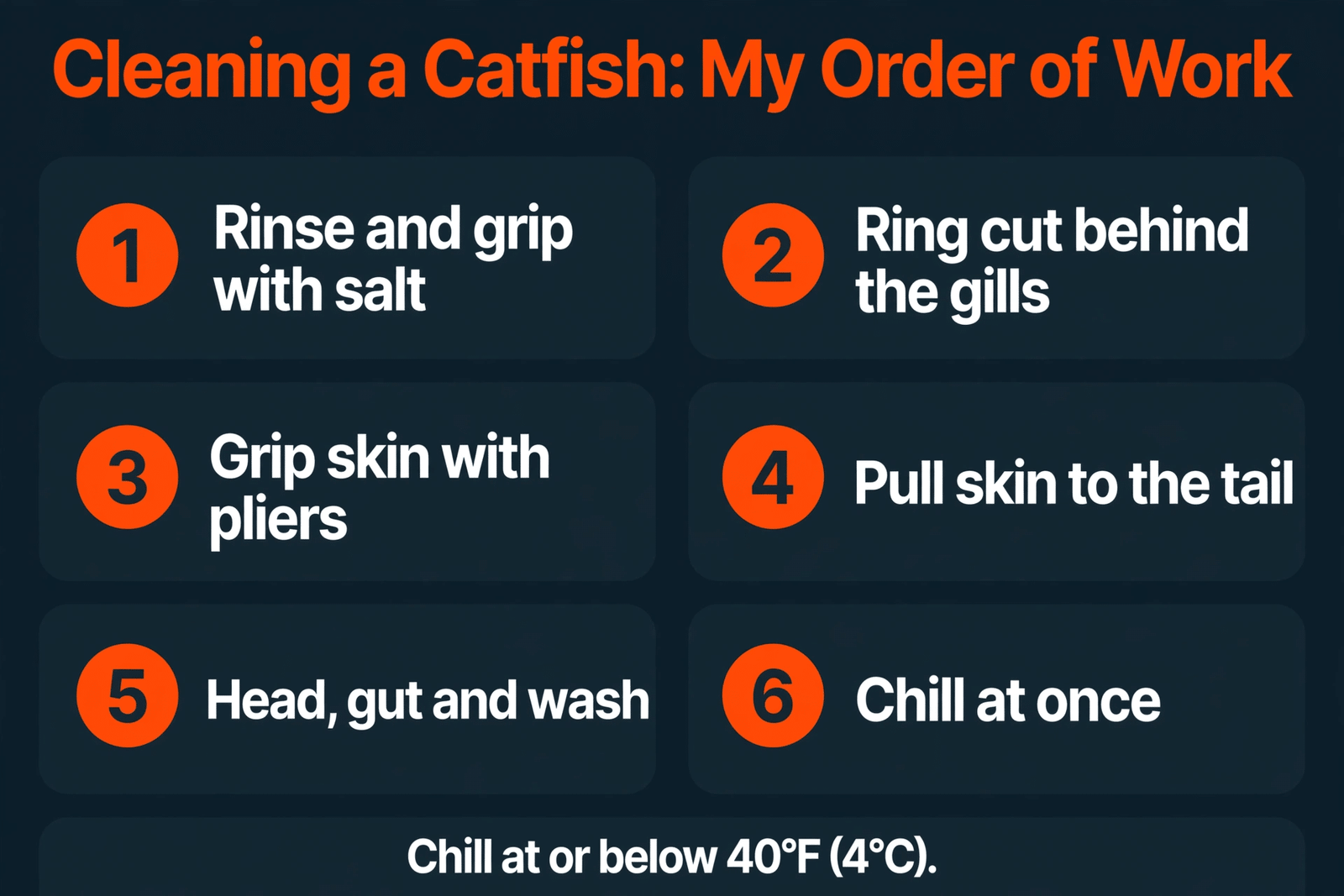
Step one: rinse and grip with salt. I rinse the whole fish under cold water, lay it on the board, rub coarse salt over the skin with a rough cloth, and wipe away the loosened slime. My hands and the board stay as dry as I can keep them from this point on.
Step two: make the ring cut behind the gills. With the fish steady, I cut a shallow ring around the body just behind the gills and the pectoral fins, cutting through the skin only. I take the knife around the top, down both sides, and under the belly until the cut meets itself. The flesh under the skin should stay uncut. This ring is the starting edge for the whole skin, so I make it neat and complete. A broken ring means a torn pull later.
Step three: grip the skin with pliers. I lift a flap of skin at the top of the ring, right behind the head, and clamp it firmly in the pliers. On most kitchen fish one strong grip at the top does the job.
Step four: pull the skin to the tail. Holding the head end steady with my towel hand, I pull the pliers down the body toward the tail in one slow, firm pull. The skin peels away like a jacket coming off. If it sticks around the fins, I free it with the tip of the knife and pull again instead of tearing. When one side is done, I turn the fish and take the other side the same way. Done well, the flesh underneath looks clean, pale and smooth, with no grey skin patches left behind.
This whole fish skinning is a cousin of fillet work, and my guide to How to Skin a Fish Fillet shows how the same respect for the skin line works once the fish is already in pieces. Learn them in that order and both feel easy.
Step five: head, gut and wash. With the skin off, I move to the head and belly work in the next section, then wash the fish clean.
Step six: chill at once. A cleaned fish never waits on my counter. It goes straight into the cold, as I explain in the storage section below.
The Whiskers: When I Trim Them
The long feelers around the mouth are called barbels, and most home cooks just call them whiskers. They are how the fish tastes and feels its way along a dark river bottom.
In my kitchen the whiskers need no special job of their own. If I am removing the head, and for skinned catfish I almost always do, the whiskers go with the head in one cut. If a fish will be headed later, I snip the whiskers off with kitchen scissors before skinning, so they do not flop across the board and get in the way of the ring cut. Either way works. What I never do is pull at them by hand. They are firmly fixed, tearing makes a mess, and a clean scissor cut takes a second. Trim them with the head, or trim them before it. Just do not let them distract you from the real work, which is the skin.
Heading, Gutting and Washing
With the skin off, the fish stops being slippery and the rest of the cleaning is straightforward, honest work.
For heading, I cut through the body just behind the gills, following the line my ring cut already marked, and take the head off in one firm cut. I keep the knife angled slightly toward the head so I waste as little shoulder flesh as I can. The head goes to the scrap bowl, or into my stock bag when I want it, never loose on the board.
For gutting, I open the belly with a shallow cut and lift the innards out with my fingers, keeping the knife shallow so nothing inside gets torn and spreads through the cavity. I run a finger or the back of a spoon along the backbone inside the belly to clear the dark bloodline, because leaving it gives the flesh a muddy, bitter edge in the pan. If gutting whole fish is new to you, my walkthrough of How to Gut and Clean a Whole Fish covers the cavity work in slower detail.
For washing, I rinse the fish inside and out under cold running water until the water runs clear and the flesh feels clean, not slimy, under my fingers. Then I pat it dry. A dry surface matters more than most cooks think. Dry flesh takes spice paste properly, fries without spitting, and browns instead of steaming. If the fish will be cut into steaks or pieces, I cut it now, on the clean, dry fish, and every piece comes out neat.
Mind the Sharp Pectoral Spines
Every catfish carries a warning, and it sits right where your holding hand wants to go.
The fins on the sides of the chest, the pectoral fins, hide hard, sharp spines, and the fin on the back carries one too. On a live or very fresh fish these spines can lock stiff, and a careless grip will earn you a painful jab. I have learned this respect the slow way over years of canal fish, and my habit now is automatic: I never grab a catfish around the middle from above. I hold it from below, behind the pectoral fins, or keep my holding hand at the head end inside the towel, well away from the fins, while the pliers do the pulling. I also warn anyone helping me before the fish comes out, not after. Children watch this job from a step back in my house.
If a spine does catch your skin, stop, wash the spot well with soap and clean water, and keep an eye on it. Do not carry on with a bleeding hand over raw fish. Clean the hand, cover it, and only then go back to the board. Big river relatives carry the same warning in a larger size, and my guide to Wallago Attu (Mallee/Malli): The Giant River Catfish Guide shows why I give those fish even more room at the cleaning stage.
Skin Off or Skin On: How I Decide
Most catfish in my kitchen get skinned, but not all of them, and the choice is about the dish, not about habit.
I skin when the fish will be fried in pieces, cooked in a curry, or coated in spice paste, which covers most of my catfish cooking. Catfish skin is thick and tough, it does not crisp the way a thin scaled skin crisps, and on a muddy river fish the skin can hold a muddy taste. Skin off, the flesh cooks evenly, takes seasoning right through, and eats clean.
I cook skin on only in a few cases. A very fresh, small catfish that I will cook whole and gently, where the skin helps hold the soft flesh together, sometimes keeps its skin in my pan. Even then, I wash and salt rub it very well first. If you are ever in doubt, skin it. You lose nothing but toughness, and you gain a cleaner taste. My honest answer for beginners is to skin every catfish while you learn. Judge the exceptions later, when your hands know the work.
Chill It Right After Cleaning
A cleaned catfish is raw fish, and raw fish waits for no one. The moment my washing and drying is done, the fish goes into the fridge or straight into cooking.
I keep my fridge at or below 40°F (4°C), and cleaned raw fish goes in covered, away from cooked food and salads. In my kitchen, raw fish keeps 1 to 2 days refrigerated, and I cook catfish on the day I clean it whenever I can, because its flesh is sweetest fresh. Once cooked, cooked fish keeps 3 to 4 days in the fridge, well covered. When I do cook it, I cook fish to 145°F (63°C) in the thickest part, the same plain standard I use for every fish on my table. If a cleaned fish smells sour or feels slimy again after washing and chilling, I do not cook it and hope. Out it goes. A clean smell and firm flesh are the two signs I trust.
Mistakes I See Again and Again
Most catfish cleaning problems come from a short list of habits, and every one of them is easy to fix.
The first mistake is cutting a wet fish with wet hands. Everything slides, the ring cut wanders, and the skin tears. Rinse first, then dry, salt and grip. The second mistake is a ring cut that never joins up. If the ring is broken, the pull breaks with it, so check that your cut meets itself before the pliers come out. The third mistake is pulling the skin with fingers instead of pliers. Fingers slip and the skin rips into strips. The fourth mistake is deep gutting cuts. A deep knife tears the innards and dirties the whole cavity, so keep the belly cut shallow. The fifth mistake is leaving the bloodline in place. It takes seconds to clear and it saves the taste of the whole dish. The last mistake is a slow, warm finish: fish left sitting on the board while the kitchen gets tidied. Clean, chill, then tidy. And when the work is done, my guide to How to Get Rid of Fishy Smell on Hands and in the Kitchen will save your hands, your board and your sink from carrying catfish into the next meal.
Frequently Asked Questions
Do I have to skin a catfish before cooking it?
No, but I skin most of mine. Catfish skin is thick and tough, it does not crisp well, and on river fish it can hold a muddy taste. For frying, curries and spice coated pieces, skin off gives you cleaner taste and even cooking. A very fresh small fish cooked whole and gently is my only regular exception.
How do I stop a catfish sliding around while I clean it?
Rinse it first, then dry your hands and rub coarse salt over the skin with a rough cloth or towel. The salt cuts the slime and gives your fingers a firm grip. Keep a towel under the fish and under your holding hand, and keep both as dry as you can while you work.
Are the whiskers safe to touch, and should I remove them?
The whiskers, properly called barbels, are harmless to touch. The sharp parts of a catfish are the spines in the pectoral and back fins, not the whiskers. I remove the whiskers with the head when I head the fish, or snip them off with scissors before skinning if the head stays on for longer.
How long does cleaned catfish keep in the fridge?
Raw cleaned catfish keeps 1 to 2 days refrigerated at or below 40°F (4°C), and I cook mine the same day whenever I can. Cooked catfish keeps 3 to 4 days in the fridge, well covered. If it smells sour or feels slimy, do not cook it.
My Closing Rule for Catfish
Grip first, cut second, pull once, chill at once. If you remember nothing else, remember that order, because it turns the slipperiest fish on my table into one of the easiest to clean. Catfish rewards the cook who respects it: respect the spines, respect the cold, and respect the simple order of work, and it gives you sweet, firm flesh that fries, grills and curries beautifully. To place this fish in the bigger picture, my comparison of Freshwater vs Saltwater Fish shows how river fish like catfish differ in taste and handling from sea fish, and when you buy fish far from home, keep an eye on Fish Names Around the World: What to Buy Where You Live, because a catfish by one name in my market may sit under a different name in yours. Now clean one slowly, cook it well, and let your hands learn. They will not forget.

3 Comments