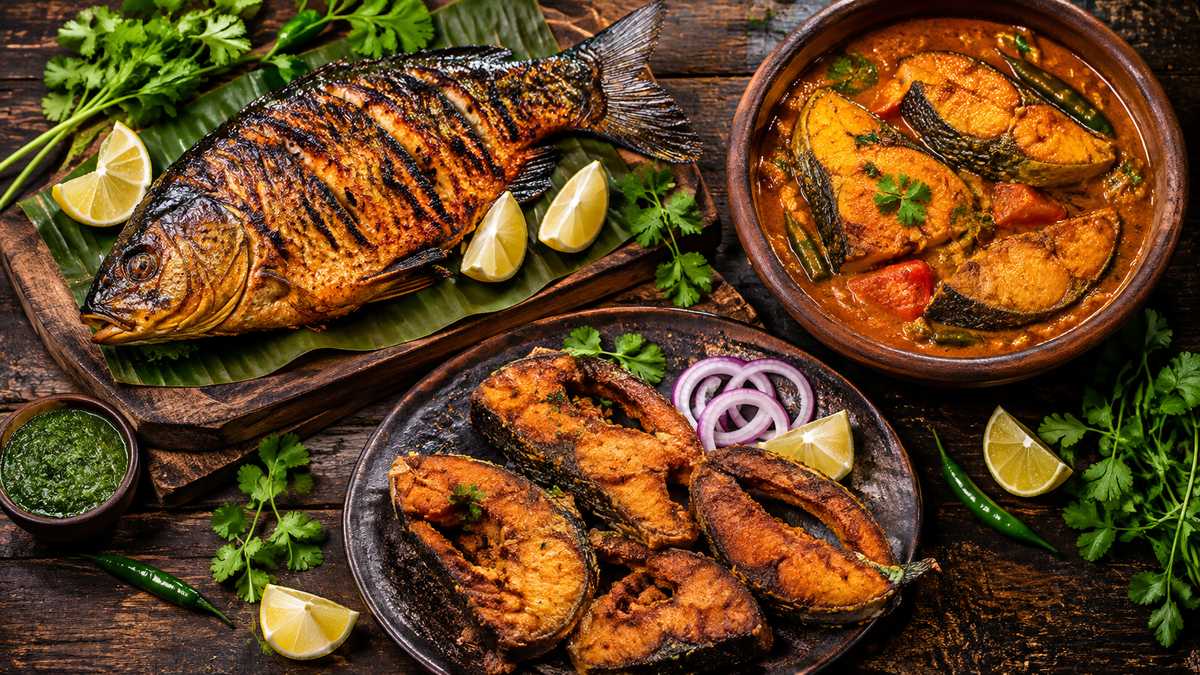
Freshwater Fish Cooking: The Complete Guide to Carp, Catla, Catfish and River Fish
The carp came up out of the canal water silver and struggling, and my first thought was not about sport. It was about dinner. Fish from rivers, canals, lakes and ponds is not a substitute for sea fish and it is not a lesser fish. It is its own subject, with its own flavour, its own bones and its own rules, and it is the subject my kitchen knows best. I have spent eight years fishing canals and more than twenty years cooking what those waters give us, and carp, catla, catfish and wallago attu are fish my hands know before my head has finished thinking.
This guide pulls the whole subject into one place: what freshwater fish means at the stove, how my four hero fish compare, how to buy and clean a river fish, how I handle muddy taste and fine bones, which method suits which species, and the safety and storage basics that keep a good fish good. Where a topic deserves a full guide of its own, I link down to it, because a pillar page should open doors, not repeat every room.
Think of this page as the companion to my Fish Species Guide, which covers species across the whole counter. That guide ranges wide. This one stays home, with the river and canal fish I still cook every week. If your fish came from your own net or line, Catch to Kitchen: How to Handle and Cook Fish You Catch Yourself will cover that earlier journey in its own pillar. Here, we start at the market stall and the kitchen board.
Table of Contents
What Freshwater Fish Means in the Kitchen
Freshwater fish means fish that live in rivers, canals, lakes, ponds and reservoirs rather than the sea, and in the kitchen it means mild flavour, honest bones and flesh that rewards seasoning and care.
A freshwater fish grows in slow or still water over mud and weed, and you can taste that home in the flesh. The flavour is usually gentle and sweet rather than briny, the texture is often softer than sea fish of the same size, and many river species carry fine bones through the flesh in a way sea fish rarely do. None of that is a fault. It is a character, and a cook who treats a carp like a sea bass will blame the wrong thing.
Freshwater fish is also the fish of inland people. It travels shorter distances to our markets, it is often sold whole and very fresh, and it costs less than sea fish in the towns where I live. For millions of families, rohu, catla, carp and catfish are the weekly fish, the curry fish, the fish of weddings and winter nights alike.
If you want the full side by side picture of how these fish differ from their saltwater cousins, I compare them honestly in Freshwater vs Saltwater Fish: Taste, Texture and Cooking Differences. One warning before we start: freshwater fish is a wide family, not a single taste. A lean pond fish and a rich giant wallago attu share almost nothing on the plate except the water they came from, which is why this guide is built around four hero fish.
The Four Hero Fish Compared
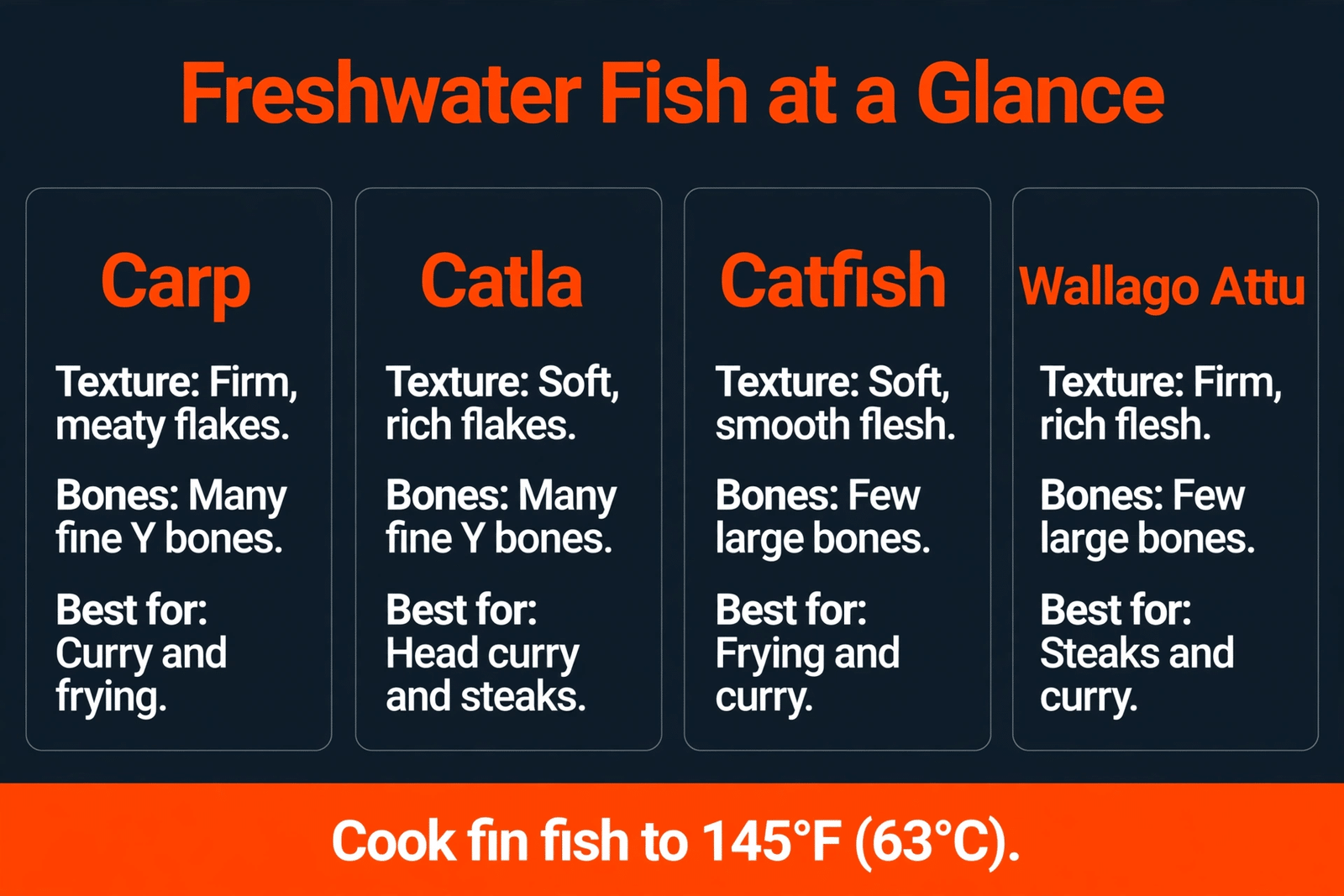
Carp, catla, catfish and wallago attu are my four hero fish because together they teach you almost everything freshwater cooking asks: firm flesh and soft flesh, fine bones and few bones, gentle flavour and rich flavour.
Carp. Texture: Firm, meaty flakes. Bones: Many fine Y bones. Best for: Curry and frying. Carp is the fish that built my patience. The flesh is full flavoured, the flakes hold together in a curry, and the fine bones are the price you learn to manage. Carp and carp family cousins like rohu are the backbone of river fish cooking across our region, and a fresh, well cleaned carp eats far above its reputation. My full buying, cleaning and cooking walk through is in Is Carp Good to Eat? How to Buy, Clean and Cook It, which answers the doubts people bring to this fish one by one.
Catla. Texture: Soft, rich flakes. Bones: Many fine Y bones. Best for: Head curry and steaks. Catla is the big headed aristocrat of the carp family. The body gives thick, rich steaks, and the head is prized in a way visitors find surprising until they taste a proper catla head curry, where the soft, fatty parts carry spice like nothing else on the table. The flesh is softer than carp, so I handle catla gently.
Catfish. Texture: Soft, smooth flesh. Bones: Few large bones. Best for: Frying and curry. Our river catfish give you smooth, mild flesh on a simple frame of large bones, with no forest of fine bones to negotiate. That makes catfish the friendly fish for nervous eaters and children. The trade off is the slime and tough skin, which need proper cleaning first.
Wallago attu. Texture: Firm, rich flesh. Bones: Few large bones. Best for: Steaks and curry. Wallago attu, called mallee or malli in my markets, is the giant of our canals, a big river catfish whose firm, rich flesh cuts into serious steaks and holds a curry with real authority. It is the fish that makes people who dismiss freshwater fish go quiet at the table.
Read the four together and the pattern shows itself. The carp family gives you flavour and fine bones. The catfish family gives you easy bones and softer or richer flesh. Almost every freshwater decision I make flows from that one split. Smaller river fish sit outside this comparison on purpose. Little fish cooked whole are a pleasure of their own, and Small River Fish: How to Cook Roach and Other Little Fish Whole will give them their own guide in a later run of this pillar.
Buying Freshwater Fish: Freshness Checks That Matter
A fresh freshwater fish smells clean and faintly of the river, has bright clear eyes, firm flesh that springs back under your thumb, and red gills, and my rule is simple: if I would not serve it to my own family tonight, it stays at the stall.
I start with the eyes, which should be clear and full, not sunken and grey. Then the gills, which I lift without apology: they should be red or rich pink and clean smelling. Grey gills or a sour smell from under the gill cover end the conversation. Then I press the flesh. Fresh fish pushes back. Old fish keeps the dent.
Smell is the check I trust most, but it needs understanding. A truly fresh freshwater fish carries a faint green, earthy trace of the river. That is not spoilage. Spoilage is sourness, ammonia, or the heavy stale smell that makes you step back. I explain the difference in Why Fish Tastes ‘Fishy’ and How to Reduce It, and every freshwater buyer should learn it, because it stops you rejecting good fish and accepting bad fish in the same morning.
Buy whole whenever you can. A whole fish shows you its eyes, gills and skin, while a fillet hides its history, and whole fish gives you the head and frame, which in my kitchen are never waste. Live fish, where your market sells it, is the gold standard, bought and cooked the same day. Dead fish should lie buried in ice, not warming on top of it. The wider buying habits that protect you with any fish are in The Complete Guide to Buying Fish and Seafood, the general companion to this pillar.
Names deserve one honest warning. The same river fish can carry different names in different towns, and the same name can be given to different fish. Mallee in my market is wallago attu, but I have seen the word used loosely for other large catfish. When a name matters, look at the fish itself. Fish Names Around the World: What to Buy Where You Live will untangle the naming maze in its own pillar.
Cleaning and Prep: The Order I Use in My Kitchen
I clean freshwater fish in a fixed order: rinse, scale if the fish has scales, gut, remove the gills, trim, wash again, and dry well, and I never change that order, because each step makes the next one cleaner.
The fish goes under clean running water first, so loose slime and dirt leave before the knife comes out. Carp family fish are then scaled, from tail to head with short strokes, and I scale before gutting so the belly stays shut and firm while I work. Gutting follows, with a shallow belly cut, because a deep cut can nick the gut and taint the flesh. The full step by step is in How to Gut and Clean a Whole Fish, the prep guide I send every beginner to first. On river fish I always remove the gills as well, because gills left in a fish cooked whole can taste bitter and hold blood that darkens the flesh.
Catfish fool people. There is no scaling, but there is slime, tough skin and whiskers, and a rushed job here follows the fish to the plate. My complete method, from the slime wash to skinning and trimming, is in How to Clean Catfish: Removing Slime, Skin and Whiskers.
Then I make my cutting decision. Steaks across the bone suit big catla, carp and wallago, and they are the traditional cut for curry in my house. Fillets suit fish you plan to fry crisp. Skin stays on for frying, where it protects the flesh and turns crisp. When skin has to go, the clean flat pull is the skill in How to Skin a Fish Fillet.
The last step is the one home cooks skip: drying. I pat the fish dry and let it sit uncovered in the fridge for a short while before it meets heat, as my own kitchen habit. Dry flesh fries and browns. Wet flesh steams and sticks. Almost every freshwater failure I am asked about begins with a wet fish and a hopeful pan.
Muddy Taste: The Short Honest Version
Muddy taste in freshwater fish comes from the water the fish lived in, it settles most in the fatty parts and the skin, and clean water fish, careful trimming, and a salt rub and rinse in my kitchen are what genuinely help.
I am keeping this section tight on purpose, because the full treatment lives in How to Remove Muddy Taste from Freshwater Fish, and repeating it here would waste your reading. The honest frame is this. Bottom feeding fish from still, warm, muddy water pick up earthy flavours from their home. Carp family fish and catfish from ponds and slow canals show it most. Fish from fast, clean river water rarely gives you the problem, which is why the same species can taste sweet from one seller and muddy from another.
In my kitchen, three things earn their place. I buy from sellers whose fish come from clean water, because prevention beats every cure. I trim dark fatty flesh and I am generous with skin removal on a suspect fish, because the muddy notes live there. And I give the fish a salt rub, a rinse and a short rest before cooking, about twenty minutes by my own practice. Honest seasoning then does the rest. What I do not do is soak fish in long milk or vinegar baths and call it a fix, and the linked guide explains why.
Bones: My Strategy for Carp Family Fish
The fine bones in carp family fish cannot be filleted away, so my strategy is to choose the cut, cook the fish so the flesh lifts cleanly, and eat with the calm technique our families have taught at the table for generations.
Let me be straight about the fish itself, because pretending otherwise helps nobody. Carp, catla and their cousins carry small forked bones, often called Y bones, set inside the flesh itself, not just along a frame you can lift out. No knife work removes them all. A seller who promises you a boneless carp fillet is selling you a hope, not a fact. Once you accept that, the fish becomes manageable, because the problem was never the bones alone. The problem is meeting them unprepared.
My strategy is habits, not equipment. I buy bigger fish when I can, because the bones in a large carp or catla are larger and easier to lift away than the hair fine bones of a small one. I cut steaks across the body for curry, so the bone pattern in each piece is predictable. I cook the fish fully and gently, because properly cooked flesh lifts away from the fine bones in flakes, while undercooked flesh clings. And I serve these fish at a table where nobody is rushing, with fingers and eyes working together, the way I was taught as a boy.
For children and nervous eaters, I change the fish, not the truth. Catfish and wallago attu, with their few large bones, are my honest answer at a family table. The complete handling guide, with scoring, cut maps and table technique, is Cooking Bony Fish: How to Handle Carp and Other Y-Bone Fish, the cluster I expect readers of this pillar to use most. One reassurance: the skill is learned fast, because the bones sit in a pattern, and the pattern repeats.
Cooking Methods by Species: Matching the Fish to the Fire
The right method follows the fish: carp and catla belong in curry, frying and steaks, catfish fries and curries beautifully, and wallago attu rewards thick steaks, gentle curry and careful grilling.
Curry is the home ground. In my kitchen, more freshwater fish meets curry than every other method combined. A spiced gravy keeps the flesh moist, carries earthy notes gracefully, and lets a firm fish hold its shape while it drinks flavour. Catla is my curry aristocrat, and its cuts, its famous head curry and the methods that suit its rich flesh get a full guide in Catla Fish: Cuts, Head Curry and Best Cooking Methods. Carp steaks in curry are the family standard I was raised on, and catfish curry on the bone is the one I serve to guests who are new to river fish.
Frying is the test of freshness. Nothing hides in a fish fry. I fry carp steaks and catfish pieces more than any other freshwater fish, always on dry, well seasoned flesh, always in a single layer, and I let the first side set properly before the fish is touched. A freshwater fry with a light spice crust, eaten hot with lemon and onion, converts people who claimed they did not like river fish.
Big fish need big fish thinking. Thick steaks cook unevenly if you rush them. My full method for cutting and timing the giants is in Cooking Large River Fish: Steaks, Cuts and Timing for Big Fish, and the giant himself gets his own profile in Wallago Attu (Mallee/Malli): The Giant River Catfish Guide, which covers buying, cutting and cooking him from canal to table. In my kitchen a wallago steak goes one of two ways: into a rich curry, or onto strong heat as a steak, with the skin side given time to crisp before any turning.
Gentle methods have their place too. Steaming and poaching suit the softer fish, and baking a whole fish suits a family meal with little watching. What I avoid is boiling freshwater fish hard in plain water, which gives you tired flesh and pleases nobody. Across every method, my sequence never changes: dry fish, honest seasoning, heat matched to thickness, and a short rest before serving.
Safety Basics: Temperature, Fridge and Timing
Cook freshwater fish to 145°F (63°C) in the thickest part, keep your fridge at or below 40°F (4°C), and treat raw freshwater fish as food for today or tomorrow, not for later in the week.
A probe in the thickest part of the piece, away from bone, tells you the truth that colour guesses at. When the flesh reaches that temperature and turns opaque and lifts in flakes, the fish is done and safe, and those two finish lines arrive together. With big steaks and whole fish, check the flesh near the backbone, because that is the last place the heat reaches.
Raw fish handling in my kitchen is plain discipline. Raw fish goes into the fridge the moment it comes home, in a covered dish that cannot drip onto other food. I wash my hands, board and knife after raw fish, and cooked fish never goes back onto a plate that held it raw.
The parasite question belongs here, honestly and without drama. Freshwater fish can carry parasites, which is exactly why I never serve river fish raw in my house. What cooking actually kills, and which popular claims are myths, is covered in full in Parasites in Freshwater Fish: What Cooking Actually Kills. The short version fits in one line: cook river fish through, every time, and the risk is handled.
Storing Freshwater Fish at Home
Raw freshwater fish keeps 1 to 2 days in the fridge and cooked freshwater fish keeps 3 to 4 days, and my rule is to cook river fish the day I buy it whenever life allows.
If the fish is whole, gut it before it goes into the fridge, because a whole fish stored with its guts in spoils from the inside. I store fish in a sealed container or well wrapped, in the coldest part of the fridge, away from foods that will be eaten raw. Cooked fish stores kindly if you cool it, cover it and refrigerate it promptly, and reheat it gently. Curry fish often tastes better the next day, and a catla curry on its second day is a small private pleasure of my kitchen. Beyond the window, though, I do not bargain. Fish that has passed its days goes out.
Freezing is a fair tool for a glut. A big wallago or a bargain of carp steaks freezes well if it is wrapped tightly with the air pressed out. I freeze in portions I will actually cook, thaw in the fridge and never on the counter, and use frozen freshwater fish for curry and frying, where it serves well.
Seasoning Freshwater Fish Without Burying It
Season freshwater fish with a confident hand and a light touch: salt first, then warm spices, citrus and herbs matched to the fish, strong enough to stand beside river flavour and never so heavy that the fish disappears.
Freshwater fish takes seasoning better than delicate sea fish, and that is one of its quiet gifts. The gentle flesh welcomes turmeric, cumin, coriander, mustard, chilli, garlic and lemon without being overwhelmed, and our regional cooking grew up on exactly that marriage. My order is salt before spice, always, and a short rest after seasoning, about twenty minutes by my practice, so the flavours settle instead of sliding off into the pan.
The mistake is panic seasoning: throwing every jar in the cupboard at a fish because you fear its flavour. A fresh river fish does not need rescuing. It needs framing. For a clean tasting catfish I may use nothing beyond salt, turmeric, a little chilli and lemon, and the fish sings. For a pond carp with a whisper of earthiness, a fuller spice coat earns its place. The blends themselves, and how I build marinades for fish, belong to Fish Spice Blends, Marinades and Seasoning: The Complete Guide, which will stand as its own pillar beside this one.
Mistakes I See With Freshwater Fish
The freshwater mistakes I see most are buying by price alone, cooking the fish wet, rushing big steaks, fearing the bones into overcooking, and serving river fish by sea fish rules.
Buying by price alone brings home the oldest fish at the stall, because the cheap pile is cheap for a reason, and river fish is inexpensive food even at its freshest. Cooking the fish wet is the second failure, and it deserves its emphasis: wet flesh steams, sticks and pales, and the cook blames the species. Rushing big fish is the third. A thick wallago or catla steak needs its time, and high heat to hurry it burns the outside while the centre waits. Lower the heat a notch and give the thick part its minutes. Patience is a cooking method.
Fearing the bones cuts both ways. Some cooks overcook carp family fish into dryness trying to cook the bones away, which no heat will do, while others avoid these fish entirely and miss some of the finest eating in our rivers. Cook the flesh properly and eat it with technique. The last mistake is the quietest: judging freshwater fish by sea fish expectations. River fish has its own standard: sweet flesh, honest bones, deep comfort in a gravy, crisp skin in a fry. Judge it by that standard and it rewards you every time.
Frequently Asked Questions
Is freshwater fish healthy to eat often?
Yes, freshwater fish is good everyday food, and it has fed river communities for generations. My guidance is variety and freshness: rotate carp, catla, catfish and other fish through your week, buy the freshest fish you can, and cook it through.
Why does my freshwater fish taste muddy?
The muddy taste comes from the water the fish lived in, most often still or slow pond and canal water, and it settles in the skin and fatty flesh. Buy from clean water sources where you can, trim dark fatty parts, remove the skin on a suspect fish, and use my salt rub and rinse before cooking. The full method is in my muddy taste guide linked from this page.
What is the easiest freshwater fish for a beginner?
Catfish is my beginner answer, because the flesh is mild and forgiving and the bones are few and large, so there is no fine bone work at the table. Buy it fresh, season it simply, and fry or curry it. Early success with catfish brings beginners back to the river fish stall.
How do I know when freshwater fish is cooked through?
Probe the thickest part of the flesh, away from the bone, and look for 145°F (63°C), with flesh that is opaque and lifts in clean flakes. On steaks and whole fish, check near the backbone, where the heat arrives last. Colour alone will mislead you, especially on rich or dark flesh, so the probe and the flake test together are my rule.
Where to Start in Your Own Kitchen
Start where my own cooking started: one fresh fish, cleaned with care, seasoned with a calm hand and cooked through without fear.
If this pillar is your first visit to river fish, here is my order for you. Buy a fresh catfish and fry it simply, so you learn the buying checks and the dry fish discipline on forgiving flesh. Then cook a carp or catla curry on the bone, until the fine bones feel like a pattern instead of a problem. Then, when a big wallago attu appears at a fair price, buy steaks with a plan and cook them the same day.
Keep this page as your map. Every section above opens into a deeper guide as this pillar grows. In my kitchen, freshwater fish is not the alternative to anything. It is the original, the fish of my canals and my family table, and cooked with the care this guide sets out, it can hold its head up beside any fish in the world.

9 Comments