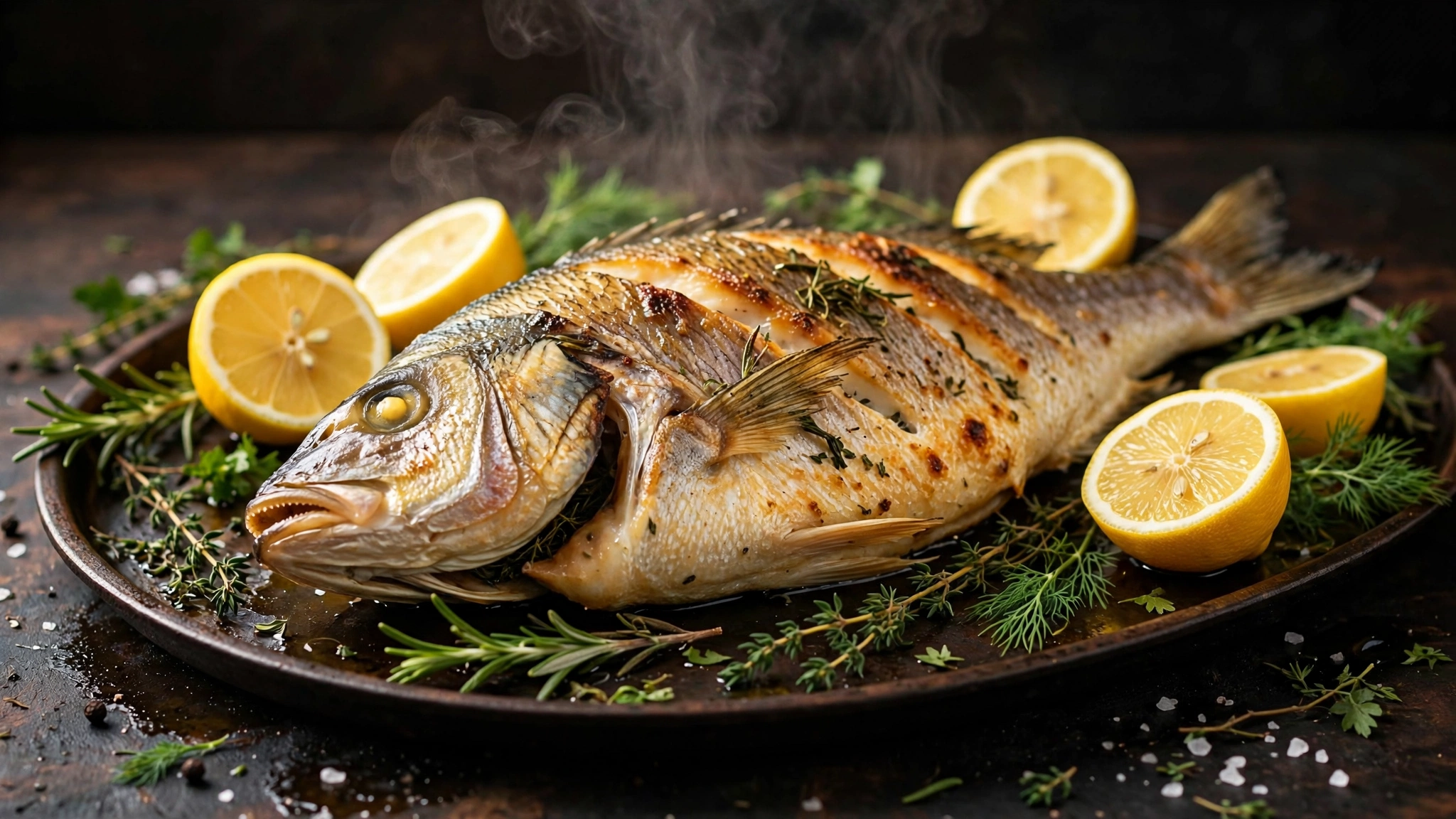
Mediterranean Baked Fish: Greek and Italian Styles
Of all the fish cooking I have borrowed from other people’s tables, the Mediterranean whole-fish bake feels most like home to me. Not because the flavours are mine — they are not. Because the discipline is the same one my kitchen runs on: buy a good whole fish, do very little to it, and let freshness do the talking.
I am Wasim Abbas Bhatti, the Fish’s Chef, and this guide sits inside Fish Recipes from Around the World, Mahigar’s world-cuisine hub. My honest place in it: I am a home cook who learned this style at my own stove, not a Greek or Italian insider. Those kitchens have their own dishes and their own arguments, and I will not invent recipes I have not been taught. What I can teach properly, from my own hands, is the shared whole-fish method underneath both styles.
Table of Contents
Greek and Italian: Two Names, One Shared Instinct
Let me draw the distinction at the level a home cook can honestly use, and no further.
Greek and Italian fish cooking both start from the same instinct: the fish is the dish. Both kitchens are known for serving fish whole and simply treated, with olive oil, lemon, and fresh herbs supporting the fish instead of covering it. Learn whole-fish baking once, and you are standing in both kitchens at the door.
Where they part — named dishes, local habits, what a harbour town does differently from an inland one — is real regional detail, and real detail needs real research, not a guess from me. On this page I stay at the level I can stand behind: whole fish, simple seasoning, an honest bake, and a proper doneness check. For tonight’s dinner, the shared instinct is enough — it is also the part that decides whether the plate succeeds.
Choosing the Fish: Whole, Fresh, the Right Size
This style begins at the counter, and it begins whole.
Buy whole fish. A whole fish gives you the truth at the counter — clear eyes, clean gills, tight shining skin, a smell like sea water — and it gives you protection in the oven, because skin and frame keep the flesh moist while it bakes. Fillets can be baked this way too, but the whole fish is the heart of the style, and it is the more forgiving cook.
Choose fish that suit whole baking. Gentle, clean-tasting whole fish are the classic fit. Branzino — the European sea bass — is the whole-roast fish I reach for most in this style; my full profile is Branzino: How to Buy and Cook European Sea Bass. A fresh whole sea bass belongs in the same conversation; the wider “sea bass” label covers different fish in different markets, so ask what fish it is and buy by freshness, as I teach in Sea Bass: How to Buy and Cook It Well.
Match sizes, and buy fresh. Fish of similar size finish together; a big fish beside a small one means one dries while the other is still raw near the bone. And freshness is the first ingredient: bright eyes, clean gills, flesh that springs back, no sour smell. Simple seasoning forgives nothing — there is no sauce to hide behind.
Prep: Scale, Gut, Score, Dry
Everything that matters happens before the oven, calmly, at the board.
Scale the fish and gut it cleanly. Rinse it, then do the step home cooks rush: dry the skin very well, inside and out. A wet fish steams in the tray; a dry one bakes with its skin turning lightly golden and its flesh staying clean. Every one of those board skills — scaling, gutting, rinsing, drying — is walked step by step in Fish Prep and Butchery: Every Skill You Need.
Score shallowly. A few shallow cuts along the thick part help heat reach evenly and give seasoning somewhere to sit — never so deep that the flesh opens up and dries. And remember the honest whole-fish rule: the frame lifts out after cooking, but small bones can still hide in the flesh, so an adult should check children’s portions piece by piece.
Season simply, and late. Olive oil, lemon, fresh herbs, and salt are the general Mediterranean habits I borrow — a short list, used with a light hand, put on near cooking time so the surface stays dry. I am giving you the habit, not a formula: how much of each is your kitchen’s hand, learned by cooking.
My Mediterranean Whole-Fish Bake Sequence
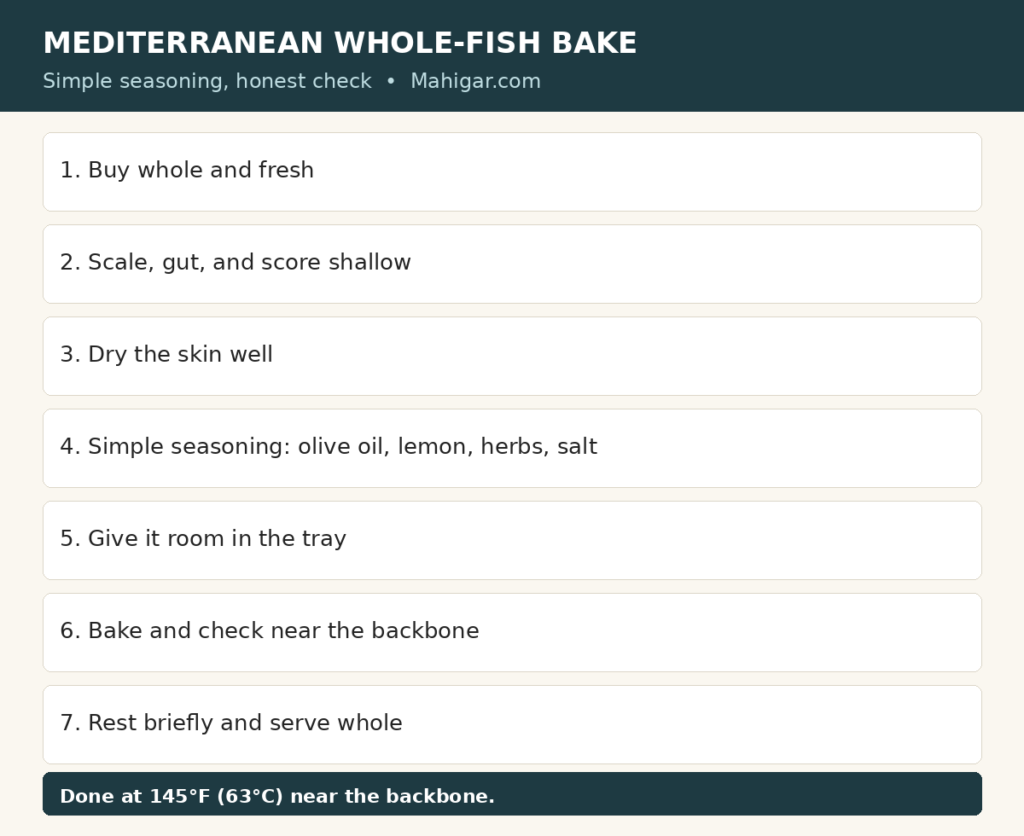
Seven simple steps for baking a whole fish.
Buy whole and fresh
Pick a fresh fish that fits your tray.
Scale, gut, and score shallow
Clean it and make shallow cuts.
Dry the skin well
Pat it dry inside and out.
Season simply
Use oil, lemon, herbs and salt lightly.
Give it room in the tray
Leave space; bake in one layer.
Bake, and check near the backbone
Check thick flesh by the bone.
Bring it to the table whole
Rest briefly and serve whole.
That sequence is the whole dish. There is no hidden step, and that is the point of the style: the fewer things between a good fish and the table, the better the fish tastes.
The Doneness Check: Near the Backbone, Always
Whole fish fools cooks who judge by the surface. Golden skin can hide a raw centre, and a pale fish can be perfectly done. There is one honest place to check: the thickest part of the flesh, right down where it meets the backbone.
The anchor does not change with the cuisine. Fin fish is done at 145°F (63°C) in the thickest part, or when the flesh is opaque and flakes easily — near the backbone on a whole fish. If you use a thermometer, slide it into that thick flesh by the bone. If you do not, lift the flesh gently at the thickest part and look: opaque and just separating into flakes means serve it; still glassy and translucent means it needs a little more heat. The full chart and the no-thermometer method live in Safe Internal Cooking Temperatures for Every Type of Fish.
Thickness, not the clock, runs this dish. A thick whole fish and a thin one will never finish together, and no recipe’s minutes can know your oven or your fish. Check the fish, not the timer.
Serving the Whole Fish
Serve it whole, on the tray or a warm plate, and let the table see what they are eating: lemon at the side, fresh herbs, and simple things beside it that catch the juices rather than compete with clean flesh.
Work from the top side first, then lift the backbone out and take the lower flesh, checking each section with a fingertip as you serve. Eat it promptly — a baked whole fish waits for nobody, and its quiet magic is in the first minutes.
What to Avoid
Crowding the tray. Fish piled together steams in its own liquid. One layer, with room, or bake in two trays.
Wet skin. It is the single most common reason a baked whole fish tastes plain. Dry it like you mean it.
Heavy seasoning to “make it interesting.” In this style, interest comes from the fish. If the fish needs hiding, it was the wrong fish.
Judging by colour or by the timer. Golden skin lies, pale skin lies, and minutes know nothing about your fish. Check near the backbone.
Rough handling after cooking. A whole baked fish is delicate. Lift it with two wide spatulas or serve it from the tray; do not drag it across a plate and break the plate’s centrepiece before anyone eats.
Frequently Asked Questions
What is the difference between Greek and Italian baked fish?
Both share whole fish with oil, lemon and herbs; local dishes differ by place.
What fish is best for Mediterranean baking?
Fresh whole fish with gentle flesh; choose by freshness, not label.
How do I know a whole baked fish is done?
Check thick flesh by the bone; it should be opaque and flake.
Can I bake fillets this way instead of a whole fish?
Yes; dry well, season simply and check early, as fillets dry faster.
What to Check Next
Start with the fish itself: my Branzino profile for the whole-roast fish this style loves, and Sea Bass: How to Buy and Cook It Well for buying that wider market label honestly. Keep the Prep pillar open while you scale, gut, and score, and the temperature guide open when the tray comes out of the oven.
Then come back to the hub and pick the next kitchen. The flavours will change completely. The rules — fresh fish, dry surface, room to cook, one honest check — will not change at all.
