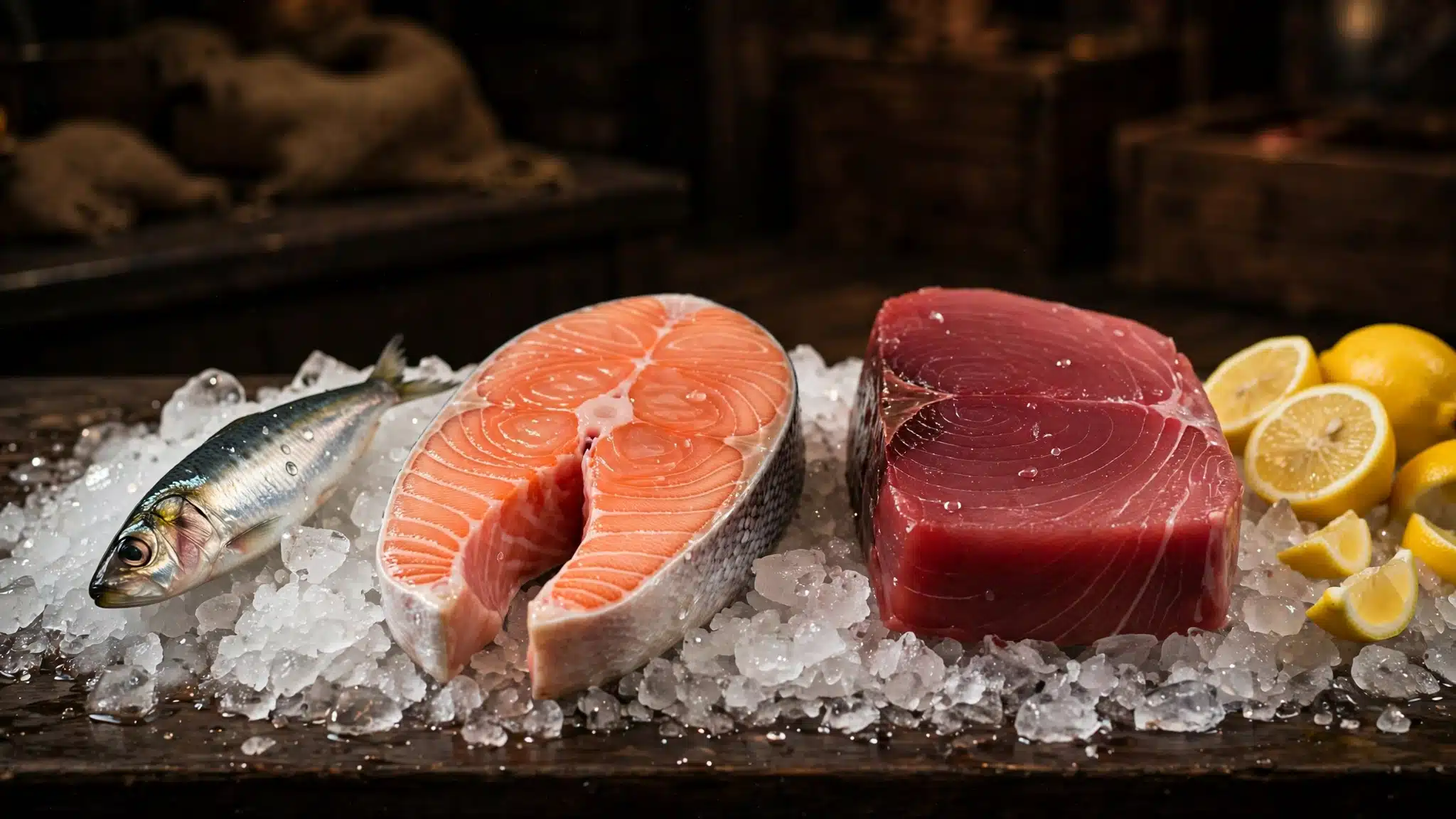
Mercury in Fish: Safe Levels by Species
The safest fish to eat often are the small, short-lived ones — salmon, sardines, tilapia, catfish, cod, and canned light tuna — which the FDA and EPA put in their “Best Choices” group at 2 to 3 servings a week. The fish to avoid completely are the big predators: shark, swordfish, king mackerel, marlin, orange roughy, bigeye tuna, and tilefish from the Gulf of Mexico. Mercury is not about fresh versus spoiled. It builds up in the fish over its life, so the species you choose matters more than anything you do in the kitchen. I have cooked fish for more than twenty years, and this is the one safety topic where I follow the official chart instead of my own habit. For the complete safety picture this belongs to, see Fish Storage and Food Safety: The Complete Guide.
This article is general information, not medical advice. If you are pregnant, breastfeeding, feeding young children, or have a health condition, follow the FDA/EPA advice below and talk to your doctor about your own situation.
Table of Contents
Why Some Fish Carry More Mercury Than Others
Almost all fish contain some mercury. It gets into water from nature and from industry, changes into methylmercury, and moves up the food chain. Small fish eat a little. Bigger fish eat many small fish. The biggest predators live long and eat other fish their whole lives, so mercury builds up in their flesh. A sardine lives fast and stays small, so it collects very little. Small and short-lived usually means lower mercury; large, old, and predatory usually means higher mercury. You cannot wash, trim, or cook mercury out of a fillet. Mercury sits in the flesh itself. Choosing the right species does the work that cooking cannot.
The FDA/EPA Chart, in Plain Words
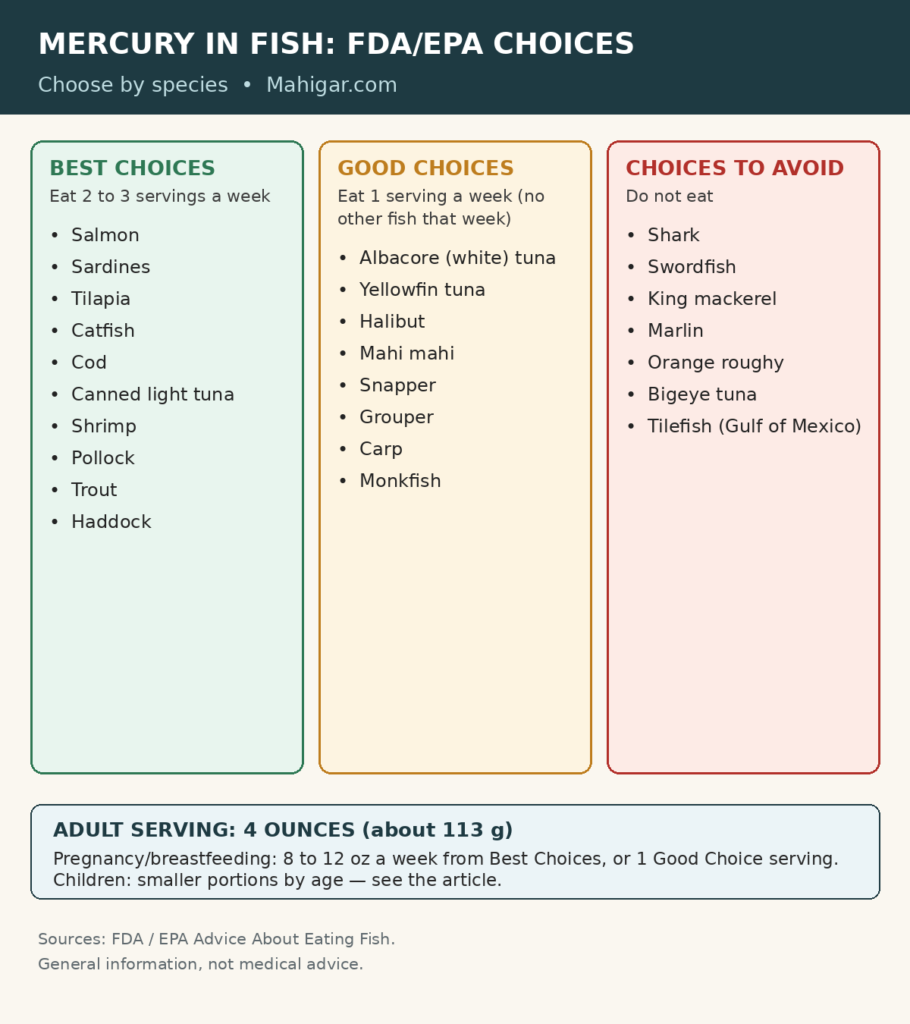
The FDA’s Advice About Eating Fish, built with the EPA, sorts fish into three groups by mercury level. This advice was written for people who might become pregnant, are pregnant, or are breastfeeding, and for children — but the FDA says everyone can follow it. The EPA’s fish advice page carries the same chart.
| Category | How Often | Fish |
|---|---|---|
| Best Choices (lowest mercury) | 2 to 3 servings a week | Salmon, sardines, tilapia, catfish, cod, canned light tuna, shrimp, pollock, trout, haddock, flounder, sole, Atlantic mackerel, anchovies |
| Good Choices | 1 serving a week — and no other fish that week | Albacore (white) tuna, yellowfin tuna, halibut, mahi mahi, snapper, grouper, carp, monkfish, Chilean sea bass |
| Choices to Avoid (highest mercury) | Do not eat | Shark, swordfish, king mackerel, marlin, orange roughy, bigeye tuna, tilefish (Gulf of Mexico) |
- Tuna is not one fish — canned light tuna is a Best Choice, albacore/yellowfin are Good Choices, bigeye is avoid.
- Mackerel is not one fish either — Atlantic mackerel is a Best Choice, king mackerel is avoid.
- A serving for an adult is 4 ounces, roughly the size of your palm.
If You Are Pregnant, Breastfeeding, or Feeding Children
Pregnancy and breastfeeding: eat 2 to 3 servings a week from Best Choices (4 ounces each, 8 to 12 ounces total), OR 1 serving a week from Good Choices — and no other fish that week. Do not eat Choices to Avoid.
Children: 2 servings a week from Best Choices, smaller portions: about 1 ounce ages 1 to 3, 2 ounces ages 4 to 7, 3 ounces ages 8 to 10, 4 ounces age 11+. Do not feed children Choices to Avoid.
Fish caught by family or friends: check your local fish advisory first. If there is no advisory, FDA says eat only one serving and no other fish that week. This is general information from FDA and EPA, not personal medical advice.
What About Our Local Fish? Rohu, Catla, Pangasius
The FDA/EPA chart is built for the US market. It lists tilapia and catfish as Best Choices, and carp as a Good Choice. Rohu is a carp, so the carp placing is the closest official guide — I do not have an FDA mercury number for rohu by name, and I will not invent one. Catla and pangasius (basa) are not named on the FDA/EPA chart. Pangasius is farmed, fast-growing, non-predatory — the profile that usually carries less mercury; catla can grow large and live long — the profile to be more careful with. For pregnant readers and young children, lean on the named Best Choices like tilapia and catfish, and treat unlisted large local fish as occasional food in smaller portions. That is less neat than a full table for every local species. It is also the truth.
Mercury Is Only One of Three Safety Checks
First it has to be fresh and stored correctly — the five signs in How to Tell If Fish Has Gone Bad catch spoilage. Second it has to be cooked properly — use the 145°F rule in Safe Internal Cooking Temperatures for Every Type of Fish. At the shop, the freshness check in How to Tell if Fish Is Fresh: The Buyer’s Checklist helps you pick the best fish in front of you.
Frequently Asked Questions
Which fish have the lowest mercury?
FDA/EPA Best Choices: salmon, sardines, tilapia, catfish, cod, canned light tuna, shrimp, pollock, trout, haddock, flounder, sole, Atlantic mackerel, anchovies. 2 to 3 servings (4 ounces each) a week for sensitive groups.
Which fish should I avoid completely because of mercury?
Shark, swordfish, king mackerel, marlin, orange roughy, bigeye tuna, tilefish from the Gulf of Mexico.
Can cooking or cleaning remove mercury from fish?
No. Mercury is stored in the flesh, so cooking, trimming skin, or removing fat does not reliably lower it. Control it at the shop by choosing lower-mercury species.
Is canned tuna safe to eat every week?
Canned light tuna is a Best Choice at 2 to 3 servings a week. Albacore (white) is a Good Choice — 1 serving a week, no other fish that week. Bigeye tuna is on the avoid list. General information, not medical advice.
What to Check Next
Mercury is decided at the shop, not in the pan. Pair this guide with the buyer’s freshness checklist before you buy, the spoilage check before you cook, and the temperature guide at the stove — all inside the pillar guide.
Sources: U.S. FDA Advice About Eating Fish; U.S. EPA EPA-FDA Advice about Eating Fish and Shellfish. General information, not medical advice.
