Pomfret: How to Buy and Cook This South Asian Favorite
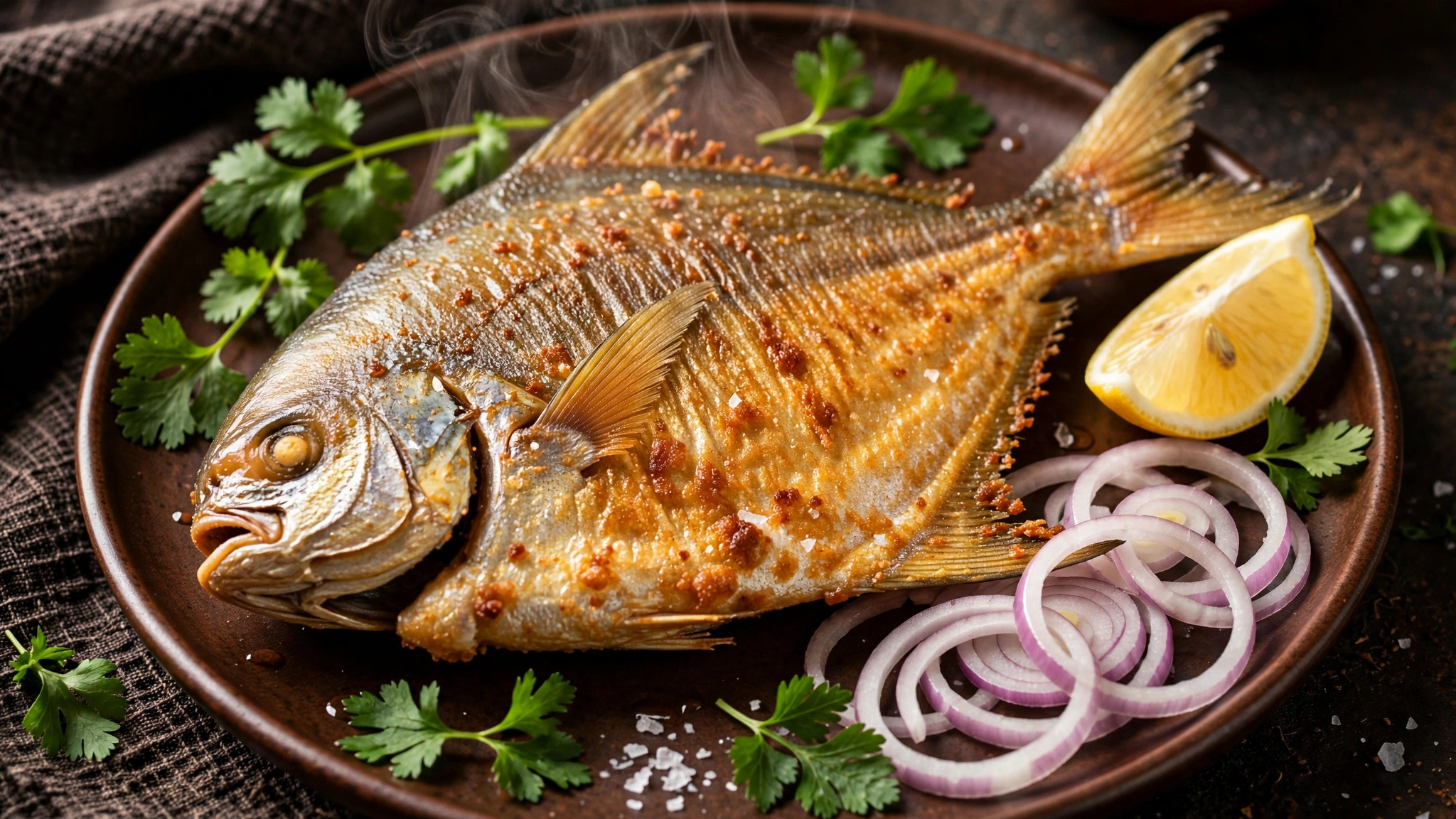
Pomfret is the fish that arrives whole and leaves the table clean. Flat, silver, and thin, with sweet flesh that flakes in soft sheets, it needs almost nothing done to it — buy it bright, dry it well, fry it once, and serve it with lemon. Handle it kindly and few fish taste cleaner.
I am Wasim Abbas Bhatti, the Fish’s Chef. Pomfret is home ground for me, the fish I meet in our South Asian markets and cook for family who want a whole fish without a fight. This profile sits inside Fish Species Guide: What to Buy and How to Cook Each One, where species are matched to the jobs they do best. Pomfret’s job is the gentle whole fish.
Table of Contents
What Pomfret Is Like
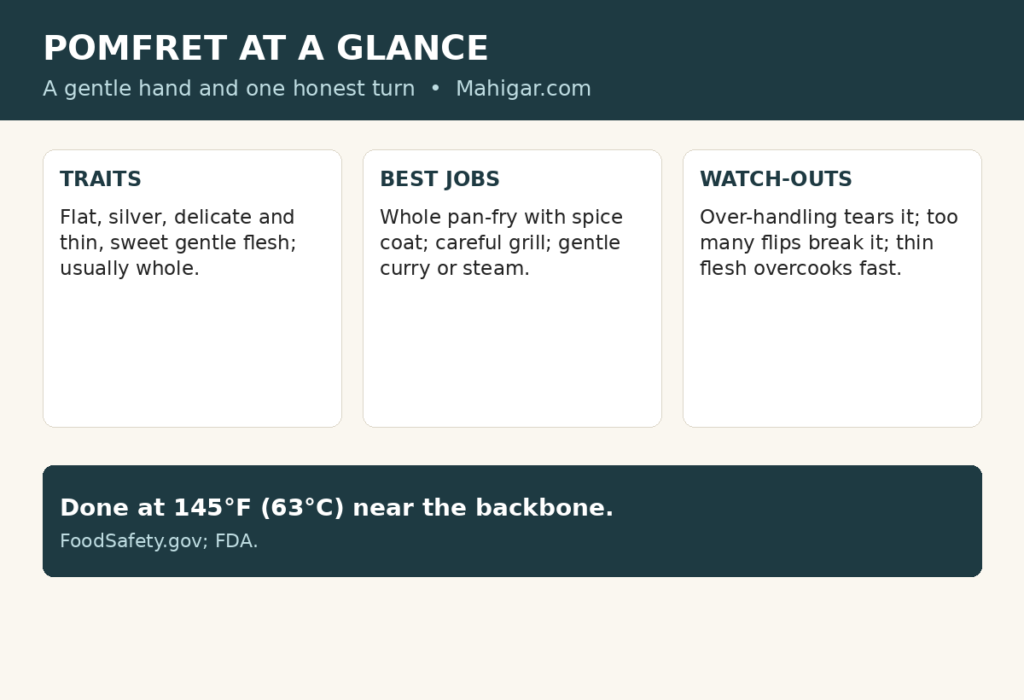
Pomfret is built flat and wide, so even a good-sized fish stays thin. The flesh is white, sweet, and delicate — softer than rohu, gentler than snapper — and it cooks fast because there is never much thickness to heat through.
You will usually meet it whole. That is how it should be bought and cooked: whole, in a pan, with the skin taking a spice coat and the flesh steaming gently inside it. Fillets exist, but a fish this thin gives up its best quality when cut down. Buy the whole fish; it is the honest form.
On flavour, pomfret asks for restraint. Salt, turmeric, chilli, a little garlic, lemon at the end — the fish itself does the rest.
Buying Pomfret in a South Asian Market
Pomfret tells you its freshness on its skin. A fresh fish is bright silver, shining like it just left the water. Dull, grey, or yellowed skin is the fish telling you it has been waiting; patches of damage or torn skin say it was handled hard or stored badly. Walk past those.
Eyes should be clear and bright, not cloudy or sunken. Gills should look clean and red. The flesh is naturally soft, so judge it gently: it should feel firm for a pomfret and spring back lightly, not stay dented, and never feel slimy.
Smell settles it. Fresh pomfret smells mild and clean, like sea water. A sour, heavy, or fishy smell means choose another fish; no spice coat fixes an old pomfret, because its gentle flesh shows tiredness first.
Buy from the counter that turns over fast, and buy fish that look alike in size if you are cooking more than one, so they finish together.
Bones, Skin, and Gentle Prep
Pomfret is kinder at the table than rohu. It has one central frame, and once cooked, the flesh lifts away in soft sheets from the backbone. There is no spread of fine Y-bones through the flesh to hunt for, which is why families serve pomfret to guests who worry about bones.
Kinder does not mean careless. Small bones sit along the edges and near the belly, so an adult still checks a child’s portion on a spare plate before serving, the same honest habit as with any whole fish.
The skin is thin and delicate. Pomfret carries only very fine scales, so it does not ask for the heavy scaling routine a carp does. The prep is the Prep pillar’s ground — gut and clean, rinse cold, pat very dry — and Fish Prep and Butchery: Every Skill You Need walks every step. Two habits matter most: dry the skin well, because surface water makes it steam instead of crisping; and make your cuts shallow if you score it, because the flesh is thin and deep cuts tear it in the pan.
Best Ways to Cook Pomfret
Whole pan-fry: the classic
This is pomfret’s lead job. A dry, seasoned fish, a flat spice coat, hot oil, one layer, one careful turn. The skin turns golden, the flesh stays sweet, and lemon and sliced onion at serving finish it. My routine is below.
Careful grill
A whole pomfret grills well if the grate is clean, oiled, and hot, and you turn it once or not at all. A grill basket helps. Do not chase char on a fish this thin; look for opaque flesh and skin that releases.
Gentle curry or steam
For a lighter plate, pomfret takes a gentle curry — sauce built first, fish laid in at the end, no stirring — or a simple steam with ginger and herbs. What pomfret never wants is a long, hard boil.
My Whole Pomfret Pan-Fry Routine
Start with a bright fish
Shining silver skin, clear eyes, mild clean smell. If it looks dull or smells heavy, choose another fish.
Clean and dry
Gut, clean, rinse cold, then pat very dry, skin and cavity both.
Season simply
Salt, turmeric, chilli, a little garlic — a thin coat, not a crust that hides the fish.
Hot pan, thin oil
Heat the pan first, then the oil, and lay the fish away from you in one layer.
Leave it alone
Let the first side set and turn golden. Do not push it around.
One careful turn
Slide a wide spatula under the whole fish and turn it once, gently.
Check near the backbone
Done at 145°F (63°C), or opaque and flaking. Rest a moment, then lemon, onion, and herbs.
The Safety Frame: Mercury and Doneness
On mercury, I give pomfret the same honesty as every fish here. The FDA/EPA chart does not name pomfret, and I will not assign it a category or a number I do not have. The official chart, its species groupings, and its guidance for pregnancy and children are in Mercury in Fish: Safe Levels by Species. Read that before building anyone’s weekly habit.
Doneness needs a kind word too. Like every fin fish, pomfret is done at 145°F (63°C) in the thickest part, near the backbone on a whole fish, or when the flesh is opaque and flakes easily, as the full chart in Safe Internal Cooking Temperatures for Every Type of Fish sets out. A pomfret is thin, so it reaches that point quickly — start checking early, and remember the flesh at the backbone is the last place to turn opaque.
What to Avoid With Pomfret
Do not over-handle it. Every extra lift, flip, and prod is a chance to tear a fish that was only asking for one turn. Do not flip it again and again to check the colour; check the backbone flesh once, with care.
Do not overcook it. Thin flesh goes from sweet and moist to dry in a very short window, and a pomfret left in the pan while you prepare the plates is already past its best.
And do not buy a dull fish because it is cheap. A delicate fish has nowhere to hide tiredness; the discount costs you the whole dish.
If Pomfret Is Not Available
Choose by job. For a gentle whole fish, sea bass or branzino is the nearest stand-in — the same careful whole cooking, the same clean plate.
Where the table wants mild fillets, tilapia is the honest swap: quicker, bone-kinder pieces for a family pan, less delicate than pomfret but in the same gentle spirit. I would not swap in a bony carp and call it the same meal; rohu is a fine fish, but a different contract at the table.
Frequently Asked Questions
Does pomfret have a lot of bones?
No. One central frame, and flesh that lifts away in sheets once cooked. Small edge and belly bones remain, so an adult checks children’s portions — but pomfret is far kinder than fine-boned fish like rohu, and it is the whole fish I serve nervous guests.
What is the best way to cook pomfret?
Whole in a pan. Dry, seasoned fish, a thin spice coat, hot oil, one careful turn, lemon and onion at serving. Grilling gently and laying it into a light curry at the end are the other honest ways. All of them share one rule: do not handle it more than the method needs.
How do I know if pomfret is fresh?
Look at the skin first: bright, shining silver. Then clear eyes, clean red gills, flesh that springs back lightly, and a mild, clean smell. Dull, grey, or yellowed skin, cloudy eyes, or a heavy smell mean choose another fish.
How do I know when pomfret is done?
At 145°F (63°C) near the backbone, or when the flesh there is opaque and flakes easily. Pomfret is thin, so it gets there fast — start checking early rather than giving it extra time to be safe. Extra time is exactly what dries it.
What to Check Next
Keep the pomfret order beside the stove: brightest fish at the counter, dry skin, simple seasoning, hot pan, one turn, off at done. Choosing from the whole counter tonight? Go back to the Species Guide and read the five traits. Pomfret is the flat, silver, delicate one; cook it like you know that.

One Comment