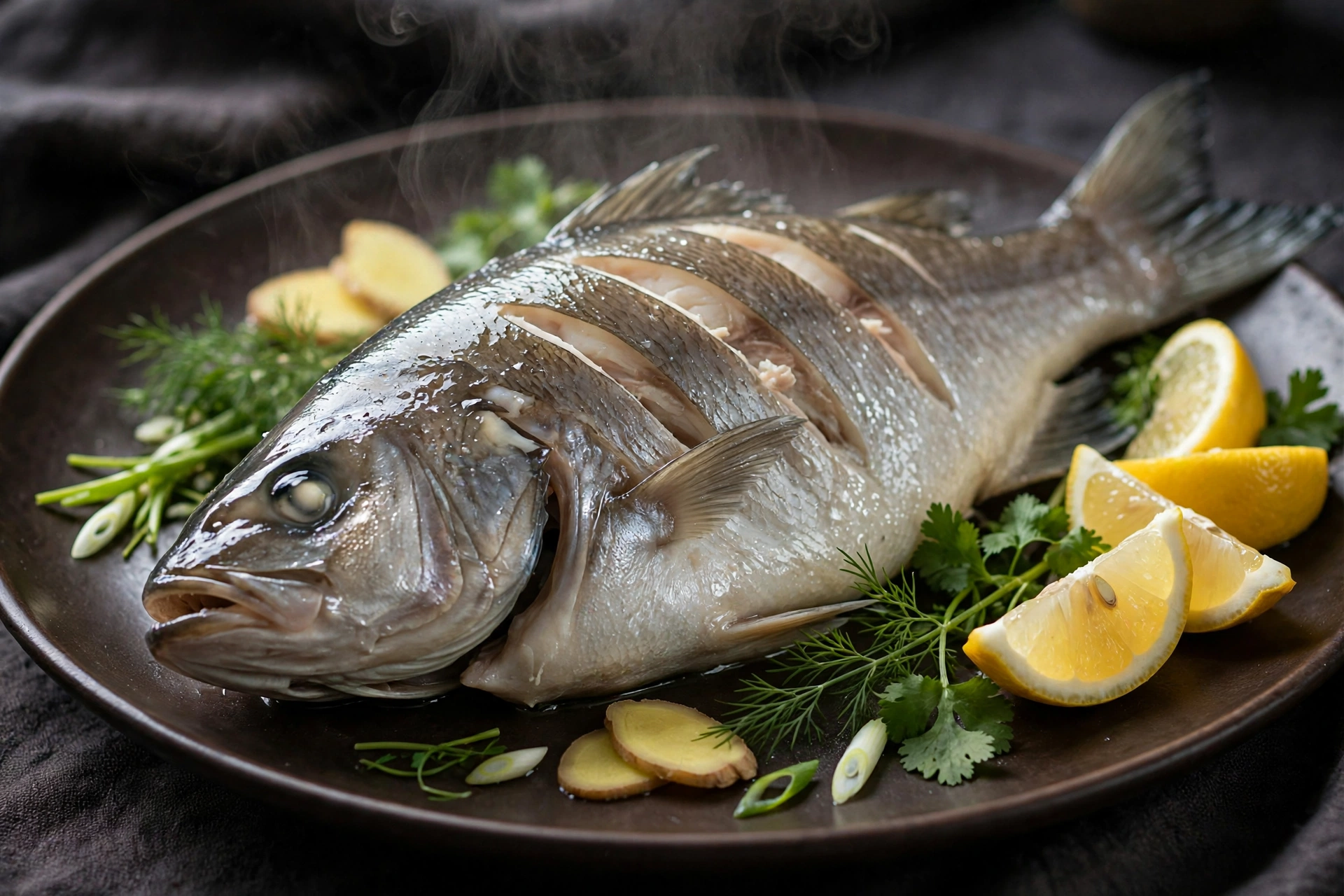
Chinese-Style Steamed Fish Guide
You want to steam a whole fish the Chinese way, but every recipe hands you a different number of minutes, and none of them knows your fish. I have watched cooks follow those borrowed minutes to watery, overcooked fish too many times. Here is the truth I steam by: minutes lie, because thickness, the steamer, and the fish itself change everything. The only honest timer is a check near the backbone.
On this page I teach you my whole-fish steaming method the way I learned it in my own kitchen: how I choose the fish, the calm board work the steam depends on, my seven-step sequence with no invented minutes, and the one backbone check that decides the plate. Steaming is the quietest way I know to cook a whole fish, and the least forgiving of carelessness. There is no crust to hide behind, no sauce thick enough to cover a mistake. The fish arrives almost as it was: skin glossy, flesh soft, flavour clean. When steamed fish is right, you taste the fish itself, which is exactly why the fish has to deserve it.
I am Wasim Abbas Bhatti, the Fish’s Chef. Chinese cooking is not my home ground, and I will not pretend to training, travel, or family knowledge I do not have. I am a fish cook with more than twenty years at the stove who learned this gentle method the way home cooks learn it: by steaming whole fish in my own kitchen and watching what the steam rewards and what it punishes. This guide sits inside Fish Recipes from Around the World, Mahigar’s world-cuisine hub.
Table of Contents
Why Steam Punishes a Careless Cook
Steam looks easy. Water boils, fish sits above it, dinner happens. That is the trap, and I fell into it myself when I started.
Steam is gentle, but it is honest. It will not brown a wet surface dry for you, and it will not rescue a tired fish with crisp edges. I have learned that a crowded steamer gives uneven cooking: the part wrapped in its own cold steam lags while the rest races ahead. A fish lifted and poked every minute loses its heat and its dignity together. And a fish left sitting in the steamer “to keep warm” keeps cooking until soft flesh turns to cotton. I do not do any of those things anymore.
What I do instead is the opposite of drama: fresh fish, calm board work, room around the plate, a lid that stays on, and one proper check near the backbone. Learn that from me, and steaming becomes the method you trust with your best whole fish.
Choosing the Fish: Whole, Fresh, the Right Size
This style begins whole, and it begins at the counter. I buy the fish the way I am about to cook it: whole.
I buy a whole fish. Steaming is a whole-fish method at heart. Skin and frame protect the flesh from the steam’s direct push, the fish cooks evenly around its own shape, and it arrives at the table looking like what it is. I have steamed fillets too, gently and in even pieces, but the whole fish is the teacher here, and it is the teacher I recommend.
Freshness is my first ingredient. Gentle cooking hides nothing, so I buy the fish I would be proud to serve almost plain. Bright, clear eyes. Clean red gills. Tight, shining skin. Flesh that springs back when I press it, and a smell like cold sea water: nothing sour, nothing heavy. If a fish fails my checks, no aromatic finish will save it, and I know steaming will show the fault faster than any other method I use.
I size for my steamer, not my ambition. The fish must lie flat on its plate with room around it inside the steamer, lid closed, steam able to travel. A fish crammed against the sides cooks unevenly and is miserable to lift out. I choose a fish my equipment can hold honestly. If I am feeding more people, I steam two smaller fish rather than wrestling one giant.
Which fish? I choose mild, clean-tasting whole fish: fish whose flesh steams up soft and white and flakes in clean sections. My species-by-species matching of fish to jobs lives in Fish Species Guide: What to Buy and How to Cook Each One; on this page, my rule leads: fresh, whole, and honest thickness beats any famous name bought tired.
Prep: The Board Work My Steam Depends On
Everything gentle in this dish is decided before my water boils.
I scale the fish properly, gut and clean it, and rinse the cavity clean. I cut shallow scores along the thick parts so the heat travels evenly. Shallow is the word I live by; deep cuts tear the flesh as it cooks and let the best juices run. Every one of those board skills, taught calmly and in order, lives in Fish Prep and Butchery: Every Skill You Need.
Then I dry the fish, inside and out. A fish dripping into the steamer dilutes its own plate juices and steams in a puddle of its own making. I pat it dry, season it simply and at the last moment — I have learned that salt on wet fish left standing pulls more moisture to the surface — and I let it wait cold, never on the counter. Raw fish belongs at 40°F (4°C) or below and I use it within 1–2 days; cooked fish keeps 3–4 days in my fridge. Fish that smells sour or like ammonia, feels slimy, or stays dented when I press it goes in the bin, never into my steamer.
One more decision before the heat: the plate. I use a heatproof plate that fits inside my steamer with room around it, and I work out how I will lift that hot plate out before the fish goes on. Steamed fish is fragile. I rehearse the lift with an empty plate, and I do not call that fussiness. It is how my fish reaches the table whole.
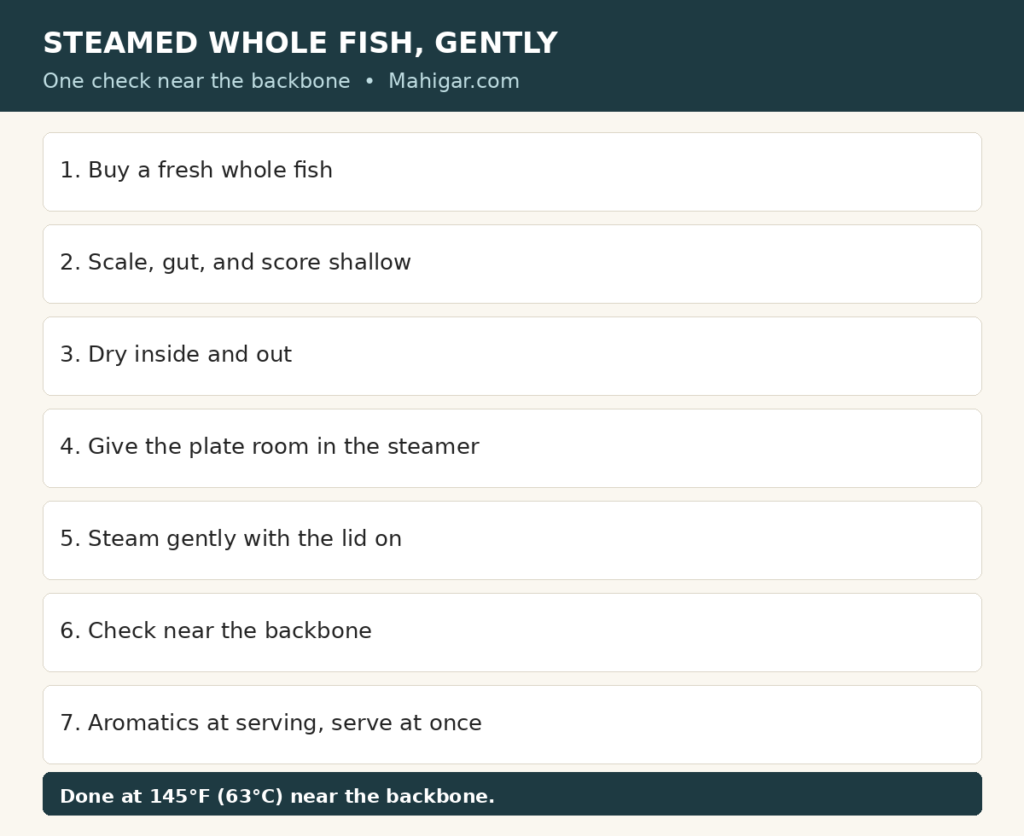
My Steamed Whole-Fish Sequence
-
I choose a fresh whole fish that fits my steamer.
Flat on its plate, room around it, lid able to close.
-
I scale, gut, and score shallow.
Clean board work, shallow scores on the thick parts only.
-
I dry inside and out, season simply, last moment.
No puddle on the plate, no long salty wait.
-
I set the plate in the steamer with room to breathe.
Steam must travel around the fish, not fight past it.
-
I steam gently, lid on.
I leave the lid alone; every peek drops the heat and stretches the cooking unevenly.
-
I check once, near the backbone.
My finish line is in the next section: I probe or peek at the thickest flesh beside the bone.
-
I finish and serve at once.
Simple aromatics over the hot fish at serving, plate straight to the table.
Notice what is missing from my steps: a number of minutes. Thickness, steamer, and the fish itself change the timing too much for a borrowed number to be honest, and I will not print one. The check decides, not the timer.
Done Means Done: The Backbone Check
My steamed fish is done at 145°F (63°C) in the thickest part, close to the backbone, or when that thick flesh is opaque and flakes easily. The full temperature chart lives in Safe Internal Cooking Temperatures for Every Type of Fish.
The backbone is where the truth lives. The tail end and the thin belly flap finish early and will happily lie to you; the deep flesh beside the spine is the last to cook. I slide a probe in beside the backbone without touching bone, or I lift a small flake there with the tip of my knife: opaque and just separating means I serve; shiny and glassy means a little more steam, lid back on, and patience.
Then I stop. Steamed fish carried past done does not announce itself with browning. It quietly goes soft, wet, and tired, and I have ruined enough fish to know the signs. I take the plate out when the check says done, even if my guests are still finding their chairs. A steamed fish waits for nobody, and honestly, neither do I.
Aromatics at Serving: My Quiet Finish
My finish for this style is simple on purpose. Once the fish is done, a small amount of fresh, bright aromatics goes over the hot fish at the table end of the cooking: fresh herbs, a little lemon, the kind of clean seasoning that perfumes rather than covers. I keep that at principle level on purpose. I will not hand you sauce ratios or a “traditional” formula I have not earned from this kitchen.
What I can tell you from my own hands is the order. Aromatics go on hot fish, at serving, never into the steamer to be boiled dull. The plate juices under a steamed fish are delicate, and I spoon them over the flesh as I serve. And my seasoning stays humble: steaming is the method that lets a good fish taste like itself, and I refuse to bury that under a loud finish and waste the whole gentle point.
At the table, I serve the fish whole and lift the flesh from the frame in clean sections. That serving skill — steady the fish, lift the top fillet, free the backbone, clear the lower fillet — deserves its own lesson, and it is the natural next read after this one: How to Debone a Whole Cooked Fish at the Table. I always check children’s portions for bones myself, whatever the fish.
Frequently Asked Questions
I buy fresh, mild, clean-tasting whole fish of an even size that fits my steamer with room around the plate. I buy by freshness first — clear eyes, clean gills, flesh that springs back — and I let the name come second.
I check the thickest flesh beside the backbone: it should be opaque, no longer shiny or glassy, and flake easily when I lift it with a knife tip. The tail and belly finish early, so I never judge by them.
In my kitchen this almost always means it went in wet, sat in its own plate juices, or stayed in the steam past done. I dry the fish inside and out, give the plate room, keep the lid on, and take it out the moment the backbone check says done.
Yes. I choose even pieces, dry them well, and give each piece room on the plate. Fillets steam fast and uneven thicknesses finish unevenly, so I check the thickest piece first and serve at once.
What to Check Next
Steam a whole fish my way once — fresh fish, calm prep, gentle steam, one honest check — and you will understand why I trust this style. Then keep travelling through the World Cuisine hub with me: the same whole-fish respect drives the Mediterranean bake, and the same gentleness drives the Japanese-style beginner page.

One Comment