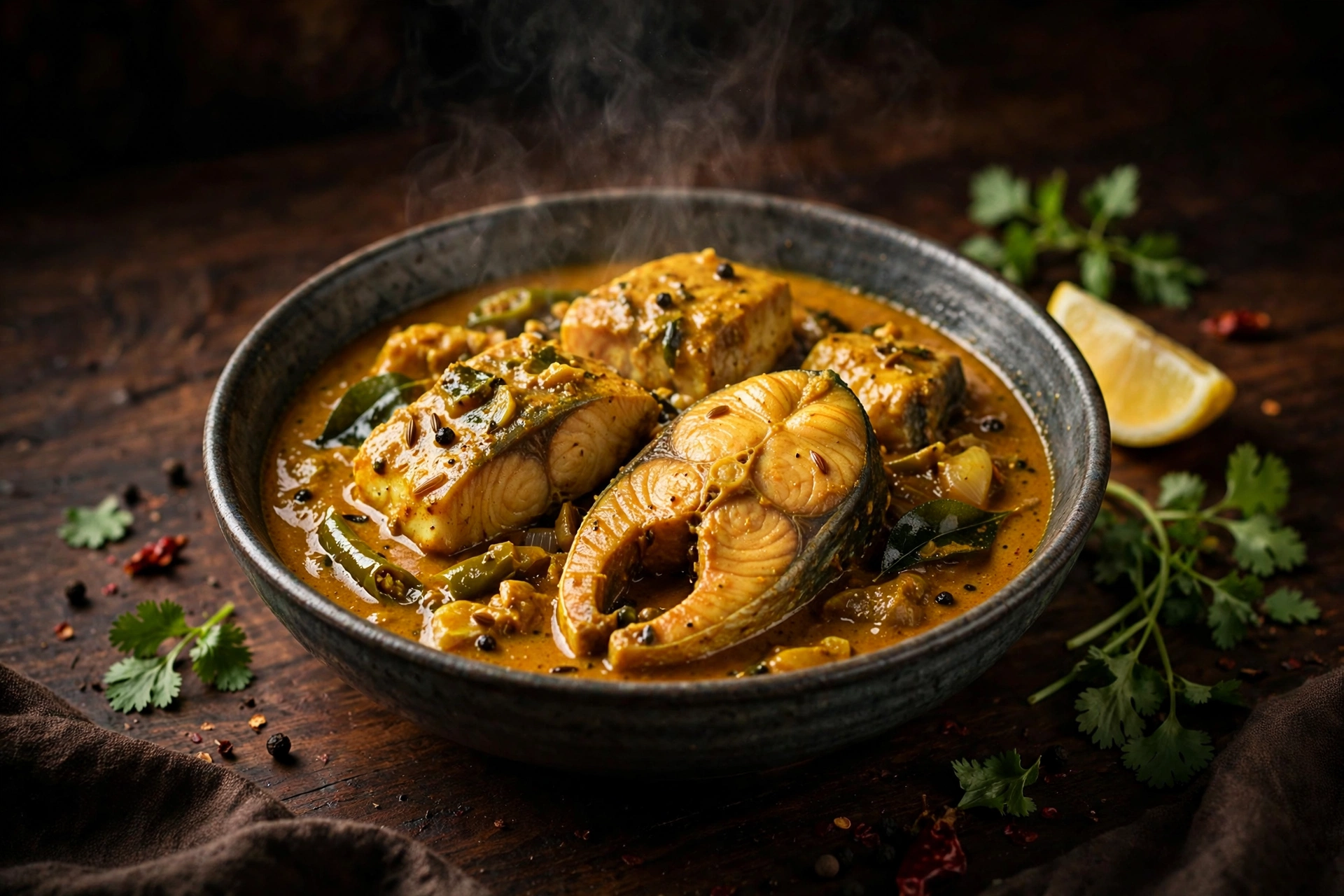
Indian Fish Curry: Regional Styles Explained
Ask ten South Asian kitchens what Indian fish curry means and you will get ten honest answers. That is not a problem to fix; it is the whole point. Indian fish curry is not one dish with one correct recipe. It is a family of regional styles, each shaped by its own water, its own markets, and its own taste, and every one of them obeys the same law of fish: choose firm pieces, add them late, handle them gently.
I am Wasim Abbas Bhatti, the Fish’s Chef, and this region is close to my home ground. The river fish of our markets, the family curry pots, and the bone-honest way we eat rohu and catla are the kitchen I grew up cooking in. This page sits inside Fish Recipes from Around the World and explains the regional styles at the level a home cook can honestly use. I will not print a borrowed recipe card and call it Bengali, Goan, or South Indian. Those kitchens earned their recipes. I will teach you their characters, then the fish discipline that works inside all three.
Table of Contents
Three Regions, Three Characters
Bengali, Goan, and South Indian fish curries differ mainly in flavour character and sauce body, while the fish handling stays the same in all three: firm pieces, added late, never stirred hard.
That one sentence is the map of this whole article. Bengali cooking is known for mustard character and proud river-fish pieces. Goan curry is known for a rich, tangy coastal pot. South Indian curries are known for sour brightness and fresh aromatics. Learn the characters and you can cook in any of the three directions tonight, without pretending to own recipes that are not mine.
Bengali Style: Mustard in the Voice, Fish in the Centre
Bengali fish curry is best understood as fish first, sauce second: river fish served in proud pieces, with mustard as the sharp, warm signature many of its kitchens are loved for.
In Bengal, fish is not an ingredient hiding in a curry. It is the centre of the meal, and pieces are meant to arrive still looking like fish, seasoned boldly but cleanly. The Bengali lesson for a home cook is confidence with strong fish: a full-flavoured river fish needs honest seasoning and a gentle hand, not rescuing. If your market fish is at its freshest and proudest, cook in this direction.
Goan Style: Rich Sauce, Bright Edge
Goan fish curry is a coastal pot: richer in body, touched with tang, and built for firm sea fish that can stand beside a fuller sauce.
The teaching here is balance. Richness without brightness sits heavy on fish, and fish under a heavy sauce disappears. A sauce with life in it lets firm flesh stay present instead of drowning. Cook this way when you want the curry itself to be the event. Just remember the shared law: the fuller the sauce, the more gently the fish must be treated, and the faster it must leave the pot once done.
South Indian Style: Sour, Bright, and Awake
South Indian fish curries lean toward clean sourness and fresh, green aromatics, often with a lighter sauce body that lets the fish taste clearly through it.
This is the style that punishes delay most. Bright flavours fade while a pot waits, and flesh keeps cooking in hot sauce. The lesson is timing and freshness together: build the sauce, add the fish late, check it early, and carry the pot straight to the table. Cook this way when you want a curry that tastes awake rather than heavy. This style hides nothing, so your fish must be at its freshest.
Choosing a Style for Tonight
Let the fish choose the style, not the other way round. Proud, full-flavoured river fish suits the Bengali direction. Firm sea fish suits the richer Goan pot. A wish for brightness suits the South Indian direction.
If your fish is delicate or thin, choose none of the three today. A borrowed regional idea never excuses breaking a fillet that wanted gentler cooking. And if the fish smells tired, stop entirely. No region on earth curries tired fish back to life. The style is chosen after the fish is in your hand, never before.
Choosing the Fish: Firm Pieces and Honest Bones
Curry fish must be firm, fresh, and cut in even pieces, because it has to survive hot sauce and still arrive at the table as a piece.
River carp like rohu is the classic family choice for our curries: firm, full-flavoured flesh that holds its shape where a delicate fillet would fall into threads. My complete guide to buying and cooking it is Rohu Fish: Buying and Cooking Guide (South Asian Staple), and it will make your curry kinder before you ever light the stove. Catla stands close beside rohu for the same work.
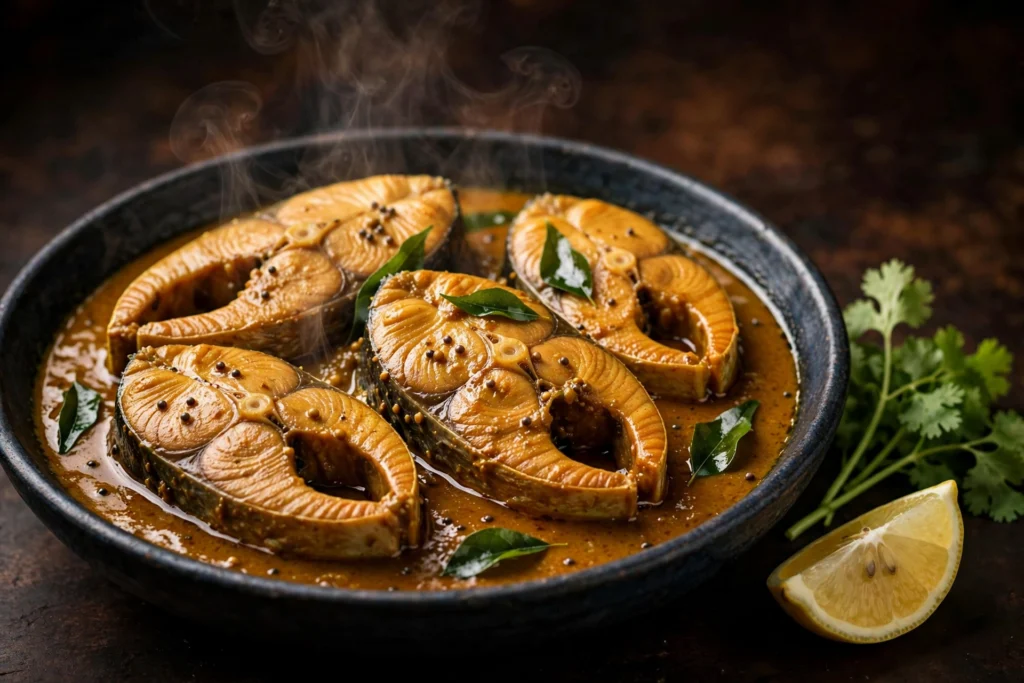
Now the honest part, because my table taught me never to skip it: bones. Rohu and catla carry fine Y-shaped bones through the flesh, and no cut, score, or sauce removes them. Serve pieces in clear sections so the bones stay visible, eat at an easy pace, and let an adult check flesh for children and for guests who did not grow up picking bones. If bones worry your table, choose a kinder fish and keep the curry idea. A nervous eater remembers nothing else about dinner.
Even pieces matter just as much. A thick steak beside a thin tail piece means one breaks while the other is still finishing. Cut close in size and the whole pot lands together.
Prep: Calm Hands Before a Hot Pot
Good fish curry is decided at the board: clean the fish properly, portion it evenly, dry the pieces, and keep them cold until the sauce is ready for them.
Scale and gut whole fish, cut steaks or fillets cleanly, and run a fingertip along every piece for pin bones. Each one of those skills, from scaling to portioning, is taught step by step in Fish Prep and Butchery: Every Skill You Need. Do this work slowly. Curry forgives many things, but it does not forgive a rushed board.
Raw fish waits at 40°F (4°C) or below and is best used within 1 to 2 days; cooked fish keeps 3 to 4 days in the fridge. Fish that smells sour, feels slimy, or stays dented when pressed goes in the bin, never in the pot. Bring the pieces out only when the sauce is built and the table is nearly ready. In curry cooking, the fish is the last guest to arrive.
My Late-Addition Curry Method
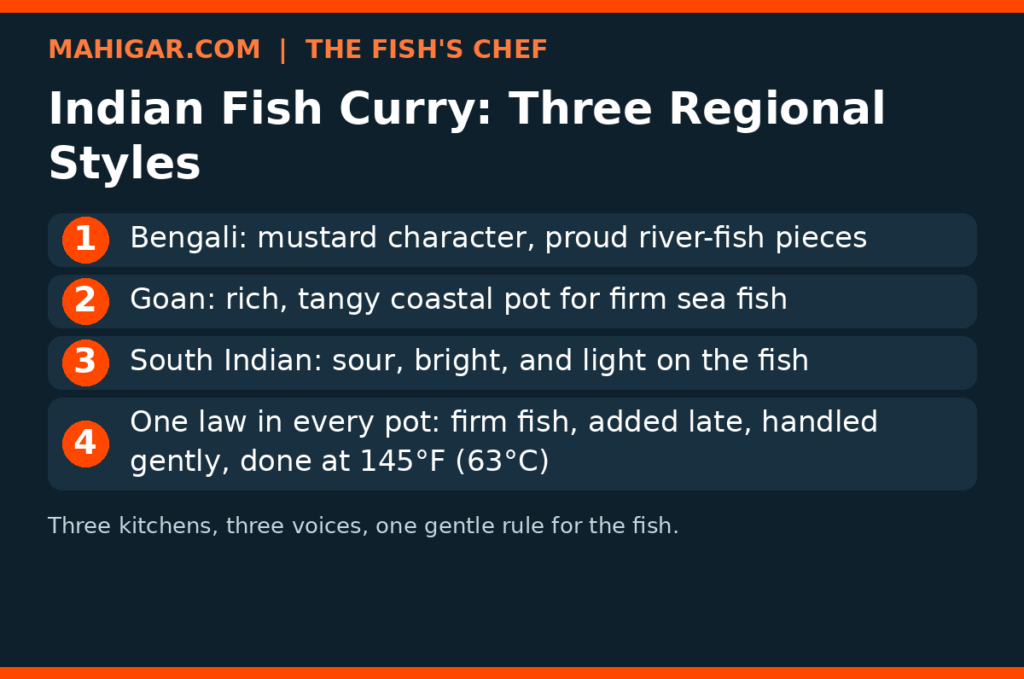
Build the sauce first, add firm fish late, poach gently, and serve at once at 145°F (63°C).
Build the sauce first
Build the sauce first, and let it become a sauce you would happily eat on its own.
Cut firm fish in even pieces
Cut firm fish in even pieces: cleaned, dried, and close in size.
Add the fish late
Add the fish late, sliding the pieces into the hot sauce in one layer where you can.
Poach gently
Poach gently. Spoon sauce over the pieces or swirl the pot; never stir fish like potatoes.
Check the thickest piece
Check the thickest piece and take the pot off the heat the moment it is done.
Serve at once
Serve at once. Fish keeps cooking in hot sauce, so the pot goes to the table, not back to waiting.
Done Means Done, In Every Region
In every regional style, fish is done at 145°F (63°C) in the thickest part, or when the flesh is opaque and flakes easily. Judge the thickest piece, never the sauce.
Hot sauce lies to you twice. It can bubble cheerfully around a centre that is still glassy, and it can keep cooking a finished piece into strings while the table is being set. Pull one thick piece, check it properly, and serve the pot the moment the fish is right. The full temperature chart for every type of fish lives in Safe Internal Cooking Temperatures for Every Type of Fish. One honest check beats ten minutes of guessing, in Bengal, in Goa, and in your kitchen.
Mistakes That Break a Fish Curry
Four habits ruin more fish curries than any missing spice ever will.
Adding the fish too early. Fish dropped into a sauce that still needs time will overcook while it waits. Sauce first, fish last.
Stirring like it is potatoes. A spoon through curry fish breaks pieces into threads. Swirl the pot, spoon sauce over, and keep your hands gentle.
Cooking tired fish under bold sauce. Strong flavour cannot hide staleness; it only dresses it. Fresh fish or no curry.
Letting the pot sit. Finished fish in hot sauce keeps cooking. Check, serve, eat. The pot that waits is the curry that disappoints.
Frequently Asked Questions
What is the main difference between Bengali, Goan, and South Indian fish curry?
Character. Bengali cooking is known for mustard-forward flavour and proud river-fish pieces; Goan curry for a rich, tangy coastal pot; South Indian curries for sour brightness and fresh aromatics. Each region holds many local dishes, so treat these as kitchen characters to cook toward, not single recipes to copy.
What fish is best for Indian fish curry?
Firm fish in even pieces that hold their shape in hot sauce. Rohu is the classic South Asian family choice, with catla close beside it. Delicate thin fillets break apart in curry; save them for the gentle pan instead.
Do I need a special curry paste or spice mix?
You need a sauce you trust, built before the fish goes in. This page teaches fish handling, not a measured regional recipe, because real regional dishes deserve their own kitchens’ knowledge. Cook the sauce your household loves, and let the method here protect the fish inside it.
How do I stop fish breaking up in curry?
Add it late, in even pieces, and do not stir hard. Poach gently, spoon sauce over the top, check the thickest piece at 145°F (63°C), and serve at once instead of leaving the pieces sitting in hot sauce.
What to Check Next
Cook one style tonight, properly, before you chase all three: sauce built first, firm fish added late, gentle hands, honest check, straight to the table. If rohu is your fish, read its full profile before you buy, because the bone honesty there will make this curry kinder for everyone eating it.
Then keep travelling. The World Cuisine hub holds a kitchen for every mood, and the fish law never changes on the journey: fresh fish, firm pieces, served on time.

One Comment