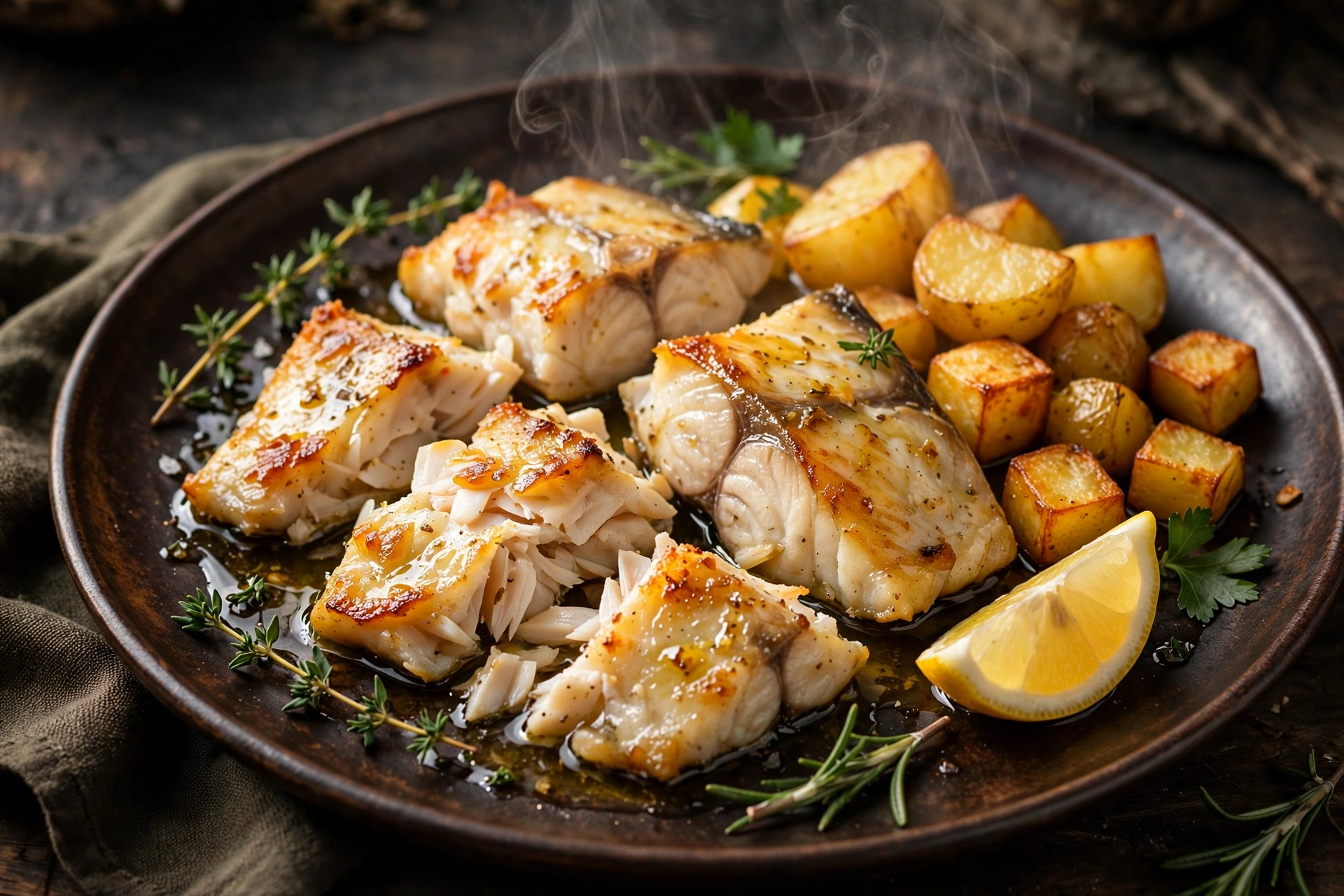
Spanish and Portuguese Fish Recipes: Bacalao and More
You bought salt cod, or you are thinking about it, and now you are stuck on the question nobody answers the same way twice: how long do I soak it? I have seen home cooks ruin good bacalao in both directions: under-soaked and harsh, or soaked to bland wool by a borrowed number of hours. Here is what I tell them, and what I do myself: no honest page can give you one universal soaking time, because thickness and the producer’s cure decide it. What I can give you is my full safe sequence: how I buy it, how I desalt it cold by the seller’s guidance, how I check the salt with a cooked taste before the batch is committed, and how I cook it gently to done.
Most fish cooking starts with a fresh fish and a hot pan. This one starts earlier, with a stiff, salt-preserved cod that cannot go near dinner until the salt has been coaxed back out of it. Bacalao is the Spanish and Portuguese way of keeping cod good for a long journey, then bringing it back to the table as tender, savoury fish. The step that decides it is the quiet one nobody photographs: the soaking.
I am Wasim Abbas Bhatti, the Fish’s Chef. Iberian cooking is not my home ground, and I will not pretend to a Spanish or Portuguese kitchen’s training. I am a fish cook learning this preserved-fish method at my own stove. What I can teach properly is the part every fish cook must respect: I buy preserved fish from a source I trust, I desalt it cold and patiently by real guidance, never by a number copied from the internet, I check the salt with my own tongue, and I cook the fish gently to a proper finish. This guide sits inside Fish Recipes from Around the World, Mahigar’s world-cuisine hub.
Table of Contents
What Bacalao Is — and What It Is Not
Bacalao is cod that has been salted and dried to preserve it. Salt draws moisture out, the fish firms up and keeps, and a kitchen far from the sea can still cook cod. Before cooking, that dryness has to be reversed: I soak the fish in water so it softens and gives much of its salt back. Only then do I cook it, gently, like the firm white fish it once was.
Two confusions are worth clearing, because I meet both at the counter. First, bacalao is not fresh cod with salt sprinkled on top. Salting a fresh fillet tonight makes salty fresh fish, not bacalao; the preserved product is its own ingredient and behaves differently in my pot. Second, desalted cod keeps a seasoned depth fresh cod does not have — that is its charm — but it punishes carelessness: under-soaked, it is harsh and tough; cooked hard after a good soak, it still dries like any white fish I push past done.
I respect it as a two-stage ingredient. Stage one is the soak. Stage two is the cooking. I have learned that rushing stage one means no sauce rescues stage two.
Buying Salt Cod: My Trusted Source, Honest Label
With preserved fish, the seller is part of my recipe. I buy salt cod from a fishmonger or reputable producer whose product is properly labelled: what fish it is, that it is salted and dried, and how they say to prepare it. A good seller tells me plainly that the fish needs soaking and gives me their guidance. That guidance is not decoration. Producers cure differently, and thickness changes everything, which is why I follow the seller’s instructions instead of printing a universal soaking time on this page.
At home, my packet should smell clean and salty: not sour, not ammonia-heavy, not off. The pieces should feel firm and dry rather than slimy. Anything that smells wrong before the soak does not get forgiven by the soak; I choose another packet. Once opened, I keep it cold: 40°F (4°C) or below is the house rule for everything fishy in my kitchen.
If my market does not sell salt cod, I do not fake it with a heavily salted fresh fillet. I cook the fresh-fish version further down this page and I call it what it is. Honest names make honest dinners.
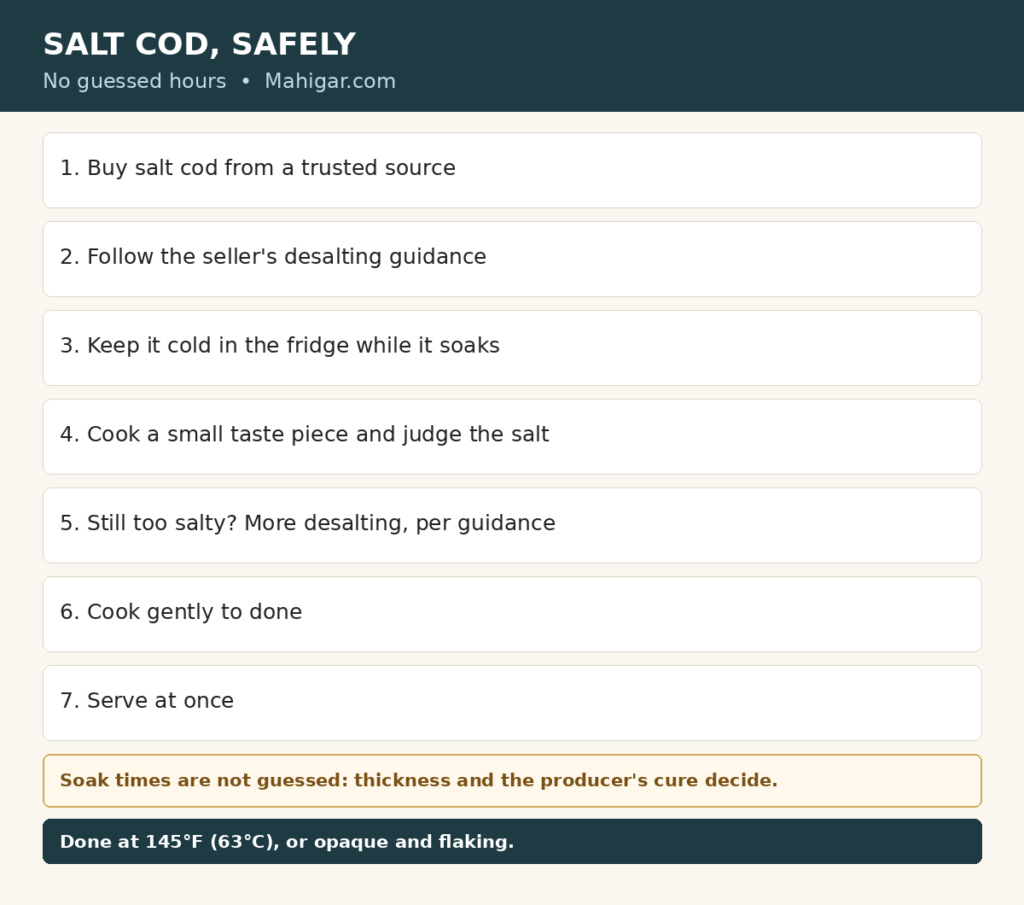
My Salt-Cod Sequence, at Principle Level
-
I buy salt cod from a trusted source.
Labelled, properly cured, with the seller’s preparation guidance.
-
I desalt it cold, by that guidance.
In my fridge, in clean water, for as long as that fish needs.
-
I cook a small taste piece.
I judge the salt before the whole batch is committed.
-
If it is still harsh, I desalt more.
Back into fresh cold water, then I taste again.
-
I portion evenly and pat dry.
Even pieces finish together.
-
I cook gently to done and serve at once.
145°F (63°C), or opaque and flaking.
The sections below walk each of those steps honestly, including why step 2 carries no number of hours from me.
Desalting: Seller Guidance, Cold Water, No Guessed Hours
Let me be clear about what depth means here. It does not mean a confident number of hours from me. No such number fits every piece of salt cod, and printing one would be the opposite of expertise. I would rather tell you the truth than hand you a number that ruins your dinner.
Thickness decides the soak: a thin piece gives up its salt far sooner than a thick loin cut. The producer’s cure decides it too. How heavily the fish was salted and how dry it was stored change what it needs to come back. A number right for one packet can leave another harsh in the middle, or turn a thin piece bland and woolly. So I follow the seller’s or producer’s desalting guidance for the exact fish I bought. Packet directions outrank every blog on earth, including mine.
My safety rules never change. I desalt the fish in the fridge, cold — 40°F (4°C) or below — in a clean covered container, never on the counter. Fish soaking in water is still fish, and I know room-temperature soaking trades a salt problem for a safety problem. I wash my hands and surfaces after handling, and I send the soak water down the sink, never reused. Ready fish should feel pliable rather than board-stiff and smell clean: gently salty, never sour.
Then comes the check no clock can do for me.
The Taste Check: Letting a Small Piece Tell Me
Salt hides inside thick fish. The outside of a soaked piece can taste mild while the centre is still fierce, and the only honest judge I trust is a cooked taste, taken before the whole batch is committed.
I cook a small piece first. I cut a modest bit from the thickest part, cook it simply until just done — the same finish as any fin fish, 145°F (63°C) or opaque and flaking, as set out in Safe Internal Cooking Temperatures for Every Type of Fish — then I taste it plain.
If the bite is pleasant and seasoned, my batch is ready. If it is harsh and makes me reach for water, it needs more desalting: back into fresh cold water in my fridge, following the seller’s guidance, and I taste again later with another small piece. If it is completely bland, I soaked past the point this time; I note it for the next packet and season the cooking gently.
This is slower than following a timer. It is also how preserved fish is judged in working kitchens: by the fish in front of me, not by a number in front of somebody else.
Cooking My Desalted Cod Gently
Once the salt is right, my bacalao asks for gentleness, not force. The flesh is firm and flakes in handsome pieces, but it has already lived one hard life in salt; a violent boil or a long, dry bake will make it tough and stringy, and I have no interest in ruining it at the last step.
At principle level, three gentle roads work for me: poach it in hot, barely-moving water or a gentle sauce; bake it in a covered tray so its own juices keep it company; or pan-cook it calmly, turned once. I deliberately give no times: thickness decides, as with fresh fish, and my finish line does not move. My desalted cod is done at 145°F (63°C) in the thickest part, or opaque and flaking easily.
Before the heat, I portion the fish into even pieces and check them for pin bones. Those skills are taught step by step in Fish Prep and Butchery: Every Skill You Need. I pat the pieces dry first; a dripping piece steams when I wanted it to cook.
I serve it as soon as it is done. Cooked fish keeps 3–4 days in my fridge at 40°F or below, reheated until steaming hot, but this dish deserves its first, best moment, and I give it that.
No Salt Cod? My Fresh White Fish Version
If bacalao is not sold near me, or tonight is not a soaking night, the gentle cooking above works beautifully with fresh firm white fish: mild fish, gentle heat, honest finish, served at once.
I choose thick, firm, mild fillets that flake in clean pieces. My comparison of the two classic white fish for jobs like this lives in Haddock vs Cod: What’s the Difference? — cod milder with bigger, softer flakes, haddock a little sweeter with finer flakes — and my rule there rules here: I buy whichever is fresher.
But I do not call the fresh version bacalao, and I do not salt a fresh fillet heavily to imitate the preserved fish. The fresh plate is its own good dinner. The name stays with the real ingredient.
Frequently Asked Questions
How long should I soak salt cod?
There is no honest single answer, and I will not invent one on this page. Thickness and the producer’s cure decide it. I follow the seller’s guidance for my exact fish, keep it in the fridge, and judge with the small cooked taste check above.
Can I desalt salt cod on the counter to speed it up?
No. I desalt mine in the fridge at 40°F (4°C) or below, always. Room-temperature soaking swaps a salt problem for a food-safety problem.
How do I know when desalted cod is cooked?
The same way as fresh fin fish: I check for 145°F (63°C) in the thickest part, or opaque and flaking easily. I serve it promptly, because gentle fish pushed past done turns tough.
Can I make bacalao by salting fresh cod at home?
Not on my guidance. Bacalao is a properly cured product I buy as such; salting a fresh fillet makes salty fresh fish, not salt cod. I buy the real ingredient, or I cook the fresh version honestly.
What to Check Next
I bring one packet of real salt cod home, desalt it cold by the seller’s word, taste a small cooked piece, and cook the rest gently to done. That patient cycle taught me more than any copied recipe. With it, the World Cuisine hub is complete: twelve kitchens, one set of rules I cook by — honest fish, the right heat, and a finish I check instead of guess.

One Comment