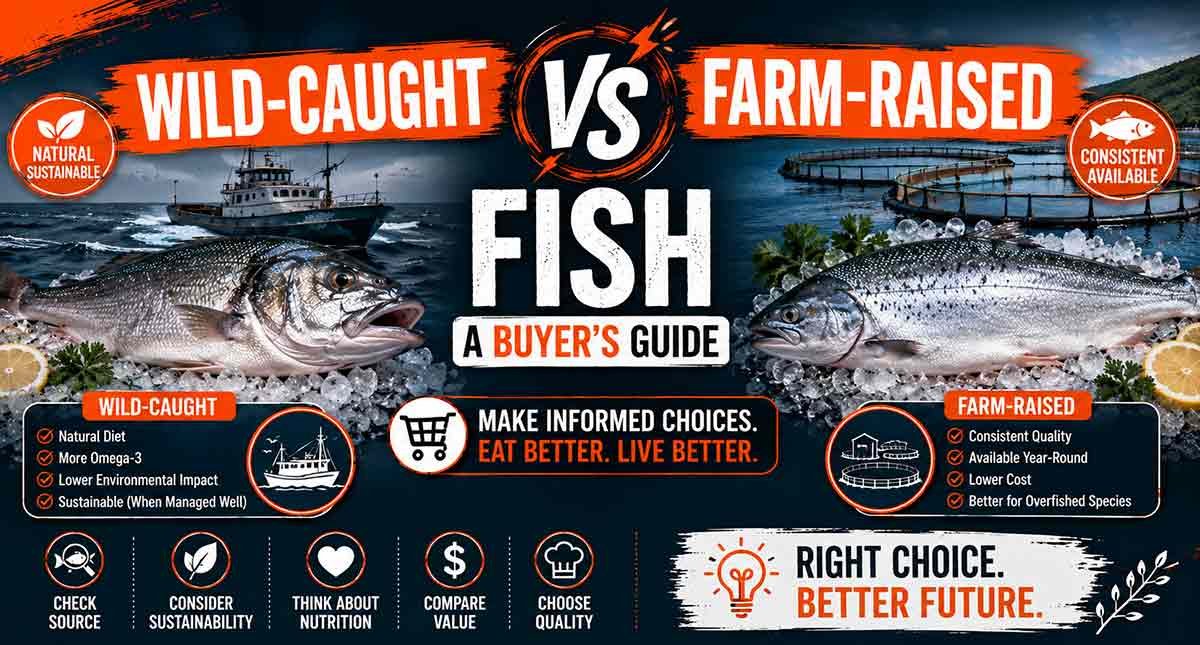
Wild-Caught vs Farm-Raised Fish: A Buyer’s Guide
Neither wild-caught nor farm-raised is automatically the better choice; the real dividing line isn’t wild versus farmed, it’s responsibly managed versus not, and both categories have genuine examples of each. A well-managed fishery and a well-run farm can both be excellent choices; an overfished stock and a poorly managed farm can both be problems, regardless of which label is on the package.
That’s a more honest answer than either side of this debate usually gives you, and it’s also more useful, because it means the real question isn’t “which type” but “how do I tell if this specific fish, whichever kind it is, was actually done responsibly.” Here’s how
Table of Contents
What’s the Real Difference Between Wild-Caught and Farm-Raised?
Wild-caught fish is taken from its natural habitat ocean, river, or lake using nets, lines, or traps. Farm-raised fish is bred and raised in a controlled environment, whether that’s ocean pens, land-based tanks, or freshwater ponds, and fed a managed diet rather than whatever it would naturally find.
That’s genuinely the whole distinction. Everything people associate with one label or the other taste, price, sustainability, nutrition comes from how that specific fishery or farm actually operates, not from the wild-or-farmed category itself. Two salmon from two different farms can be more different from each other than a wild salmon is from a farmed one.
Which Is More Sustainable?
It depends on the specific fishery or farm, and both categories carry real, different environmental costs worth knowing honestly rather than picking a side.
For wild fisheries, the core risk is overfishing, taking fish faster than populations can reproduce. Well-managed fisheries actively guard against this: more than 90% of the U.S. fish stocks that are actively monitored are not currently subject to overfishing, a direct result of regulation and monitoring, not an accident. Poorly regulated fisheries elsewhere in the world don’t have the same track record, which is exactly why where a fish was caught matters as much as whether it was wild.
For farmed fish, the core trade-off is feed and containment. Many farmed species, salmon especially, are fed diets that include wild-caught forage fish. NOAA’s own figures put it at roughly half a metric ton of wild fish to produce one metric ton of farmed seafood, a real cost even though the farmed fish itself was never caught from the wild. Open-water pen farming can also allow disease to move between farmed and wild populations nearby, by NOAA’s own account.
On the other side of that ledger, NOAA also notes that marine aquaculture generally has a smaller carbon footprint and converts feed to protein more efficiently than land animals like cattle or pigs, and farmed shellfish in particular (oysters, mussels, clams) can be genuinely low-impact. Neither list cancels the other out; they’re just the real trade-offs, and they’re specific to the species and the farm, not the category.
Does Where the Fish Was Farmed or Caught Actually Matter?
Enormously, and this matters more than the wild-versus-farmed question itself. Regulatory standards for both wild fisheries and fish farms vary hugely by country. U.S. fisheries and farms operate under some of the most closely monitored standards in the world, but that oversight doesn’t automatically extend to seafood caught or farmed elsewhere and imported.
This is exactly why a certification label matters more than the wild-or-farmed label alone; it tells you an independent body actually checked the specific fishery or farm, rather than asking you to trust a country-of-origin label you can’t verify yourself.
If you’re outside the U.S., check whether your own country publishes something equivalent to NOAA’s FishWatch, or lean on the international MSC and ASC certifications, which apply the same standard regardless of where the seafood was produced.
Which Tastes Better?
Wild fish generally has a firmer texture and more variable flavor depending on season, diet, and how far it swam; some people prefer this variation, others find it inconsistent. Farmed fish tends to be milder, fattier, and more consistent from one piece to the next, since diet and environment are controlled rather than left to nature.
Neither is objectively better; it’s closer to a genuine preference question than a quality one. I find the honest test is to try both from a source you trust and decide for yourself, rather than assuming one is automatically superior. A lot of the taste reputation on both sides comes from bad examples of each, not a fair comparison.
Is Farmed Fish Less Healthy Than Wild?
Not inherently; both can be nutritious, and the bigger factor is the specific farm or fishery’s practices rather than the wild-or-farmed category itself. This question deserves a fuller answer than fits here, since it involves omega-3 content, contaminant levels, and how different species compare. The complete breakdown is in Is Farmed Fish as Healthy as Wild-Caught?.
Which Species Are Usually Better Wild vs Farmed?
For a few species, one option is genuinely more common or more reliable than the other in practice. Salmon is widely available both ways, and quality varies enormously within each category, so certification matters more than the label here. Shellfish oysters, mussels, clams are farmed at massive scale with some of the lowest environmental impact of any seafood, and farmed is often the more sustainable and more consistent default. Catfish and tilapia are almost entirely farmed in most markets, so the practical choice is really about which farm, not wild versus farmed. Species like cod, halibut, and most wild-caught whitefish are still predominantly wild, simply because they haven’t been farmed at commercial scale the way salmon and shellfish have.
This changes over time as aquaculture technology develops, so treat this as a general starting point, not a permanent rule.
How Do You Actually Check Which You’re Buying?
Look for a certification label first: MSC for wild, ASC or BAP for farmed, since that tells you an independent body verified the specific source. If there’s no label, ask directly: where was this caught or farmed, and is it wild or farmed? A seller who can answer specifically is a better sign than the label on the package alone.
In the U.S., you can also cross-check a specific species against NOAA’s FishWatch database, which lists current sustainability status and management information species by species. It’s a genuinely useful tool most home cooks never think to use, and it takes less time than reading a package label carefully.
Frequently Asked Questions
Is wild-caught always more expensive than farmed?
Not always, but often, since farming provides more consistent supply and lower production cost at scale for many species. Price varies more by species and season than by category alone.
Is it true that farmed salmon is dyed to look pink?
Not exactly. Salmon’s color comes from a natural pigment called astaxanthin either way: wild salmon get it from eating krill and shrimp, and farmed salmon are fed the same pigment as a supplement since their diet doesn’t naturally include it. The color itself isn’t artificial, though how it’s disclosed varies by region.
Can wild fish also be unsustainable?
Yes. An overfished or poorly managed wild fishery isn’t automatically sustainable just because it’s wild; the label alone doesn’t guarantee good management, which is exactly why certification matters more than wild-or-farmed on its own.
Is imported farmed fish held to the same standards as fish farmed domestically?
Not necessarily. Regulations vary significantly by country, which is part of why an independent certification label matters more when buying imported seafood specifically.
What to Check Next
The full breakdown of what certification labels actually mean, and how to spot a real one versus marketing language that just sounds sustainable, is in The Complete Guide to Buying Fish and Seafood. And if health is your main concern rather than sustainability, the complete comparison is in Is Farmed Fish as Healthy as Wild-Caught?.
