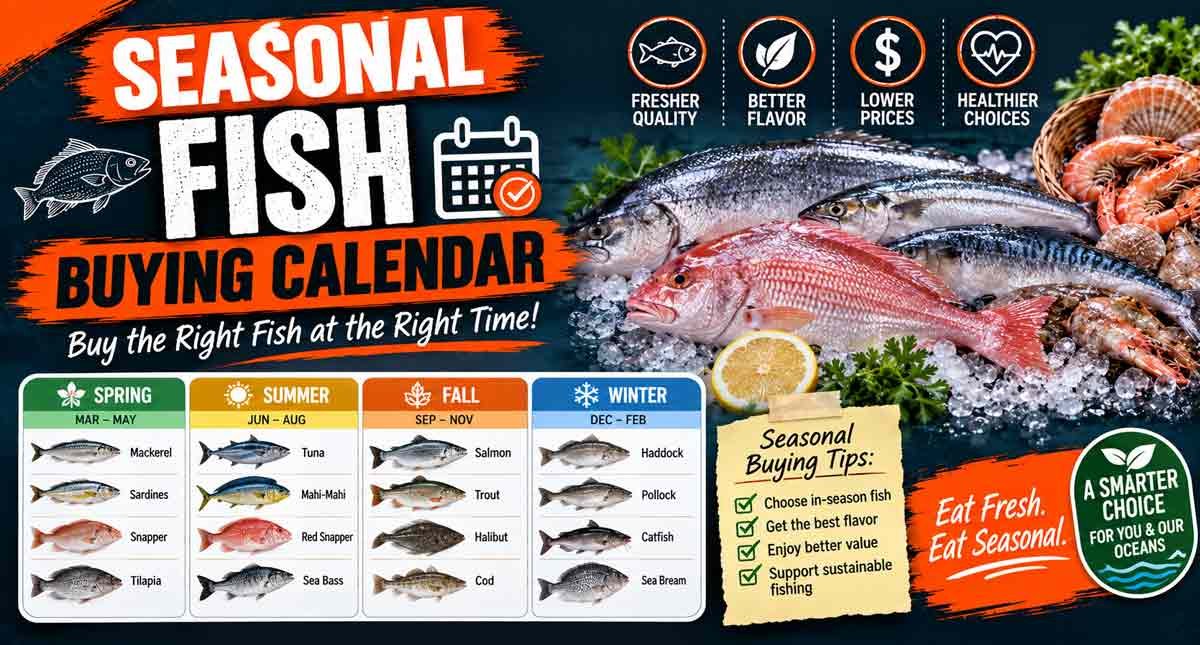
Seasonal Fish Buying Calendar
Fish absolutely have seasons, but no single calendar works everywhere, and any list that claims otherwise oversimplifies. Seasonality depends on hemisphere, region, and even which specific body of water a fish comes from; a species at its peak in one part of the world can be completely out of season, or not present at all, somewhere else at the same time of year.
What’s genuinely useful, and what actually holds up regardless of where you live, is understanding why fish have seasons in the first place and how to find that information for your own specific location, rather than memorizing a list that was written for somewhere else.
Table of Contents
Why Does Fish Even Have a Season?
Wild fish populations move, spawn, and feed on natural cycles tied to water temperature, and all of that affects when a species is most abundant, in its best condition, and easiest to catch. Many species carry more fat and richer flavor right before spawning, then taste noticeably leaner just after. Others migrate through a given area for only part of the year, meaning they’re not present, and therefore not being caught locally, the rest of the time.
Weather plays a practical role too: rougher seas or ice cover in certain seasons can shut down fishing for a species entirely, regardless of whether the fish itself is available, which affects supply and price independent of the fish’s own biology.
Does Seasonality Work the Same Everywhere?
No, and this is the single most important thing to understand about fish seasonality. The Northern and Southern Hemispheres have opposite seasons entirely, so a species at its summer peak in one is experiencing winter conditions in the other at the exact same calendar month. Even within one hemisphere, coastal versus inland regions, and different specific fisheries, can have completely different seasonal windows for what looks like the same species.
This is exactly why a single fixed calendar, the kind you’ll see printed as “what’s in season in [month]” without naming a specific region, is more likely to mislead you than help you. The genuinely useful version of this guide isn’t a list of dates. It’s the logic below, for finding accurate seasonal information specific to where you actually shop.
Is Farmed Fish Seasonal at All?
Barely, and this is one of the real, practical advantages of farmed fish. Because farmed conditions, feeding, and water temperature are controlled rather than left to nature, farmed species are available in consistent supply and quality throughout the year, without the peaks and gaps wild fish go through.
This isn’t a reason to always choose farmed over wild; the full comparison, including the real environmental trade-offs each carries, is in Wild-Caught vs Farm-Raised Fish: A Buyer’s Guide. But if year-round consistency matters more to you than seasonal peak flavor, it’s worth knowing which of the two you’re actually buying.
How Do You Actually Find Out What’s in Season Near You?
Ask directly, and ask specifically. “What’s in season right now” or “what came in freshest and most abundant this week” gets you a real, current answer that a printed calendar never could, and it’s worth asking every time you shop rather than relying on what you learned last visit.
A dedicated fish market or a full-service counter is generally more useful for this than a standard grocery store, since grocery stores tend to stock the same handful of species year-round through imports rather than reflecting genuinely local, seasonal supply. The full comparison of the two is in Fish Market vs Grocery Store: Where to Buy Fish.
Sudden abundance and a noticeably lower price on a specific species are both reliable real-world signals that something is currently in season, even without asking, since supply naturally increases and price naturally drops when a species is at its peak.
Does Buying in Season Actually Save Money?
Generally yes, and this connects directly to shopping for value overall. In-season fish typically costs less because supply is higher and the fish traveled a shorter distance to reach you, both of which lower the price without lowering the quality.
This overlaps significantly with general budget fish shopping, since some of the best-value species are simply the ones that happen to be genuinely abundant locally rather than flown in. The full list of consistently good-value options is in Budget Fish Buying Guide: Best Value Species.
Do Different Species Have Different Seasonal Windows?
Yes, significantly, and this is where species-specific information matters more than a general seasonal guide can offer. A cold-water species and a warm-water species won’t share a seasonal pattern even in the same region, and migratory species can have a narrow window of just a few weeks versus others that are available most of the year with only minor peaks.
As an illustration rather than a rule: many Northern Hemisphere coastal species peak in the warmer months as water temperatures rise and feeding activity increases, while the Southern Hemisphere sees the mirror image on the opposite calendar. For guidance specific to an actual species you’re planning to cook, rather than a generic seasonal pattern, see the Fish Species Buying and Cooking Profiles hub.
Frequently Asked Questions
If a seasonal calendar exists for my exact region, is it worth following?
Yes, a calendar built specifically for your own region, ideally by a local or national fisheries authority, is genuinely useful. The caution here is specifically about generic, region-less calendars that don’t disclose which hemisphere or area they’re actually describing.
Is out-of-season fish unsafe to eat?
No. Out-of-season simply means less abundant, more likely imported or frozen, and possibly past its peak flavor, not unsafe.
Does frozen fish bypass seasonality entirely?
Largely yes, since fish is often frozen at peak season and available afterward, which is one of the reasons well-handled frozen fish can be a genuinely good choice outside a species’ fresh season.
How do I know which hemisphere’s seasonal pattern applies to imported fish?
Ask where the fish was actually sourced, not just where you’re buying it. Imported fish follows its origin’s season, not yours.
What to Check Next
For the complete buying process this fits into, including freshness, sourcing, and value together, start with The Complete Guide to Buying Fish and Seafood.
