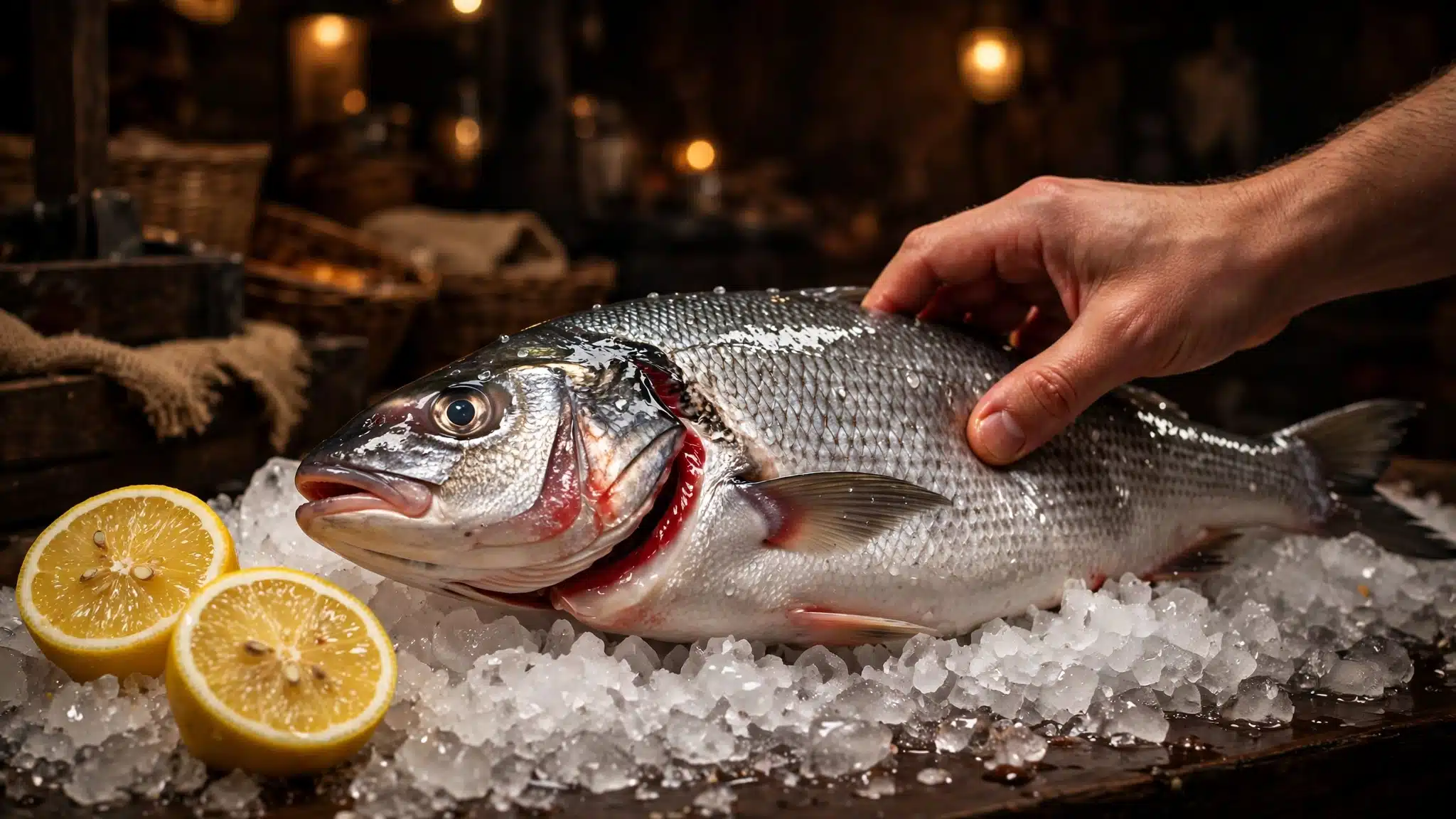
How to Tell If Fish Has Gone Bad
Fish has gone bad when it smells sour, fishy, or like ammonia, feels slimy or soft instead of firm, or has been in the fridge longer than 1 to 2 days raw or 3 to 4 days cooked. If two or more of those are true, do not cook it and do not taste it to check. Throw it out.
That can feel wasteful, especially with an expensive fillet, but it is the correct call. Spoiled fish is not a quality problem you can cook away. After more than twenty years of buying, fishing, and cooking fish, this is the one rule I never bend: when in doubt, throw it out.
For the complete storage and safety picture this check belongs to, see Fish Storage and Food Safety: The Complete Guide.
Table of Contents
First, Know What “Bad” Actually Means
There are two different problems, and it helps to keep them separate.
The first is spoilage. Bacteria already present on the fish multiply over time, even in the fridge. They change the smell, texture, and color. This is what your nose and fingers can detect, and it is what most of this guide covers.
The second is safety without obvious signs. Fish that was left warm for too long can become unsafe before it smells terrible. This is why time and temperature are not a backup check at the end of this article. They are equal to smell and touch, and sometimes they overrule them.
A fish can look acceptable and still be the wrong decision if you know it sat out, or you cannot remember when it went into the fridge.
Sign 1: The Smell Test Comes First
Fresh fish smells mild and clean, a little like the sea. It should never hit you with a strong odor the moment you open the package.
According to the FDA’s seafood safety guidance, spoiled seafood can smell sour, rancid, fishy, or like ammonia, and those odors become stronger after cooking. If you smell any of them in raw fish, do not eat it. If you only notice a faint or persistent ammonia smell after cooking, that cooked fish should not be eaten either.
This is the fastest and most reliable single check you have. In my own kitchen, I smell the fish before I look at anything else. If the smell makes you pull back, the decision is already made. Do not let marinade, lemon, or heavy spices talk you out of it. Seasoning can hide an odor. It cannot make spoiled fish safe.
One honest limit: a mild smell does not rescue fish that has broken the time rules below. Smell is necessary. It is not sufficient on its own.
Sign 2: Look at the Eyes and Gills on Whole Fish
For whole fish, the FDA gives a clear freshness picture: eyes should be clear and bulge a little, flesh should be firm and shiny, and gills should be bright red and free from slime.
So turn that around. Fish is likely past its best, and often past safe, when you see:
- Cloudy, grey, or sunken eyes instead of clear, slightly raised ones
- Brown, grey, or faded gills instead of bright red or pink ones
- Milky slime on the gills or a dull, dry-looking skin
These signs are strongest on whole fish, because a fillet has no eyes or gills left to read. That is also why the freshness check at the shop is different for the two forms. If you buy whole fish often, practice reading eyes and gills while the fish is good. You will recognize the change much faster later.
For fillets, skip to the next two signs. They do most of the work.
Sign 3: Press the Flesh and Feel for Slime
Good fish flesh is firm and springs back when you press it gently with a finger. That spring is one of the FDA’s core checks, and it is easy to learn.
Bad fish gives you the opposite:
- The flesh stays dented after you press it
- It feels soft, mushy, or starts falling apart instead of holding together
- The surface feels slimy or sticky in a way that does not rinse into a clean, moist feel
A thin, clear moisture on very fresh fish is normal. A thick, milky, or tacky coating is not.
Do this check with clean hands, and wash them right after. If the fish also smells off, stop there.
Sign 4: Check the Color and the Edges
Fillets should look moist, with their natural color for the species, and no discoloration, darkening, or drying around the edges. That is the FDA’s wording, and the edges matter because they dry and change first.
Warning signs are dull or grey flesh where it should look bright and slightly translucent, yellow or brown patches, darkened edges, and a dry, curling rim on a fillet.
Color alone can mislead you. Some species are naturally darker, and previously frozen fish may not look identical to never-frozen fish. Combine it with smell and texture. Bad color plus a bad smell, or bad color plus soft flesh, is a clear discard.
Sign 5: Count the Days and Check the Temperature
This is the check people skip, and it is the one that protects you when your senses are unsure.
The FoodSafety.gov Cold Food Storage Chart lists raw fin fish at 1 to 3 days in a refrigerator at 40°F (4°C) or below, and on Mahigar I teach the tighter, safer kitchen rule used in our storage chart: 1 to 2 days for raw fish, and 3 to 4 days for cooked fish.
Use the exact timelines in How Long Does Fish Last in the Fridge? (Storage Times Chart) for whole fish, fillets, shellfish, and cooked leftovers.
- Raw fish in the fridge more than 2 days: discard, even if the smell seems mild.
- Cooked fish in the fridge more than 4 days: discard.
- Fish left at room temperature more than 2 hours, or more than 1 hour above 90°F (32°C): discard.
If you cannot remember when the fish went in, treat that as a failed check. I label fish with the day I bought it for exactly this reason.
What About Frozen and Cooked Fish?
Frozen fish. Freezing pauses the clock; it does not rewind it. After thawing, judge it exactly like fresh fish: smell, texture, and color, and use it within 1 to 2 days. Heavy frost, torn packaging, or fish that is bendable while supposedly frozen can mean it thawed and refroze — covered in Can You Refreeze Fish After Thawing? The Real Answer.
Cooked fish. Cooked fish should smell mild, not sour or ammonia-like. Slimy texture, mold, or a fridge life past 3 to 4 days means discard.
Previously frozen fish from the store. It may not show every perfect fresh sign, but it should still smell fresh and mild, never sour or rancid. Hold it to the smell and time rules strictly.
Can Cooking Save Fish That Has Gone Bad?
No. Cooking kills many bacteria, but it does not reliably destroy every toxin that can build up in temperature-abused fish, and the FDA is explicit that spoiled odors get stronger, not safer, after cooking.
There is no version of “cook it well done,” “fry it hard,” or “put it in a curry” that fixes a fish that has failed the checks above.
If you are standing at the stove still debating, you already have your answer.
A Quick Decision Guide
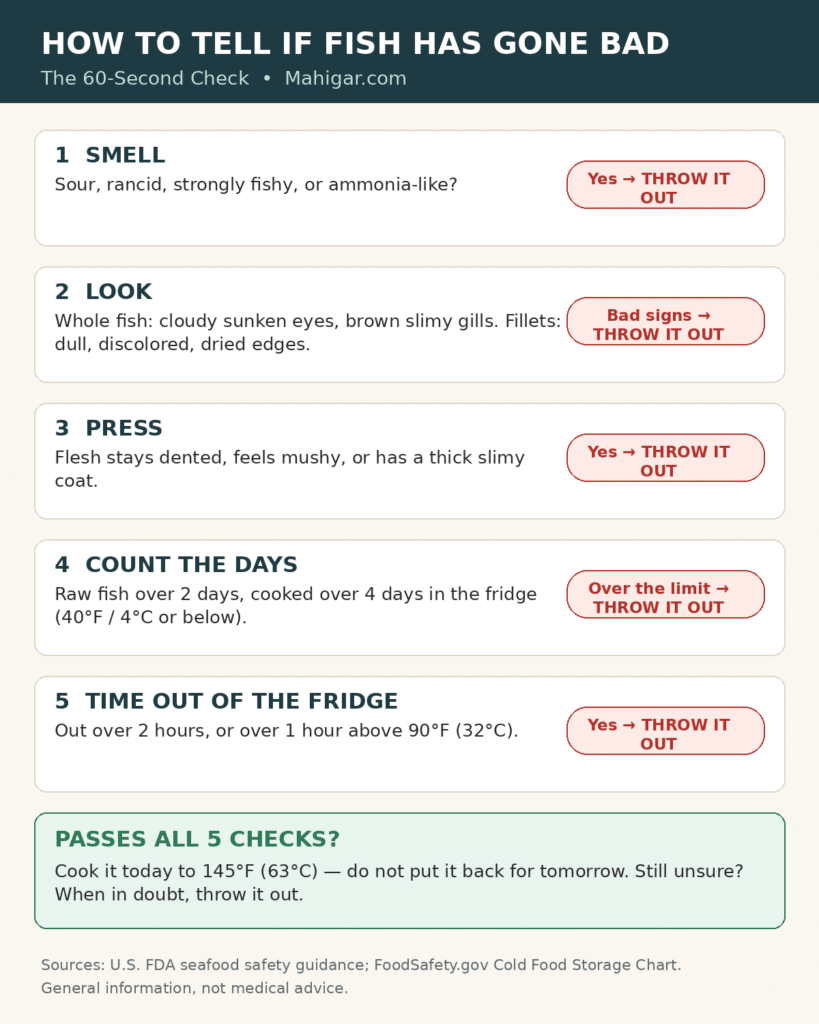
How to check if fish has gone bad in 60 seconds
Smell it
Sour, rancid, strongly fishy, or ammonia-like: discard.
Look at it
Whole fish: cloudy sunken eyes or brown slimy gills: discard. Fillets: dull, discolored, or dried edges: suspect.
Press it
Flesh stays dented, feels mushy, or has a thick slimy coat: discard.
Count it
Raw over 2 days, cooked over 4 days, or left out over 2 hours: discard, no exceptions.
Still unsure?
Discard.
If it passes all five, cook it today, to 145°F (63°C), rather than putting it back for tomorrow.
Frequently Asked Questions
Does fresh fish smell a little bit fishy normally?
Only very mildly, like clean seawater. A strong fishy, sour, or ammonia smell is not normal for fresh fish and is a spoilage sign, according to the FDA.
Can you tell if fish has gone bad just by looking at it?
Not reliably on its own. Color and appearance help, especially dull flesh and dried edges, but smell, texture, and days in the fridge must agree before you trust it.
Is slimy fish always bad?
A thick, milky, or sticky slime is a spoilage sign. Very fresh fish can feel lightly moist, but it should not leave a tacky coating on your fingers.
What should you do if you already ate fish that tasted bad?
Stop eating it and keep the packaging if you have it. This article is general food-safety information, not medical advice. If you develop symptoms or feel unwell, contact a doctor or local medical service promptly rather than waiting it out.
What to Check Next
To stop good fish from reaching this point in the first place, start at the shop with How to Tell if Fish Is Fresh: The Buyer’s Checklistthen store it using the timelines above. Together with the pillar guide, those three articles cover buying, storing, and checking fish in the right order.
Sources: U.S. FDA — Selecting and Serving Fresh and Frozen Seafood Safely; FoodSafety.gov — Cold Food Storage Chart.
