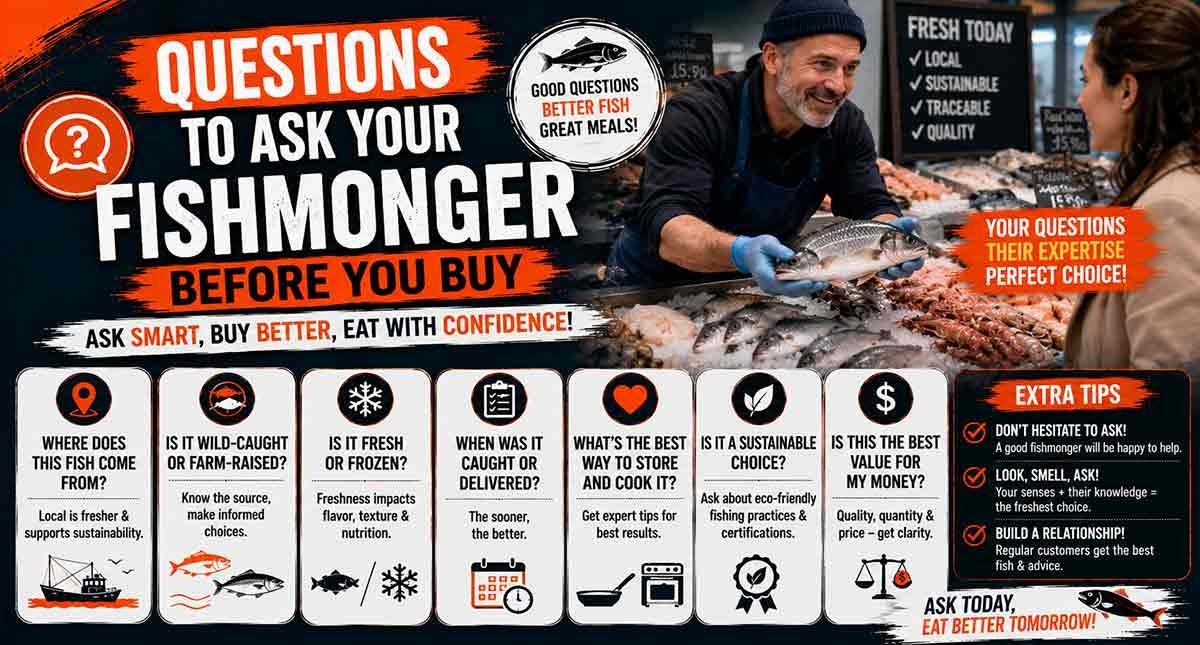
Questions to Ask Your Fishmonger Before You Buy
A good fishmonger wants these questions, not just tolerates them; the ones who hesitate or get vague are telling you something useful too. Asking well is one of the most underused tools a home cook has, and it costs nothing.
I’ve been asking the same core set of questions for years, at markets I know well and ones I’ve never been to, and the pattern holds every time: a confident, specific answer is a good sign regardless of the setting, and a dodge or a generic reassurance is worth paying attention to. Here’s the complete list, including what changes when you’re buying shellfish specifically.
Table of Contents
The Three Questions That Matter Most
What came in freshest today? Is this wild or farmed, where’s it from, and can I smell it before I buy? These three cover most of what you actually need, and I ask them out of habit even at counters I’ve shopped at for years.
If you only remember three questions, these are the ones. Everything below adds depth for specific situations, but this core set works almost everywhere, on almost anything.
Questions That Go Beyond the Basics
Has this been previously frozen? “Fresh” on a label only means never frozen; it doesn’t tell you how many days ago it was caught, so this question fills a real gap the label leaves open.
When did this actually arrive? More specific than “is it fresh,” this gets you a real answer about turnover rather than a generic reassurance.
Do you have this whole, or only as fillets? Whole fish lets you check eyes and gills yourself; if it’s only available as fillets, that’s useful to know before you commit. The full reasoning for choosing between the two is in Whole Fish vs Fillets: Which Should You Buy?.
Can you clean or fillet this for me? Most fishmongers will do this at the counter, often at no extra charge, which removes the biggest barrier to buying whole fish if you’re not confident with a knife yet.
What do you recommend today, and why? An open-ended question that lets real expertise show. A good answer names something specific and explains the reasoning; a generic “everything’s fresh here” answer doesn’t.
How should I store this, and how long will it keep? Worth asking every time, since it varies by species and exactly how it was handled before you bought it. The complete guide once you’re home is in Fish Storage and Food Safety.
Does this carry any certification? Not every good source will have one, but it’s worth asking, especially for species where sourcing varies a lot by region.
Questions Specific to Buying Shellfish
Is this still alive? For live shellfish like clams, mussels, and oysters in the shell, this matters directly: a shell that’s open and doesn’t close when tapped means it’s already dead and shouldn’t be bought.
Can I see the shellfish tag? In the U.S. and other regulated markets, live shellfish are legally required to carry a tag recording where and when they were harvested, kept on file by the seller specifically so the source can be traced if there’s ever a safety concern. Almost nobody asks to see this, but a legitimate seller has it and shouldn’t hesitate to show it or confirm the details.
Was this shrimp previously frozen and thawed for display? Most shrimp sold as “fresh” at a counter was actually frozen at some point and thawed for sale, which isn’t a problem, but it’s useful to know since it affects how you should handle and cook it.
Shellfish is less forgiving than fish if something’s wrong, so I’m stricter here than almost anywhere else in the store.
What Does a Good Answer Actually Sound Like?
Specific and immediate. A real fishmonger can tell you exactly what came in, when, and from where without checking or hesitating, because they handle this information daily. Vague reassurance “it’s all fresh,” “everything’s great today” without any actual detail is the pattern worth noticing.
This matters more than any individual answer. I’m less interested in whether a specific fish is wild or farmed than in whether the person selling it can answer confidently and specifically. That confidence is a better predictor of quality than any single fact I could ask for.
What If You’re Worried About Bothering the Fishmonger?
Don’t be. These questions are routine for anyone who sells fish for a living, and a seller who’s genuinely bothered by them is telling you something worth knowing on its own. I ask every time, including at places I’ve shopped at for years, and I’ve never once had a good fishmonger react like it was an imposition.
If anything, asking specific questions tends to get you better service, not worse. Sellers generally give more attention and better recommendations to customers who show they’re paying attention.
Frequently Asked Questions
Is it okay to ask these questions even if I’m a beginner?
Yes, these questions work exactly the same regardless of experience level, and a good fishmonger will usually give you more guidance, not less, once you show you’re paying attention.
What if the fishmonger doesn’t know the answer?
That’s useful information too. A seller who genuinely doesn’t know where their own fish came from is a real signal worth weighing, though one unsure staff member at a busy counter isn’t automatically disqualifying; ask again, or ask someone else at the same counter first.
Do these questions work at a grocery store seafood counter too?
Yes, exactly the same way. A staffed seafood counter at a grocery store should be able to answer them just as directly as a dedicated market.
Can asking good questions actually get you a better price or better service?
Sometimes, indirectly showing genuine interest and knowledge doesn’t guarantee a discount, but it often earns better cuts, more attention, and more honest recommendations, which matters more than price alone.
What to Check Next
Once you’ve got answers, the freshness checklist tells you what to actually look for yourself; see How to Tell if Fish Is Fresh: The Buyer’s Checklist. And for the complete buying process this fits into, start with The Complete Guide to Buying Fish and Seafood.
