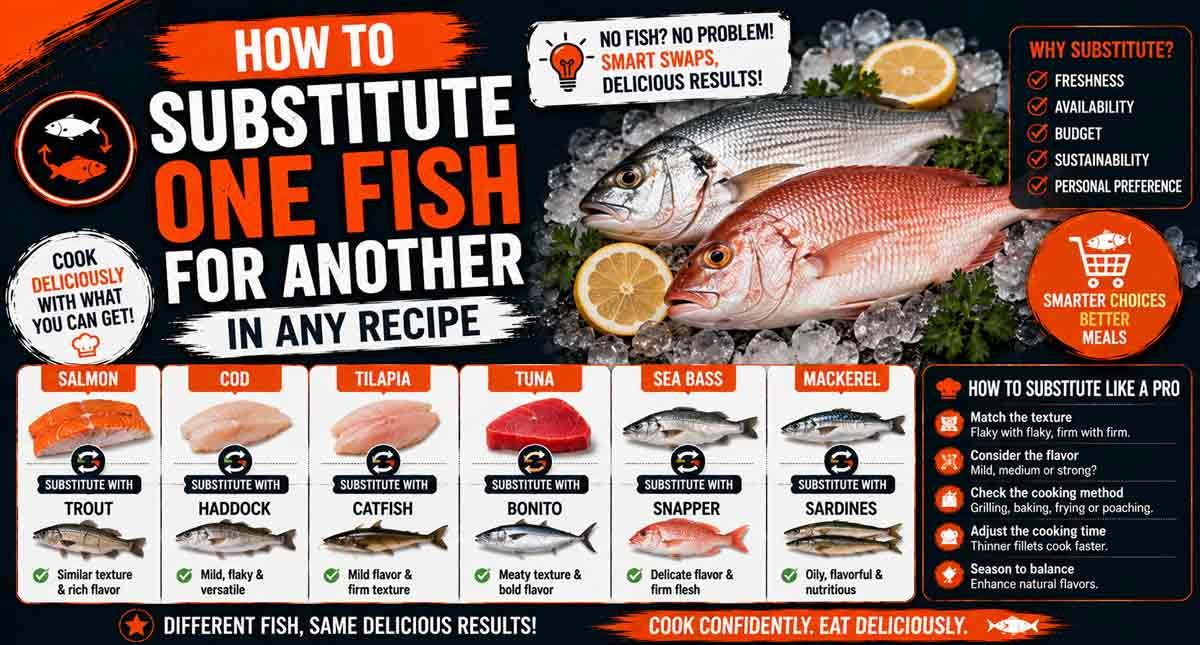
How to Substitute One Fish for Another in Any Recipe
Substitute based on texture and fat content, not on how similar two species sound or look. A firm, meaty fish and another firm, meaty fish will behave the same way in a recipe even if they’re not remotely related; two fish from the same family can cook completely differently if one is delicate and the other is firm.
This isn’t a theoretical skill for me; several of the species that show up constantly in international recipes simply aren’t available where I live, so substitution is something I rely on in a lot of the recipes I test, not an occasional workaround. Here’s the actual logic behind it, not just a list of swaps.
Table of Contents
Why Species Name Isn’t What Matters
Two fish can share a family name and still behave completely differently in a pan: flounder and halibut are both flatfish, but one is delicate and flakes apart easily while the other is firm enough to grill in steaks. Meanwhile, two fish from entirely different families, like cod and haddock, or swordfish and tuna, can be nearly interchangeable in a recipe because they share the qualities that actually matter for cooking.
What actually determines whether a substitute works is how the fish behaves under heat: how firm it stays, how much moisture it holds, and how strongly it tastes. Species name tells you almost nothing about any of that on its own.
The Two Things That Actually Determine a Good Substitute
Texture (how firm or delicate the flesh is) and fat content (how rich or lean it is) are the two factors that matter most. Match both, and a substitute will usually behave almost identically to the original in a recipe. Match only one, and you’ll get an edible but noticeably different result usable in a pinch, but not quite right.
Fish Grouped by Texture
Firm and meaty: swordfish, tuna, halibut, mahi mahi, and monkfish hold together well under high heat, can be cut into steaks, and stand up to grilling without falling apart.
Medium-firm and flaky: cod, haddock, snapper, sea bass, and grouper flake into large, distinct pieces but still hold their shape reasonably well through most cooking methods.
Delicate and flaky: sole, flounder, tilapia, and trout cook quickly, flake into small pieces easily, and need gentler handling, since they fall apart under high heat or rough treatment.
These three groups swap well within themselves and poorly across groups. A recipe built around a delicate fish like sole will disappoint with a firm substitute like swordfish standing in, and the reverse is just as true.
Fish Grouped by Fat Content
Rich and fatty: salmon, mackerel, sardines, bluefish, and Arctic char carry enough natural fat to stay moist through higher heat and forgive slightly longer cooking times.
Lean and mild: cod, tilapia, flounder, sole, snapper, halibut, and mahi mahi have very little fat, which means they dry out faster and benefit from sauces, marinades, or careful attention to cooking time.
Fat content affects forgiveness more than flavor. A fattier fish gives you more room for error on timing; a lean fish rewards precision and often needs a sauce or moisture source built into the recipe to stay at its best.
How Do You Combine These Two Factors?
Match texture first, then check fat content as a secondary refinement. Texture determines whether a substitute will physically hold up to the recipe’s cooking method at all; fat content affects how forgiving it is and how rich the final dish tastes, which matters, but matters less than the dish simply working.
If you can’t match both perfectly, prioritize texture. A lean fish substituted for a fattier one in the same texture group still cooks correctly, just slightly less rich; a delicate fish substituted for a firm one in a grilling recipe may fall apart entirely, which is a bigger failure than a flavor mismatch.
Does Flavor Intensity Matter Too?
Sometimes, as a third, secondary factor. Mild fish like tilapia, cod, and flounder take on seasoning without adding much fish flavor of their own; stronger-flavored fish like mackerel and sardines bring real character that a recipe built around a mild fish wasn’t designed for.
Flavor intensity matters most in simply prepared dishes where the fish itself is the whole point, and matters much less in a curry, a heavily spiced dish, or anything with a bold sauce doing most of the work. In those dishes, texture and fat content alone will usually get you a good result.
What About Substituting Shellfish?
Shellfish substitution follows a narrower version of the same logic: match texture and cooking behavior, not species. Shrimp and scallops both cook quickly and firm up similarly, so they often swap reasonably well; mussels and clams behave alike too, both cooking until they open. Crab and lobster are closer to interchangeable with each other in most recipes than either is with shrimp, since both have a denser, more fibrous texture that shrimp doesn’t share.
A Few Reliable Substitution Pairs
Cod and haddock swap almost seamlessly in nearly any recipe. Tilapia and flounder work interchangeably for anything calling for a mild, delicate fish. Halibut and swordfish both hold up well on a grill or in a pan and can usually stand in for each other. Salmon and Arctic char share enough richness and texture to swap in most preparations. Snapper and sea bass are close enough in both texture and flavor to substitute in almost any recipe calling for either.
The next time one of Mahigar’s own recipes, like The Foolproof Guide to Baked Salmon, calls for a species you can’t find, this same logic tells you exactly what to reach for instead.
Frequently Asked Questions
Can you substitute frozen fish for fresh in the same recipe?
Yes. This substitution logic is about species, not fresh versus frozen. Once thawed, a properly frozen fish behaves the same as fresh in any recipe.
Is it safe to substitute a fattier fish into a recipe built for a lean one?
Yes, it’s safe. The main effect is a richer final result and slightly more forgiveness on cooking time, not a safety concern.
Does this substitution logic work for smoked or cured fish too?
Less directly. Smoking and curing change texture and flavor enough that the same fresh-fish logic doesn’t fully apply; substitutions there depend more on matching the curing process itself.
What’s the safest substitute if you genuinely don’t know a fish’s texture or fat content?
A medium-firm, moderately lean fish like cod or snapper is the safest general-purpose substitute, since it sits in the middle of both spectrums and handles most cooking methods reasonably well.
What to Check Next
For species-specific buying and cooking notes that go beyond general substitution logic, see the Fish Species Buying and Cooking Profiles hub. And for the complete buying process this fits into, start with The Complete Guide to Buying Fish and Seafood.