Freshwater vs Saltwater Fish: Taste, Texture and Cooking Differences
Which tastes better, the fish from the river or the fish from the sea? I hear this question at my own table, usually with a plate of each in front of the person asking, and my answer always disappoints the argument lovers: you are comparing two characters, not two grades. Fish is one subject with two homes, and the water a fish lived in shapes its flavour, its texture, its bones and even its smell long before my knife or my pan gets a say.
Let me set my own position honestly at the start, because a comparison is only worth reading if you know where the writer stands. My daily hands on cooking is freshwater. Carp, catla, catfish and river fish are the fish of my canals, my markets and my kitchen. Saltwater fish I know through study, through technique and through cooking sea species that reach my market. I have never fished the sea, and I will not pretend otherwise anywhere on this page. What I can do is compare the two sides fairly, from the stove, where the differences actually matter.
This comparison sits inside my pillar guide, Freshwater Fish Cooking: The Complete Guide to Carp, Catla, Catfish and River Fish, where the freshwater side gets its full treatment. Here we hold the two sides up to the light together, so you can choose tonight’s fish with your eyes open.
Table of Contents
The Short Answer: Neither Side Wins
Neither freshwater nor saltwater fish tastes better. Freshwater fish is usually milder, softer and more delicately flavoured, while saltwater fish is usually cleaner tasting, firmer and more distinctly of the sea, and the right choice depends on your dish.
That is the whole comparison in one breath, and everything below is the detail that makes it useful. Cooks get into trouble when they judge one side by the other side’s strengths. A river carp asked to behave like a grilled sea steak will seem bony and earthy. A fine sea fish buried in a heavy curry will seem wasted. Both judgments say more about the match than about the fish. In my kitchen, the question is never which water wins. The question is what tonight’s dish needs: gentle flesh that drinks a sauce, or firm flesh that stands up to fire. Answer that, and the water chooses itself.
Flavour: Earth and River vs Sea and Brine
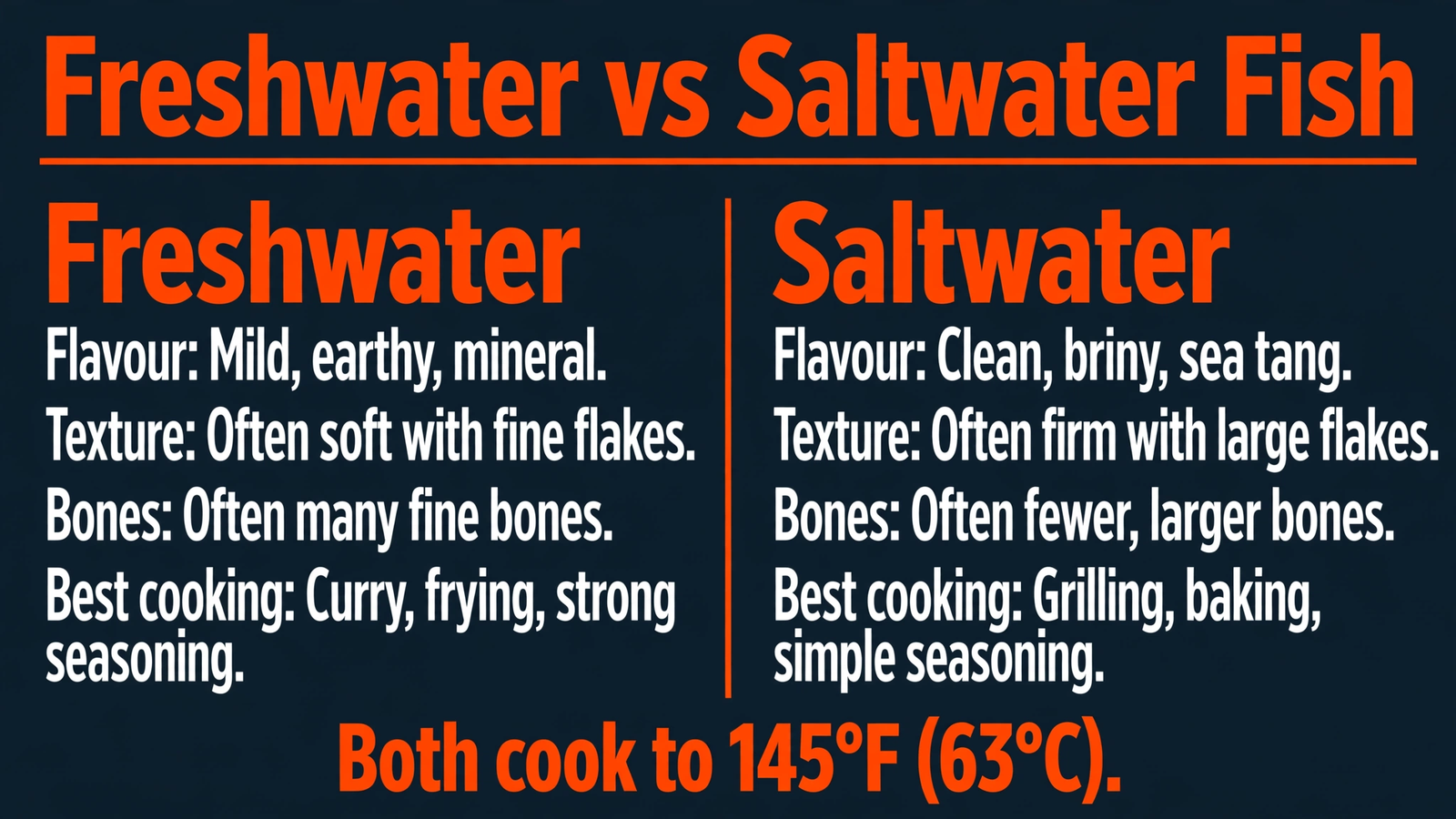
Freshwater flavour is mild, earthy, mineral. Saltwater flavour is clean, briny, sea tang. Those six ideas explain most of what your tongue will find on each side.
Freshwater fish tastes of sweet flesh first and its home second. In a clean river fish the home note is faint and pleasant, a green, mineral freshness. In a fish from still or muddy water, that home note grows into the earthy flavour cooks call muddy taste, which is a water problem, not a species problem, and my full handling of it is in How to Remove Muddy Taste from Freshwater Fish. Sea fish tastes of its home too, but the sea announces itself differently: a clean saltiness, a briny lift, and in oily sea species a deeper iodine richness that freshwater fish simply does not have.
One piece of food science helps here, and I keep it brief. Sea fish carry a compound in their flesh that helps them live in salt water, and after the fish dies that compound slowly turns into the sharp smell and taste people call fishy. Freshwater fish carry far less of it, which is why a fresh river fish can smell almost sweet while a sea fish of the same age already smells strongly of the sea. Neither side is cleaner by nature. They just age in different voices, and a good buyer learns both.
My own palate was raised on the river side, so earthy notes read as home to me. A guest raised on the coast may read the same note as a fault. Taste is partly biography, and mine is written in canal water.
Texture and Fat: How Each Side Feels
Freshwater texture is often soft with fine flakes. Saltwater texture is often firm with large flakes. Fat follows the same loose pattern: many freshwater fish are lean and gentle, while the sea gives you both very lean white fish and very rich oily fish at the extremes.
The word often is doing honest work in those sentences. There are firm freshwater fish, and wallago attu from my own canals cuts like a steak. There are delicate sea fish that fall apart if you look at them with intent. But as a buying rule, the pattern holds: river fish tends toward softer, finer flesh that wants a gentle hand, and sea fish tends toward firmer flesh that forgives stronger handling. In the pan, freshwater fish rewards steaming, curry and careful frying, and punishes rough turning by breaking or drying. Sea fish, especially the firm steak fish, takes grilling, searing and roasting with a confidence I admire.
Fat is where the sea shows its range. The richest, oiliest fish most cooks know are sea fish, and their fat carries flavour and keeps the flesh moist under heat. Our freshwater rich fish, catla and wallago attu, are rich in a softer way, satisfying without the heavy oiliness. Lean fish on both sides share the same truth: they dry fast, they forgive little, and they are done sooner than you think. Judge fat by the species, never by the water alone.
Bones: The Hidden Difference at the Table
Freshwater bones are often many fine bones. Saltwater bones are often fewer, larger bones. Of all the differences on this page, this is the one your guests will notice most.
The carp family, the great freshwater family of our rivers, carries fine forked bones inside the flesh itself, and eating carp or catla well is a learned table skill in my culture, taught young and used for life. Most sea fish sold for the table carry their bones in a frame and a tidy line you can lift away, which is why a sea fish fillet feels easy to a nervous eater. Catfish are the freshwater exception that proves the pattern is a tendency, not a law: our river catfish and wallago attu carry few large bones and eat as easily as any sea fish.
My advice is plain. If bones decide your menu, because of children or guests who fear them, choose by species, not by water. A freshwater catfish will serve you better than a bony sea fish, and a carefully eaten carp will teach your table more than a fillet ever will. Bones are a difference in technique, not a difference in worth.
Smell When Fresh: What Your Nose Should Find
A fresh freshwater fish smells faintly sweet and green, like clean river water, while a fresh saltwater fish smells clean and briny, like a sea breeze, and on both sides a sour or ammonia smell means the fish is past its best.
Shoppers judge river fish by sea fish smell and sea fish by river fish smell, and reject good fish both ways. The faint earthy trace on a fresh carp is its home, not spoilage. The clear sea tang on a fresh sea fish is its home, not strength or age. Spoilage speaks a different language on both sides: sourness, sharpness at the back of the nose, a smell that makes you pull back. I teach that language in full in Why Fish Tastes ‘Fishy’ and How to Reduce It.
Sea fish, because of the compound I mentioned above, develops its off smell faster and louder as it ages. Freshwater fish fades more quietly, which is its own trap: an old river fish can look calm while its flesh has already softened. So with freshwater fish I press the flesh and check the gills as carefully as I smell, and with sea fish I let my nose lead. Two waters, two checks, one standard: I would serve it to my family tonight, or I leave it.
Cooking Methods: What Suits Each Side
Freshwater best cooking is curry, frying, strong seasoning. Saltwater best cooking is grilling, baking, simple seasoning. Match the method to the texture, and both sides shine.
Freshwater fish, soft and mild, loves methods that support and surround it. Curry is its great home, because the gravy keeps the flesh moist and the spice frames the gentle flavour. Careful frying gives it a crisp coat to protect the soft flesh. Steaming suits its delicate pieces. What freshwater fish does not love is naked high heat with rough handling, where it breaks and dries before it browns.
Saltwater fish, firmer on the whole, loves exposure. Grilling and searing give its firm flesh a crust it can hold. Baking whole sea fish is a pleasure I happily borrow for my table. Simple seasoning suits it because the sea already seasoned the flesh with its own character, and lemon, herbs and good oil are often all a fine sea fish asks for. Rich oily sea fish also grills beautifully, because its fat bastes the flesh as it cooks.
Both sides meet at the same finish line, and I never let a comparison hide it: cook fin fish to 145°F (63°C) in the thickest part, with flesh that turns opaque and flakes cleanly. One safety note belongs to my side of the water in particular. Freshwater fish can carry parasites, so I cook river fish through every time and never serve it raw, and the careful detail is in Parasites in Freshwater Fish: What Cooking Actually Kills. Respect the fish, respect the heat, and both waters feed you safely.
Seasoning: How Much Help Each Side Wants
Freshwater fish welcomes a fuller spice hand, while saltwater fish usually wants a lighter touch, because river flavour is gentle and sea flavour already speaks loudly.
In my kitchen, freshwater fish takes turmeric, cumin, coriander, mustard, chilli, garlic and lemon in real quantity and tastes balanced rather than buried, because the mild flesh has room for company. That is the seasoning marriage our regional cooking is built on. Sea fish, especially the clean tasting white fish and the rich oily ones, asks for restraint from me: salt, citrus, herbs, and spice used as an accent instead of a coat. Over season a fine sea fish and you have paid sea prices for a spice dish.
The blends and marinades I build for fish will get their own full treatment in Fish Spice Blends, Marinades and Seasoning: The Complete Guide, and the rule that page will stand on is already the rule here: match the weight of the seasoning to the weight of the fish flavour, on whichever side of the water your fish was born.
Buying and Price: The Honest Reality
Freshwater fish is usually the inland bargain: locally caught or farmed, sold whole and fresh, and priced for weekly eating, while saltwater fish costs more the further it travels from the coast.
Where I live, river and pond fish reach the market fast and cheap, and a family can eat carp, catla or catfish through the week without strain. Sea fish arrives over distance, on ice and through middlemen, and its price carries that journey. On the coast the picture reverses. Price follows distance, not quality, and I remind my readers of that whenever a high price is used to argue that sea fish must be better. Expensive fish is often just fish that has been on a road.
The other buying question, wild against farmed, cuts across both waters. My buyer’s treatment of that choice, with its flavour and quality trade offs, is in Wild-Caught vs Farm-Raised Fish: A Buyer’s Guide, and it applies on both sides of this comparison. Whatever the water and whatever the label, my freshness checks do not change: bright eyes, red gills, firm flesh, clean smell.
Nutrition in Plain Terms
Both freshwater and saltwater fish are nutritious, protein rich foods, and the honest difference is one of degree: the richest oily sea fish are famous for their healthy fats, while freshwater fish offers lean, satisfying protein that suits everyday eating.
I keep this section in general terms on purpose, because nutrition claims deserve exact sources and this is a comparison of taste and cooking. From the kitchen side, the practical point is simple. Freshwater fish like carp and catfish give a family filling, protein rich meals with gentle fat, and they suit frequent eating. Sea fish brings its own range, from very lean white fish to the rich oily species that health guidance praises most. Neither water owns good nutrition, and a varied fish table is the pattern I feed my own family.
Which Fish to Choose by Dish
Choose by the dish, not by the water: curry, frying and strong seasoning call for freshwater fish, grilling, baking and simple seasoning call for saltwater fish, and your own table decides the rest.
Here is my choosing summary, in the same words I use at the market. Flavour: freshwater is mild, earthy, mineral, saltwater is clean, briny, sea tang. Texture: freshwater is often soft with fine flakes, saltwater is often firm with large flakes. Bones: freshwater is often many fine bones, saltwater is often fewer, larger bones. Best cooking: freshwater suits curry, frying, strong seasoning, saltwater suits grilling, baking, simple seasoning.
Turn that into plates and the choices make themselves. A family curry night wants carp, catla or catfish in the gravy. A crisp fry with bold spice wants freshwater fish in a seasoned coat. A grill night with simple sides wants a firm sea fish, or my own wallago attu steaks, which break the pattern proudly. A gentle steamed plate wants whichever fish is freshest that morning, from either water, and I mean that literally: on a true tie, freshness beats geography every single time. When you want to go species by species and match each fish to its best job, my Fish Species Guide is the companion I wrote for exactly that decision.
Frequently Asked Questions
Does freshwater fish taste better than saltwater fish?
Neither tastes better in any honest general sense. Freshwater fish is usually milder, softer and more earthy, while saltwater fish is usually cleaner tasting, firmer and more briny. Your dish and your seasoning decide which you prefer, and in my kitchen both are welcome.
Why does freshwater fish sometimes taste muddy?
Muddy taste comes from the water the fish lived in, most often still or slow pond and canal water, and it settles in the skin and fatty flesh. Sea fish does not show this fault, because the open sea does not flavour fish that way. Choose clean water fish, trim fatty parts, and use my salt rub and rinse method from the muddy taste guide linked on this page.
Is saltwater fish healthier than freshwater fish?
Both are nutritious, protein rich foods, and I would not rank the waters. The richest oily sea fish are praised for their healthy fats, and freshwater fish offers lean protein that suits frequent, everyday eating. Variety across both sides, bought fresh and cooked well, is the healthiest pattern I can honestly recommend.
Can I cook freshwater and saltwater fish the same way?
You can share the basics: dry flesh, honest seasoning and cooking to 145°F (63°C) in the thickest part. Beyond that, adjust to the fish. Give soft freshwater fish support, curry, a coat or gentle heat, and give firm saltwater fish the direct heat and simple seasoning it enjoys. Treat each fish by its texture, not by habit.
My Rule for Choosing
My rule is simple, and it has never failed my table: buy the freshest fish in front of you, from whichever water it calls home, and cook it the way its own character asks.
I am a freshwater cook by birth, by water and by daily practice, and this page has not hidden that for a paragraph. But respect is not rivalry. The sea feeds other families the way my canals feed mine, and its fish, cooked with the care they ask for, deserve their place on any honest table. Learn both characters, season each one fairly, and the argument about which water wins quietly ends, because dinner has already answered it.

One Comment