Fish Spice Blends, Marinades and Seasoning: The Complete Guide
The fish was perfect and the dish was flat. That has happened in my kitchen more times than I like to admit. Fresh fish, cooked to the right point, tender and moist, and then one bite tells me the seasoning never really reached it. Too little salt. Spice sitting only on the surface. A marinade rushed for five minutes, or left so long the flesh turned soft and sour.
Fish is the central ingredient in my kitchen, and seasoning is how I respect it. A good blend does not hide fish. It lifts it, giving warmth without burning and aroma before the first bite. When it is right, a simple river fish tastes like a complete meal.
This pillar is my complete system for seasoning fish before and during cooking. I keep sauces separate here on purpose. This guide is about dry blends, rubs, marinades, brines, curry bases, and seasoned coatings. Below I share the three house blends I actually use, with the exact ratios in parts that I settled on after more than twenty years of testing, tasting, and correcting. I cut and rebalanced my early blends until these ratios became the ones my hand reaches for.
Table of Contents
The Short Answer: Season Fish in Layers
Season fish in layers, salt first for structure, spice blend second for flavour, and acid last and briefly.
That is the heart of this guide. Salt goes on early enough to season the flesh and firm the surface. Your spice blend is chosen for the cooking method, not just for the fish, because a blend for the grill is not the same as a base for curry. Acid, lemon, lime, vinegar, or tamarind, is used in small amounts and for a short time, or added at the end where it brightens without damaging texture. Keep that order, salt, spice, acid, and most seasoning mistakes disappear.
Why Fish Needs a Different Seasoning Approach Than Meat
Fish needs lighter, shorter, and more careful seasoning than meat because its flesh is delicate, its flavour is mild, and acid and salt change its texture much faster.
Chicken and red meat can sit in a strong marinade for hours. Fish cannot. Its muscle fibres are short and its connective tissue is thin. Leave a delicate fillet in lemon juice for an hour and the outside turns opaque while the inside stays raw. Leave it in a heavy spice paste overnight and it tastes of paste, not fish. I proved this to myself with two pieces from the same fish, one marinated for twenty minutes, one for three hours in the same mix. The short one was moist and clean. The long one was soft at the edges and muddy.
My troubleshooting pillar The Science of Cooking Fish: A Troubleshooting Guide explains the proteins and moisture behind this in plain language. Fish does not need spice to cover it. It needs spice to frame it. Cumin and coriander support fish without shouting, turmeric gives colour and gentle earthiness, and chili is never the loudest voice in my everyday blends.
Seasoning Starts With Good Fish
Seasoning cannot fix poor fish, so start with fresh, well chosen fish and season it only after you have dried its surface.
Old fish carries a stale smell that no masala should be asked to hide, and using extra chili to cover it is the worst habit in fish cooking. In my kitchen, if fish smells wrong, it does not get cooked. If it smells clean and sweet, it needs only honest seasoning. When I shop, I follow the checks in The Complete Guide to Buying Fish and Seafood, looking at eyes, gills, firmness, and clean smell. Keep the fish cold in a fridge at or below 40°F (4°C), cook it soon, and pat it completely dry, because a wet surface steams and stops a rub from sticking.
My Three House Blends and the Ratios I Actually Use
My three house blends cover almost every fish dish in my kitchen: an everyday fish masala, a grill dry rub, and a curry spice base.
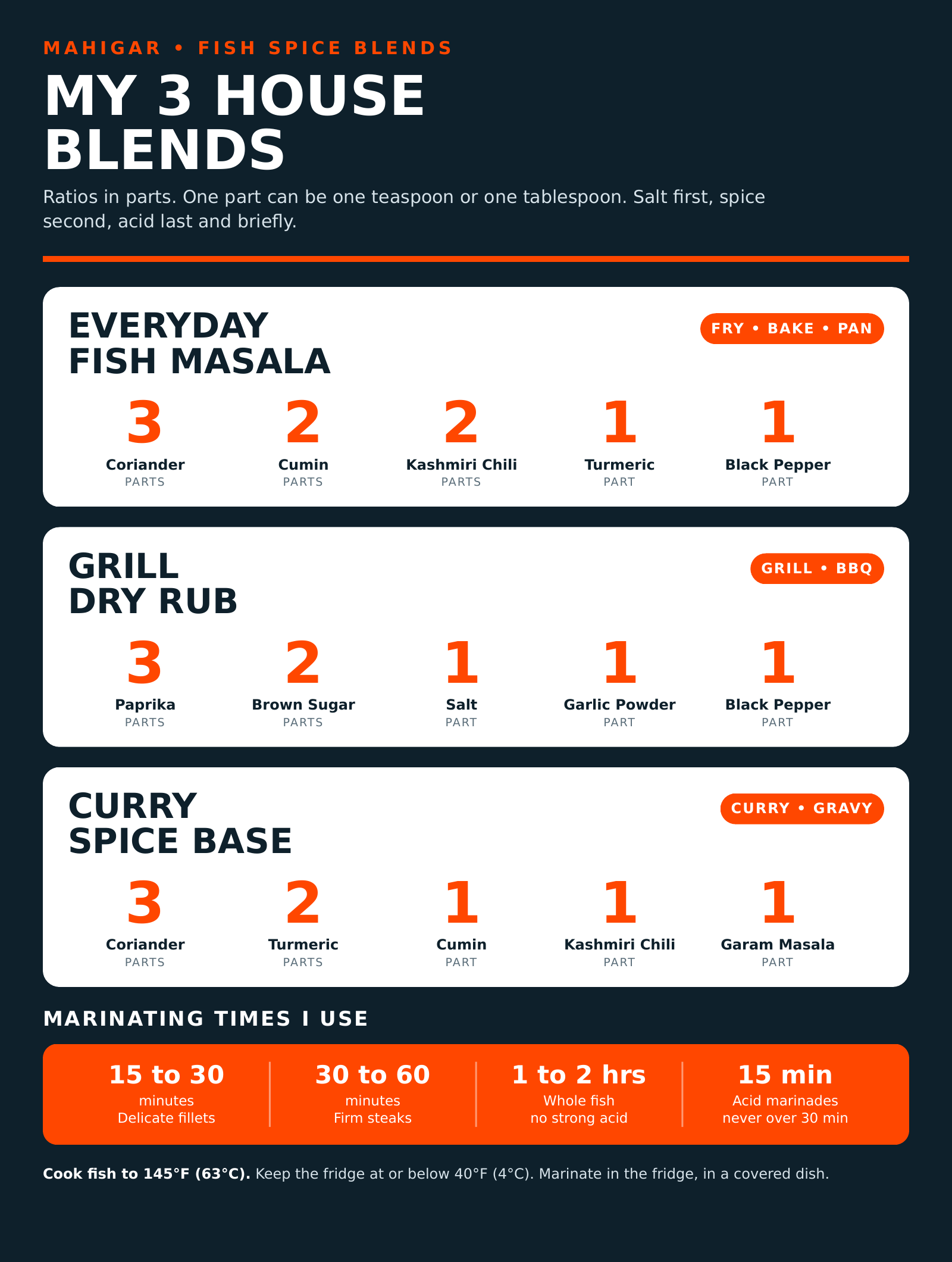
I keep these mixed in labelled jars, in small batches so they stay fresh. I write the ratios in parts, not fixed spoon amounts, so you can make a teaspoon batch or a jar batch with the same balance. One part can be one teaspoon or one tablespoon. The balance stays the same.
Everyday Fish Masala, in parts: 3 parts ground coriander, 2 parts ground cumin, 2 parts Kashmiri chili, 1 part turmeric, 1 part ground black pepper. I add salt separately to the fish first, so I control both layers, but if you want it premixed, use about 1 teaspoon of fine salt for every tablespoon of blend. This is my default for fried steaks, baked fillets, and everyday pan fish. Coriander is the base because it is friendly to fish and never bitter when cooked.
Grill Dry Rub, in parts: 3 parts paprika, 2 parts brown sugar, 1 part fine salt, 1 part garlic powder, 1 part ground black pepper. The sugar helps colour on the grill and balances the salt and pepper, but it burns over a wild fire, so I use this rub over steady, medium heat. There is no turmeric or cumin here on purpose. On the grill I want smoke, sweetness, and pepper first.
Curry Spice Base, in parts: 3 parts ground coriander, 2 parts turmeric, 1 part ground cumin, 1 part Kashmiri chili, 1 part garam masala. This is a dry base only. In the pot it meets oil, onion, ginger, garlic, and tomato or tamarind to become a real gravy. The garam masala part is small because its warm top notes fade if fried hard for a long time. For a hotter curry I add fresh green chili in the pot, not more dry chili in the jar.
These are the same ratios shown on the infographic with this article. If you change one thing, change only one part at a time and taste it on plain fish first.
Making Your Own Fish Masala at Home
A homemade fish masala tastes fresher than most shop packets because you control the balance, the salt, and the age of the spices.
Many packets are built for long shelf life, which often means too much salt, too much raw chili heat, and dusty turmeric. When I make my own, the coriander smells bright and the whole jar smells like food. My full method is in How to Make Your Own Fish Masala Blend at Home, with a hotter variation for river fish. In short, I grind in small batches and never make more than I will use in about a month.
I use this masala three ways. As a dry seasoning on salted, dried fish with a little oil, rested fifteen to twenty minutes before frying or baking. Mixed with a spoon of yogurt or mustard oil into a thin paste for grilled or baked steaks. Or bloomed in hot oil at the start of a curry for thirty seconds only, until fragrant, never until dark. Burnt masala turns bitter in seconds.
Dry Rubs for Grilled and BBQ Fish
A good dry rub for grilled fish should season, help colour, and protect the surface, without drawing out so much moisture that the fish steams instead of grilling.
I salt and rub the fish twenty to thirty minutes before grilling, no longer, and I pat it lightly again if a lot of moisture has come out. I oil the fish, not just the grill, and I leave it alone until it releases. For the complete method, including a sugar free herb rub for delicate fillets and how I use a basket or foil for fragile fish, read my cluster guide Dry Rubs for Grilled and BBQ Fish, which builds directly on the grill rub ratio above. For whole fish I score the skin lightly and work the rub into the cuts and the cavity.
Do not use a curry base as a grill rub, because turmeric heavy blends scorch over direct flame. Pick one system, dry rub or marinade, and keep the coat thin. Thick coats slide off and steam the fish.
Spice Base for Fish Curry and Gravy
A fish curry base should be cooked in oil until the raw spice smell leaves and the oil begins to separate, before any fish goes into the pot.
I heat oil, add onion, and cook it properly until golden. I add ginger and garlic, then my curry spice base mixed with a little water into a paste so it does not scorch, and I fry it on medium heat until it smells cooked and sweet and the oil glistens at the edges. Only then do I add tomato, tamarind, or water, season the gravy with salt, and simmer it until it tastes complete on its own. The fish goes in last, in a single layer, and poaches gently. I never boil fish hard in curry and I never stir it roughly once it is in.
Heat, sourness, and body are the three balances I check before the fish goes in. Heat comes from chili, black pepper, and fresh chili. Sourness comes from tomato, tamarind, or a finish of lemon, and it should be bright, not sharp. Body comes from onion cooked down, tomato, or coconut in some curries. If the gravy is thin and harsh before the fish goes in, the finished curry will be too. Fix the base first.
My dedicated cluster, Spice Base for Fish Curry and Gravy: Balancing Heat, Sourness and Body, gives my three base variations in full, a tomato base, a tamarind base for sour river fish curries, and a lighter mustard and turmeric base, with the order of adding each spice. The same balance appears in Fish Recipes from Around the World, from South Asian curries to Mediterranean tomato braises.
Seasoned Coatings for Fried Fish
A seasoned coating should crisp, protect the flesh, and carry spice in every bite, without becoming a thick shell that separates from the fish.
I use three coating families. Flour gives a light, delicate crust for fillets. Cornmeal gives a firmer, golden crunch for steaks and whole small fish. Besan, chickpea flour, gives a nutty crust I love for pakora style fish and river fish steaks, especially in a thin, well seasoned batter. In every case the seasoning belongs in two places, on the fish itself first, salt and a light dusting of everyday masala, and in the coating second, so crust and flesh both taste seasoned.
The coating must be thin, the oil hot enough to set it at once, and the fish dry before it goes into the flour. I shake off every loose bit, rest the coated fish for a few minutes so the coating sticks, and fry in batches. My full guide, with exact mixes for flour, cornmeal, and besan coatings, is Seasoned Coatings for Fried Fish: Flour, Cornmeal, Besan and Spices, and it also covers how I keep the first batch crisp while the second fries. I finish fried fish on the same rule as always, cook fish to 145°F (63°C), with a short rest on a rack, not on paper that steams the crust soft.
Marinades: How Long, What Works, and When Not To
Most fish needs only 15 to 30 minutes in a marinade, firm steaks can take 30 to 60 minutes, and no fish in my kitchen marinates in acid for more than 30 minutes.
Marinades in my kitchen have three jobs, to add surface flavour, to add a little oil that helps cooking, and to carry spice evenly. They do not tenderise fish, because fish is already tender. A long marinade makes it softer, wetter, and sometimes mushy. I build a simple marinade from oil or yogurt, salt, a chosen blend, and ginger and garlic if the dish wants them, with acid only in a small amount or saved for the end. Yogurt marinades suit baked and grilled steaks. Oil based marinades suit almost everything.
My timing strip, the same one on the infographic, is simple. Delicate fillets, 15 to 30 minutes. Firm steaks, 30 to 60 minutes. Whole fish, scored and seasoned, 1 to 2 hours in a salt and spice marinade without strong acid. Acid marinades, 15 minutes as my working rule, and never over 30 minutes. If a recipe tells you to marinate fish in lemon overnight, ignore it. I have tested that road and it ends with chalky edges.
When not to marinate matters too. Very fresh, delicate white fish that I plan to steam or poach gets only salt, a herb, and a finish of oil or lemon after cooking. My complete timing table and the full list of when I skip marinating are in How Long to Marinate Fish (and When Not To). Always marinate in the fridge in a covered dish, and discard used marinade.
Dry Brining Fish: Salt, Sugar, and Time
Dry brining seasons fish deeply, firms the flesh, and gives a drier surface that browns and crisps better.
A dry brine is simply salt, sometimes with sugar and spice, rubbed on fish and left in the fridge for a set time, then wiped lightly and dried well before cooking. The salt first draws moisture out, then that salty moisture is reabsorbed and seasons the flesh more evenly than salt thrown on at the pan. The surface left behind is drier, and a dry surface is the friend of a good crust and of crisp skin.
My working mix is fine salt on its own for clean, savoury fish, or about 4 parts salt to 1 part sugar for grilled or baked fish where a hint of balance helps. Thin fillets need 15 to 30 minutes. Thick steaks need 30 to 60 minutes. A whole side can take a few hours, but I do not dry brine delicate fish overnight, because the flesh firms toward a cured texture. The full method, with timing by thickness and how I add spice after brining for the cleanest flavour, is in my guide Dry Brining Fish: Salt, Sugar and Time. Used well, dry brining is the single change that improved my plain grilled and pan fried fish most, because it solves seasoning and surface dryness in one step.
Matching Herbs and Spices to Each Type of Fish
Delicate fish wants gentle herbs and light spice, firm white fish takes warm blends well, oily fish stands up to strong and sour flavours, and freshwater fish benefits from aromatic warmth.
I think in families, not single recipes. For delicate white fish, I reach for dill, parsley, lemon zest, a little black pepper, and very light turmeric or paprika, and I keep cumin small. For firm white fish and steaks, my everyday masala in full strength works beautifully, as do mustard, coriander, and smoked paprika rubs. For oily fish such as mackerel and sardines, I am bolder, mustard, chili, tamarind, and fennel, because the rich flesh can carry them and sourness cuts the oil. For salmon type fish, I like dill, mustard, black pepper, a little brown sugar in a rub, and lemon, and I avoid heavy turmeric blends that fight its colour.
Freshwater fish deserves its own note. Carp, catla, and catfish carry warm, aromatic seasoning well, and a balanced masala or curry base lifts them without hiding them. If you cook a lot of river fish, Freshwater Fish Cooking: The Complete Guide to Carp, Catla, Catfish and River Fish tells you how each river fish eats, and this guide tells you how to season what you have chosen. Pantry fish has its own needs too, gentle for canned fish that is already salted and bolder for smoked fish served simply, a subject I flag through Canned, Smoked and Pantry Fish: A Buying and Cooking Guide, which will sit alongside this pillar when it is published.
Cross check with Fish Species Guide: What to Buy and How to Cook Each One, which groups fish by texture and flavour. My detailed pairing table lives in Best Herbs and Spices for Each Type of Fish. Fresh soft herbs go on late, dried herbs and ground spices go on before.
Using Acid With Fish Without Ruining the Flesh
Acid brightens fish best when it is used in a small amount, for a short time before cooking, or as a finish after cooking, never as a long soak.
Lemon and lime are my everyday acids. Vinegar is sharper and I use less of it. Tamarind is sour and fruity at the same time, and it belongs in curries where its depth is an asset, not just its sharpness. All of them change raw fish if they sit on it. The flesh turns opaque, firms, and then turns soft and chalky. That change is not cooking, and it does not make fish safe.
My rules are plain. If acid is in a marinade, I keep the time to 15 minutes for most fish and never over 30 minutes with strong acid. If I want a stronger lemon or tamarind flavour, I add it in the last minutes of cooking or as a finish over the hot fish, where the aroma is fresh and the texture is untouched. My full guide to choosing and timing each acid, including how much tamarind to soak and strain for a curry, is Using Acid with Fish: Lemon, Lime, Vinegar and Tamarind. One more habit, I use lemon zest often, because zest gives lemon aroma without the damage of juice.
Building a Fish Spice Pantry That Actually Gets Used
A useful fish spice pantry is small, fresh, and built around the blends you actually cook, not a shelf of jars you never open.
I keep coming back to the same core. Ground coriander, ground cumin, turmeric, Kashmiri chili, paprika, black pepper, mustard, fennel, garam masala, garlic powder for rubs, fine salt, and brown sugar for grilling. With fresh ginger, garlic, lemons, and a small set of fresh herbs, those spices make every blend in this pillar. My exact list, with why each spice earns its place and what I skip, is in Building a Fish Spice Pantry: 12 Essentials, which is the shopping companion to this pillar. Buy whole spices where you can for cumin, coriander, black pepper, and mustard, because whole spices keep their aroma far longer, and grind them in small amounts.
I keep jars away from the stove, in a dark cupboard, labelled with the month I opened them. A spice that no longer smells strong when you rub a pinch between your fingers will not season fish well. I flag How to Toast, Grind and Store Whole Spices for Fish here as its own guide in this pillar, covering toasting and grinding whole spices. I also note Essential Equipment for Cooking Fish at Home here for the grinder, mortar, and jars I rely on.
Seasoning by Cooking Method, a Quick Kitchen Reference
Match the seasoning system to the cooking method, dry blends for frying and baking, rubs for grilling, bases for curry, coatings for deep frying, and salt plus herbs for steaming and poaching.
Pan frying, salt first, everyday masala thin, hot pan, finish with lemon if the dish wants it. Baking, salt, masala or herb rub with oil or a thin yogurt paste, steady heat, rest before serving. Grilling, dry brine or grill rub, oil the fish, steady fire, no thick wet coats. Curry, build and finish the base first, fish in last, gentle poach in the gravy. Deep frying, seasoned fish plus a seasoned thin coating, hot oil, drain on a rack. Steaming and poaching, salt, ginger, herbs, and light aromatics, with a flavourful finish after, because heavy dry blends wash off in liquid.
My finish is always the same check. Taste a small flake, add the one thing it needs, salt, heat, or brightness, and stop. The doneness rule never changes, cook fish to 145°F (63°C), and keep the fridge at or below 40°F (4°C).
The Seasoning Mistakes I See Most Often
The mistakes I see most are salting too late, marinating too long in acid, using stale spices, coating too thickly, and trying to hide poor fish under heavy chili.
Salting too late means the surface tastes salty and the centre plain. A fifteen minute rest fixes it. Stale spices make a dish that looks right and tastes of almost nothing. Thick coatings burn outside and stay raw inside. I lay fish in a single layer, season from a height so the blend falls evenly, turn the pieces, and season the second side the same way. That tray habit made my seasoning consistent.
Frequently Asked Questions
What is the best seasoning for fish?
In my kitchen the best all purpose seasoning for fish is my everyday fish masala, 3 parts ground coriander, 2 parts ground cumin, 2 parts Kashmiri chili, 1 part turmeric, and 1 part ground black pepper, used with salt applied first to the dried fish. It suits fried, baked, and pan cooked fish. For grilling I switch to my grill rub, and for curry I use my curry spice base, because the cooking method should decide the blend.
How long should I marinate fish?
Marinate delicate fillets for 15 to 30 minutes, firm steaks for 30 to 60 minutes, and whole scored fish for 1 to 2 hours in a marinade without strong acid. Keep any marinade with lemon, lime, or vinegar to 15 minutes as a working rule and never over 30 minutes, always in the fridge in a covered dish, because acid changes the texture of fish quickly.
Should I salt fish before cooking or after?
Salt fish before cooking, with time for the salt to work, 15 to 30 minutes for fillets and 30 to 60 minutes for thick steaks as a dry brine. Salting early seasons the flesh evenly and firms the surface. You can add a tiny finishing pinch after cooking if needed, but salting only at the table leaves the centre plain.
How do I stop spices from tasting raw or burning on fish?
Keep spice coats thin, cook masala in oil for a curry base until the raw smell leaves and the oil glistens, and use steady heat for fried or grilled fish, watching sugar and turmeric heavy blends closely because they colour and burn fast. A thin coat on dry fish, cooked to 145°F (63°C), tastes cooked and clean.
My Closing Advice on Seasoning Fish
Start with one blend, learn it on plain fish, and change only one thing at a time, and your seasoning will improve faster than if you chase a new recipe every week.
Take the everyday masala and use it for a month on the fish you cook most. Salt first. Pat dry. Thin coat. Short rest. Cook to temperature. Then try the grill rub and the curry base, and notice how the same fish changes with the system around it.
Keep your sauces for the table in their own place, a subject I cover in Sauces That Pair Perfectly with Fish, because a good sauce finishes a well seasoned fish beautifully, but it should never do the seasoning work that belonged before cooking. If you are newer to fish cooking, I flag Fish Cooking for Beginners: The Confidence Guide here as the companion pillar to read alongside this one, starting with simple salt and lemon fish and building up to masalas and curries at your own pace. Season with respect for the fish in front of you, keep your spices fresh, your coats thin, your marinades short, and your salt early, and the flat fish that opened this guide will become a rare visitor at your table.

4 Comments