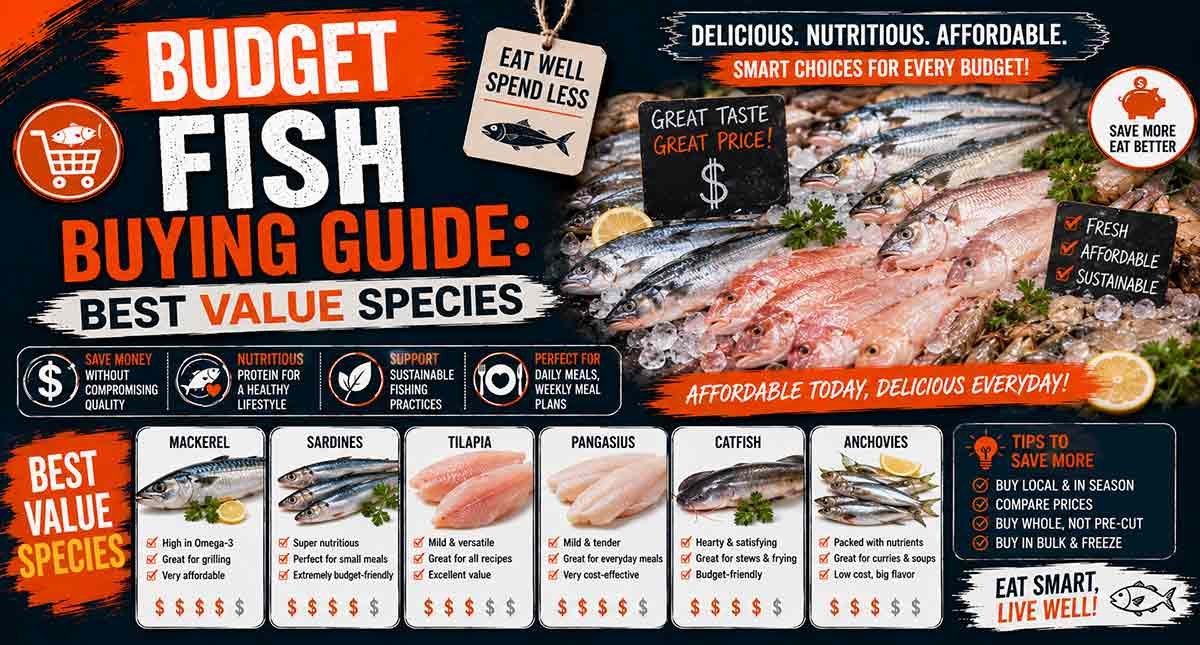
Budget Fish Buying Guide: Best Value Species
Price and quality in fish are much less connected than people assume. Some of the best-tasting, most versatile fish available are also consistently the cheapest, simply because they’re farmed efficiently or haven’t been marketed the way salmon and cod have. This list covers the species that are reliably good value almost everywhere, plus how to think about finding value in your own specific market, since exact prices shift constantly by region, season, and where you’re shopping.
I grew up cooking with fish that never had any marketing behind them at all, and it taught me early that the price tag tells you very little about how good a fish can actually be.
Table of Contents
Why Are Some Fish So Much Cheaper Than Others?
Mainly production efficiency and demand, not quality. Species that farm well at scale, grow quickly, tolerate dense farming conditions, needing less specialized feed, cost less to produce and reach the market at a lower price almost automatically. Tilapia and pangasius are the clearest examples of this: both grow fast, farm efficiently, and are produced at massive global scale, which keeps the price down regardless of how good they taste.
Demand plays an equally large role. Species like salmon and cod have decades of marketing and menu presence behind them, which pushes price up independent of actual scarcity or quality. Plenty of species taste just as good, or better, but simply never got the same marketing push, especially ones more common in cuisines outside the ones a given market’s supermarkets are built around.
The Best Value Fish You Can Buy
Tilapia is about as reliable a budget choice as exists: mild, widely farmed, and forgiving of almost any cooking method, which makes it a genuinely good entry point if you’re newer to cooking fish at all.
Pangasius (also sold as basa or swai) is often even more affordable than tilapia, with a similarly mild flavor that takes on whatever seasoning you pair it with. It’s sold almost exclusively as frozen fillets in most markets, which keeps the price down further.
Catfish, farmed rather than wild, is consistently good value and holds up particularly well to bold seasoning, frying, and grilling; it’s a genuine workhorse fish rather than a delicate one.
Carp is one of the most undervalued fish in many Western markets, specifically because it’s unfamiliar there, despite being a staple, well-loved fish across much of Asia and Eastern Europe. Where it’s available, it’s often dramatically cheaper than more “recognized” fish, and it holds spice and strong flavors extremely well; this is genuinely one of the fish I grew up cooking most.
Mackerel is a real outlier: an oily, flavorful, nutrient-dense fish usually priced well below salmon despite offering comparable richness. It doesn’t keep quite as long as leaner fish, so buy it closer to when you plan to cook it.
Sardines and herring, fresh or canned, are about as inexpensive as fish gets, and they’re some of the most nutrient-dense options available for the price, period.
Don’t Forget Canned Fish
Canned tuna, salmon, sardines, and mackerel are genuinely excellent value, often cheaper per serving of protein than any fresh option, and they require zero skill to buy correctly, since there’s no freshness judgment involved. They’re shelf-stable too, which means no risk of waste from a fish that doesn’t get cooked in time.
Canned fish isn’t a downgrade so much as a different tool: it’s harder to build a dinner-party centerpiece around, but for a quick lunch, a pasta sauce, or a sandwich, it consistently outperforms its cost. I keep a rotating stock of canned sardines and mackerel specifically because they’re this reliable.
How Do You Find Good Value in Your Own Market?
Exact prices shift constantly by region, season, and even which store you’re in, so a fixed price list goes stale fast. What doesn’t go stale is the approach: ask what’s currently abundant or in season locally, since abundance drives price down regardless of species; check whether a species is farmed at scale nearby, since local farming usually beats imported for both price and freshness; and don’t automatically skip a fish just because you don’t recognize the name.
This is the same logic behind budget shopping in general: build the meal around what’s genuinely good value that day, rather than shopping for one specific fish and paying whatever it costs. The full strategy, including whole versus fillet and fresh versus frozen for value specifically, is covered in the main buying guide, linked below.
Does Cheaper Mean Lower Quality?
Not inherently it usually means better production efficiency or less marketing, not worse fish. Some of the least expensive species are also some of the most forgiving and versatile to cook, which makes them a genuinely good place to build real cooking confidence rather than a compromise you settle for.
I’ve built entire dishes, including some of the ones I’m proudest of, around fish that cost a fraction of what salmon or cod would have. The technique and the seasoning are what make a dish good; the species is just the starting material.
Frequently Asked Questions
Is frozen fish cheaper than fresh for these budget species?
Usually yes, and for mild, versatile species like tilapia and pangasius, there’s rarely a noticeable difference in the finished dish, since they’re mostly sold frozen anyway.
Are budget fish less nutritious than expensive ones?
No. Some of the least expensive options, like sardines and mackerel, are among the most nutrient-dense fish available. Price and nutrition aren’t closely linked either.
Why is carp considered a “trash fish” in some markets?
More history and unfamiliarity than anything about the fish itself. It’s a staple, respected fish across much of Asia and Eastern Europe, and the reputation says more about regional food culture than about carp’s actual quality.
Is it worth buying whole budget fish instead of fillets?
Often yes, for the same reasons covered in the whole-fish-versus-fillet guide; it typically stretches your budget further once you’re comfortable with the prep.
What to Check Next
Whichever you buy, the freshness checklist in How to Tell if Fish Is Fresh: The Buyer’s Checklist still applies once it’s thawed. For full recipes built specifically around affordable species, see Budget-Friendly Fish Recipes. And for the complete buying process this fits into, start with The Complete Guide to Buying Fish and Seafood.

One Comment