Fish Protein Content Compared by Species
Tuna tins shout about protein, salmon marketers claim it too, and the humble white fillet quietly gets treated like the loser. I have watched that noise push readers toward the priciest tin on the shelf. The fish with the most protein, by the numbers I could verify, is canned light tuna: about 25.5 grams of protein in every 100 grams, drained. Canned sardines follow at about 24.6 grams. After those two, the honest surprise: salmon, shrimp, tilapia, and trout all sit within half a gram of each other near 20 grams, and even the lowest fish here, catfish, gives about 15 grams. I did not write this from memory. Every number below comes from USDA FoodData Central, opened entry by entry.
I am Wasim Abbas Bhatti, the Fish’s Chef. I have cooked fish for more than twenty years, and “which fish is best for protein?” is a question readers bring to my counter often. This guide is my sourced answer, inside Fish Nutrition and Health: The Complete Guide, Mahigar’s nutrition hub. One note before the chart: this is general information, not medical advice. How much protein you personally need is a question for your own doctor or dietitian.
Table of Contents
How I Built This Chart (Read This Before the Numbers)
One source. Every figure comes from USDA FoodData Central (fdc.nal.usda.gov), SR Legacy entries, opened one by one. No blog lists, no packaging claims, no numbers from my memory.
One measure. For each fish I read one field: Protein (FoodData Central nutrient 203), in grams. The fat figures in my notes come from the same opened entries. Nowhere else.
One basis, with two labelled exceptions. All figures are per 100 grams, raw. The exceptions are the two canned fish. FoodData Central has no raw sardine entry, and canned is the tuna most of us buy. Both are labelled “canned” everywhere, per 100 grams drained.
No serving-size mathematics. You will not find “grams per serving” here. Turning raw laboratory values into cooked servings needs cooked weights I did not verify, and I will not invent them.
Guidance, not laboratory precision. Protein varies with wild or farmed origin, the cut, and water content. Where fish sit within about a gram of each other, I call them tied, because on your plate, they are.
The Chart: Fish Protein Content Compared by Species
Here is the full chart first, then my cook’s notes. The last column is the FDA/EPA mercury category, and notice: every fish here, including the two canned ones, sits in Best Choices.
| # | Fish | Protein (g per 100 g) | Fat (g per 100 g) | FDA/EPA mercury category |
|---|---|---|---|---|
| 1 | Canned light tuna (in water, drained) | 25.5 | 0.8 | Best Choices |
| 2 | Sardines (canned in oil, drained, with bone) | 24.6 | 11.5 | Best Choices |
| 3 | Atlantic salmon (farmed) | 20.4 | 13.4 | Best Choices |
| 4 | Shrimp | 20.1 | 0.5 | Best Choices |
| 5 | Tilapia | 20.1 | 1.7 | Best Choices |
| 6 | Rainbow trout (farmed) | 19.9 | 6.2 | Best Choices |
| 7 | Atlantic mackerel | 18.6 | 13.9 | Best Choices |
| 8 | Atlantic cod | 17.8 | 0.7 | Best Choices |
| 9 | Haddock | 16.3 | 0.5 | Best Choices |
| 10 | Channel catfish (farmed) | 15.2 | 5.9 | Best Choices |
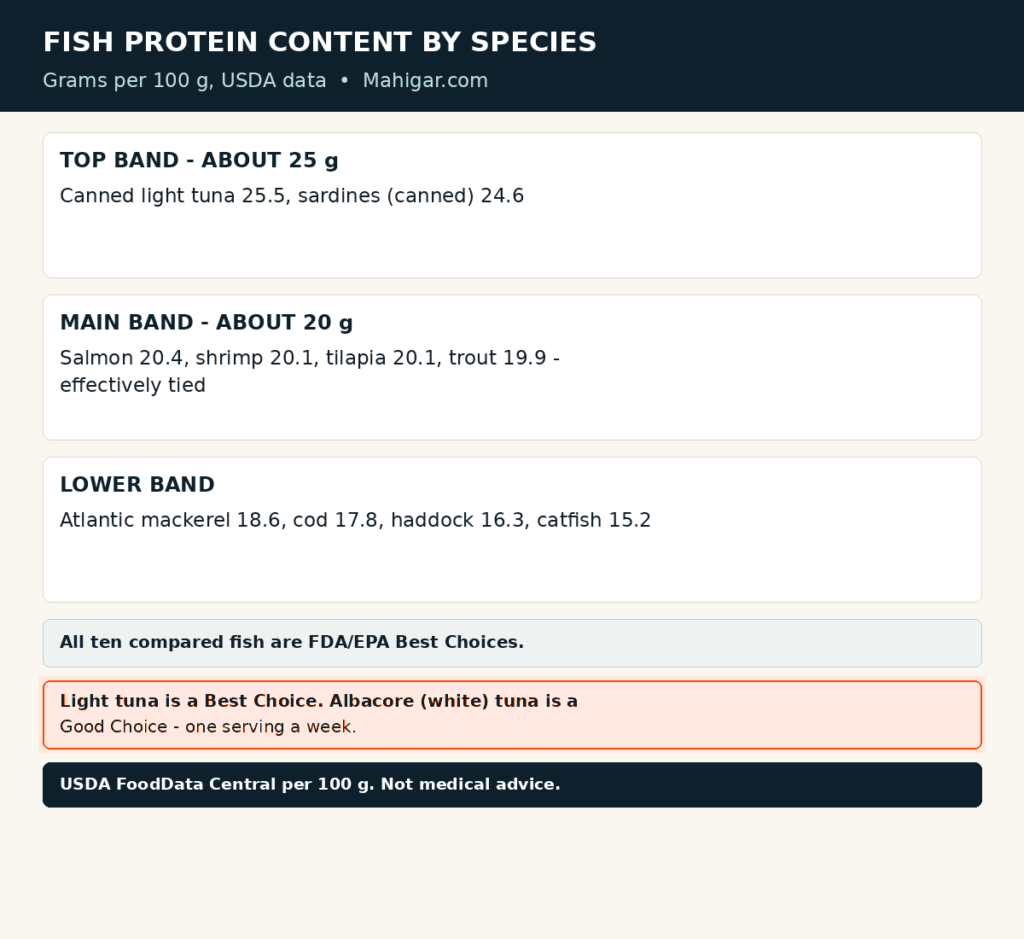
Read the chart in bands, not ranks. The two canned fish form a top band of their own. Salmon, shrimp, tilapia, and trout form a main band near 20 grams where the differences are too small to taste. The last four sit a few grams lower, still solid protein foods. Nobody’s dinner succeeds or fails over two grams in this table.
The Top Band: The Two Canned Fish
Canned light tuna: 25.5 g
The chart-topper is a pantry tin: light tuna, canned in water, without salt, drained solids, with 25.5 grams of protein and under a gram of fat (0.8 g), eaten on rice, in salads, in sandwiches. One caution rides with it: light tuna is an FDA/EPA Best Choice. Albacore (white) tuna is a different fish on the mercury chart, a Good Choice at one serving a week. The name on the can changes the answer.
Sardines, canned: 24.6 g
Close behind, carrying their soft bones: Atlantic sardines canned in oil, drained, at 24.6 grams of protein and 11.5 grams of fat. That fat is why sardines appear in every omega-3 conversation, but for protein alone a drained tin is one of the strongest pantry foods I know: already cooked, already portioned.
One honest note. Both leaders are canned and drained, which concentrates the fish. Water has left, so each 100 grams holds more flesh than raw fillet. Not cheating; it is how we eat them. But it is part of why the tins stand apart.
The Main Band: Four Fish, Effectively Tied
Salmon at 20.4, shrimp at 20.1, tilapia at 20.1, trout at 19.9, half a gram from top to bottom. No honest chart calls that a ranking. These four are the same protein food wearing different clothes.
Atlantic salmon (farmed): 20.4 g
The famous one, and the richest plate of the four: 13.4 grams of fat ride along with the protein. That fat is no flaw: it is where salmon’s omega-3 lives, and it keeps a fillet forgiving when a beginner gives it one minute too many.
Shrimp: 20.1 g
The leanest strong performer on the chart. At 0.5 grams of fat, shrimp is close to pure protein by this table. The cost is attention, not nutrition: shrimp cook in moments and turn firm and dry when forgotten.
Tilapia: 20.1 g
The fish people apologise for, matching the famous names gram for gram at a lean 1.7 grams of fat. Its mildness is a flavour fact, not a nutrition verdict. It will not bring salmon’s omega-3 (lean fish never will), but for protein it stands level with this whole band. Dismiss it for taste if you like. Do not dismiss it for protein.
Rainbow trout (farmed): 19.9 g
Salmon’s gentler cousin takes the middle path: 19.9 grams of protein with a moderate 6.2 grams of fat, some of salmon’s richness without going all the way there. Half a gram below salmon is not a gap.
Choose between these four by fat, price, taste, or the day’s omega-3 plan, not by protein. Protein has already voted, and it is a tie.
The Lower Band: Still Honest Protein
The last four sit a few grams lower, and this band holds the chart’s best lesson: the fish that “loses” a protein comparison can be the one that wins the week.
Atlantic mackerel: 18.6 g
Read this line twice. The lowest-protein oily fish here is the fish that topped this site’s omega-3 ranking. At 13.9 grams of fat, mackerel spends part of its flesh on fat, and that fat is the cargo the omega-3 guide cares about. Protein is one job of a fish; mackerel proves it is not the only one. The full story is in Omega-3 Rich Fish, Ranked by Species.
Atlantic cod: 17.8 g
The classic white fillet: 17.8 grams of protein at 0.7 grams of fat, clean, mild, built for dishes where a sauce, a curry, or a crisp batter carries the richness. Cod asks one thing in return: care at the stove. Lean fish dry out when overcooked, and no protein figure rescues a fillet left five minutes too long.
Haddock: 16.3 g
Cod’s close relative sits a step lower, at 0.5 grams of fat, as lean as shrimp on this chart. Haddock is the fish-and-chips fish for a reason: it flakes in clean layers and takes a crust kindly. A gram and a half between cousins does not argue back. Choose it for the eating, not the arithmetic.
Channel catfish (farmed): 15.2 g
The chart’s last line is still a solid protein food by any honest measure. Catfish trades a little protein for a softer, slightly richer flesh at 5.9 grams of fat, and in the kitchens I cook from, that trade is the point: catfish takes spice, frying, and gravy in ways leaner fish cannot. This chart ranks one nutrient. Dinner ranks the fish.
What the Chart Cannot Tell You
Raw is not cooked. This chart compares raw fish (and two drained tins) because that is the cleanest honest basis FoodData Central offers. When fish cooks, water leaves the flesh, so the same protein sits in a smaller, lighter piece.
Protein does not choose your fish for you. The American Heart Association’s plain point is that fish is a good source of protein and, unlike fatty meat products, is not high in saturated fat. Most fish cluster close together; the real differences are fat and omega-3.
Mercury still sets the guest list. Every fish on this chart is an FDA/EPA Best Choice at two to three servings a week. The one name to watch is albacore (white) tuna, a Good Choice at one serving a week. The full chart, with pregnancy and child servings, lives in Mercury in Fish: Safe Levels by Species.
How to Use This Chart in a Real Week
Stop hunting for the perfect protein fish. There isn’t one, and that is liberating.
Pick by the job. Protein with almost nothing else attached? Shrimp, cod, and haddock are the lean carriers. Protein plus the omega-3 cargo? Salmon, sardines, and mackerel carry both. Protein that survives a busy week in the pantry? The two canned fish are already cooked and waiting. And if you are building high-protein plates on purpose, High-Protein Fish Recipes is the guide this chart feeds into.
Then rotate. Two to three fish meals a week, mixed across these bands, covers protein without a single calculation at the counter. For how that pattern fits the official guidance, see How Much Fish Should You Eat Per Week?.
Frequently Asked Questions
Which fish has the most protein?
Canned light tuna: about 25.5 grams per 100 grams drained, with canned sardines close behind at 24.6 grams, both from USDA FoodData Central. Among raw fish, salmon, shrimp, tilapia, and trout all sit near 20 grams, effectively tied.
Is salmon a high-protein fish?
Yes: about 20.4 grams per 100 grams raw, level with shrimp and tilapia. What sets salmon apart is not extra protein but its fat: about 13.4 grams per 100 grams, where its omega-3 lives.
Does cooking change the protein in fish?
Cooking does not destroy protein; it drives water out, so a cooked piece carries its protein in a smaller weight than the raw piece. That is why this chart compares raw values per 100 grams instead of inventing cooked serving numbers.
Is fish protein enough on its own, or do I need meat too?
Fish provides high-quality protein (the building-block role USDA describes for protein foods), without the saturated fat of fatty meats. Whether fish alone covers your needs depends on your whole diet; ask your doctor or dietitian. Among fish, protein is rarely the reason to choose one over another. This is general information, not medical advice.
