How Much Fish Should You Eat Per Week
Every label, headline, and fish-counter neighbour gives a different number for how much fish to eat, and I have watched that confusion keep fish off family tables entirely. For most adults, the answer is: two servings of fish a week, at least one of them oily, chosen from the lower-mercury fish. The American Heart Association recommends 2 servings of fish (particularly fatty fish) per week. The Dietary Guidelines for Americans recommend at least 8 ounces of seafood a week. The FDA/EPA chart says the same thing in its own way: fish in the Best Choices group can be eaten 2 to 3 servings a week. Three voices, one rhythm: fish twice a week.
I am Wasim Abbas Bhatti, the Fish’s Chef. I have cooked fish for more than twenty years and fished local canals for eight. Readers ask me this question at the fish counter more than any other: “How much of this should we actually eat?” This guide sits inside Fish Nutrition and Health: The Complete Guide, Mahigar’s nutrition hub, and gives the official answer in kitchen language, pregnancy and children included.
One note before the numbers: this is general information, not medical advice. If you are pregnant, feeding young children, or following your own doctor’s advice, that personal guidance comes first.
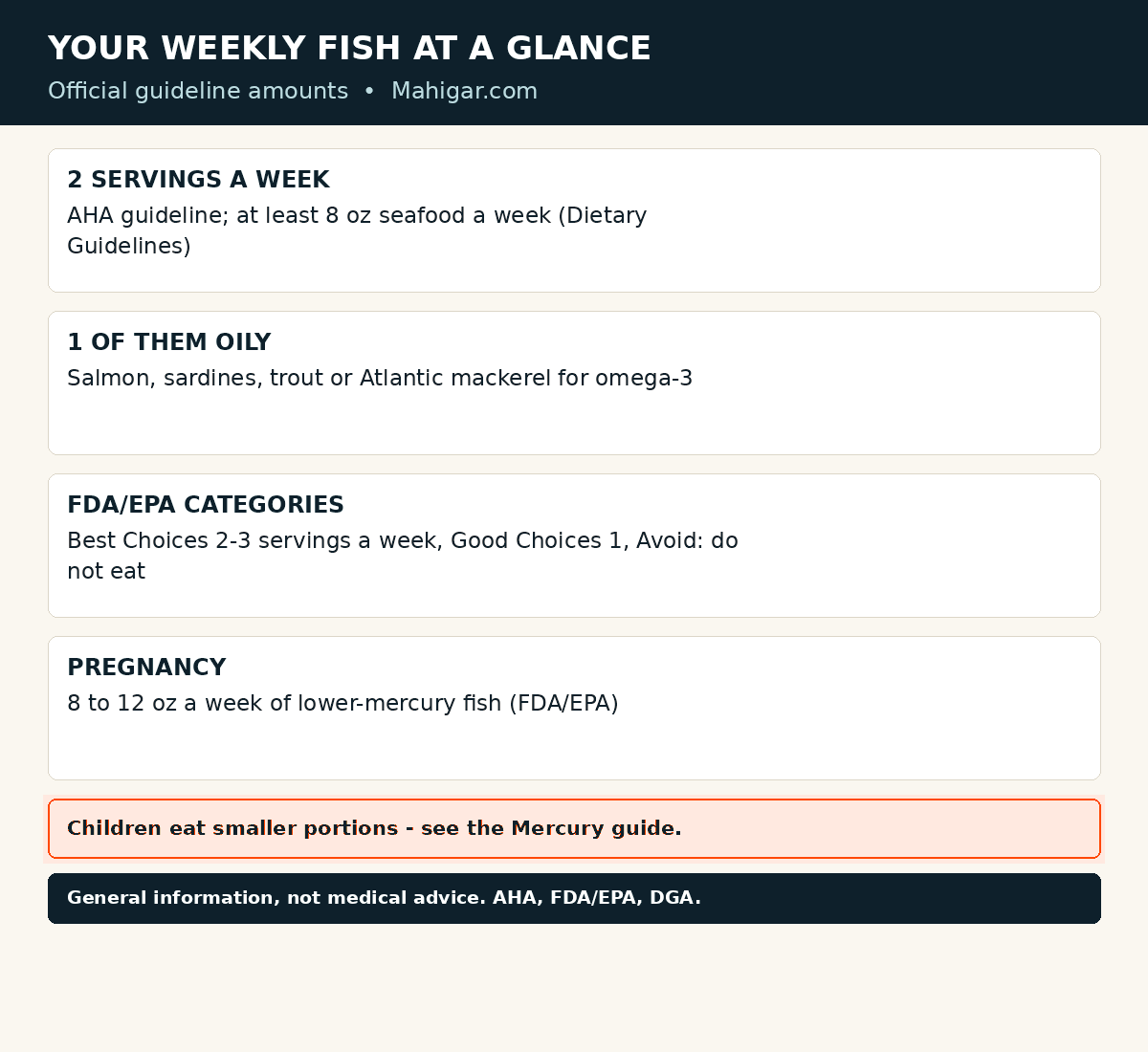
Table of Contents
What Counts as a Serving?
The official numbers look different because the bodies measure a serving differently. Once you see that, they stop arguing with each other.
The AHA serving is 3 ounces, cooked. The American Heart Association’s serving is 3 ounces of cooked fish, about 3/4 cup of flaked fish. On the plate, that is a piece roughly the size of a deck of cards.
The FDA/EPA serving is 4 ounces. The mercury chart counts an adult serving as 4 ounces, about the size of your palm. That is the serving behind “2 to 3 servings a week” for Best Choices fish. Two palm-sized servings make 8 ounces, which lands exactly on the Dietary Guidelines floor of at least 8 ounces of seafood a week.
So do not stack the numbers. Two AHA servings is about 6 ounces cooked; two FDA/EPA servings is 8 ounces. Either way, you land on “fish twice a week.” At my own table I keep it simpler: a palm-sized piece, twice a week, one of them oily.
Which Fish Fill Those Servings? The Mercury Categories Decide
How much fish you can eat depends on which fish it is. Mercury builds up in big, long-lived predators, and no cooking removes it, so the FDA and EPA sort fish into three groups:
- Best Choices (lowest mercury): 2 to 3 servings a week. Salmon, sardines, tilapia, catfish, cod, canned light tuna, trout, haddock, and Atlantic mackerel live here, among others. Fish from this group can fill both of your weekly servings.
- Good Choices: 1 serving a week, and no other fish that week. Albacore (white) tuna, halibut, mahi mahi, snapper, and carp sit in this group.
- Choices to Avoid: do not eat. Shark, swordfish, king mackerel, marlin, orange roughy, bigeye tuna, and tilefish from the Gulf of Mexico.
The full chart (every species, plus the pregnancy and child servings) is in Mercury in Fish: Safe Levels by Species. One habit ties it all together: variety. The American Heart Association notes that eating a variety of fish helps reduce any potential effects of environmental pollutants. Rotate the species, and you spread the nutrients and the small risks at the same time.
If You Are Pregnant or Breastfeeding
Here the advice is not “eat less fish.” It is “eat the right fish, on purpose.” The FDA/EPA Advice about Eating Fish recommends 8 to 12 ounces of seafood a week during pregnancy and breastfeeding (that is 2 to 3 servings of 4 ounces), drawn from a variety of lower-mercury choices, and the Dietary Guidelines for Americans give the same 8 to 12 ounces. Fish provides key nutrients that support a baby’s brain development, which is why the guidance wants fish on the plate, chosen carefully.
The working rules are simple: build the week from the Best Choices; if you eat one serving from the Good Choices, make it the only fish that week; eat nothing from the Choices to Avoid. And please treat this as what it is: general FDA/EPA guidance, not medical advice for your pregnancy. Your own doctor knows your situation; follow them first.
Children: Smaller Portions, Same Best Choices
Children eat from the same chart, in smaller pieces. The EPA-FDA Advice about Eating Fish recommends that children eat 1 to 2 servings of fish each week from the “best choices” list, in smaller portion sizes than adults: about 1 ounce per serving for the youngest children, at ages 1 to 3, growing with age until about age 11, when a child can eat the adult-sized portion of 4 ounces. The exact portion for each age, and the fish never to serve children, are laid out in the Mercury guide linked above.
In my kitchen that means the same family fish, cut smaller: a mild Best-Choice fillet like tilapia or cod, bones checked carefully, in a portion that fits the child. The rule from the pregnancy section applies here too: this is general information, and your child’s doctor comes first.
Fresh, Frozen, or Canned: It All Counts
Readers sometimes ask whether the weekly servings only count at the fish counter. They do not.
Fresh fish counts, of course. Frozen fish counts the same way. Fish frozen promptly holds its goodness, and a well-frozen fillet beats a “fresh” one that has sat too long. Canned fish counts too, and the name on the tin matters: canned light tuna is a Best Choice that can fill a weekly serving, while albacore (white) tuna is a Good Choice at one serving a week. Sardines and canned salmon bring oily-fish value from the pantry shelf.
Once a tin is opened, treat it like cooked fish: into the fridge at 40°F (4°C) or below, and use it within three to four days. The serving rules never change with the packaging. Only the species and the portion do.
What If You Eat More, or Less?
More. None of the sources above gives healthy adults a hard weekly ceiling for low-mercury fish. What they give instead is guardrails. Stay mostly inside the Best Choices. Keep the variety wide. Treat one serving of a Good-Choice fish as that week’s fish. And if you eat a lot of fish (more than 8 ounces a week, especially fish you catch yourself), the EPA advises paying particular attention to the local advisories for the waters you fish. I fish canals, so that sentence is written for people like me. Through all of it, the oily serving is the one doing the special work, because oily fish carries the omega-3 EPA and DHA, ranked species by species in Omega-3 Rich Fish, Ranked by Species.
Less. One serving a week is not failure; it is one serving more than none. The benefits in the research belong to patterns (fish on the plate regularly, often instead of fattier meats), not to hitting a quota under pressure. Start with one fish you genuinely enjoy, cooked well, and let the second serving arrive when it wants to.
One Ordinary Week, As an Example
This is not a meal plan and not a prescription, just how the guidance looks on real plates in my house:
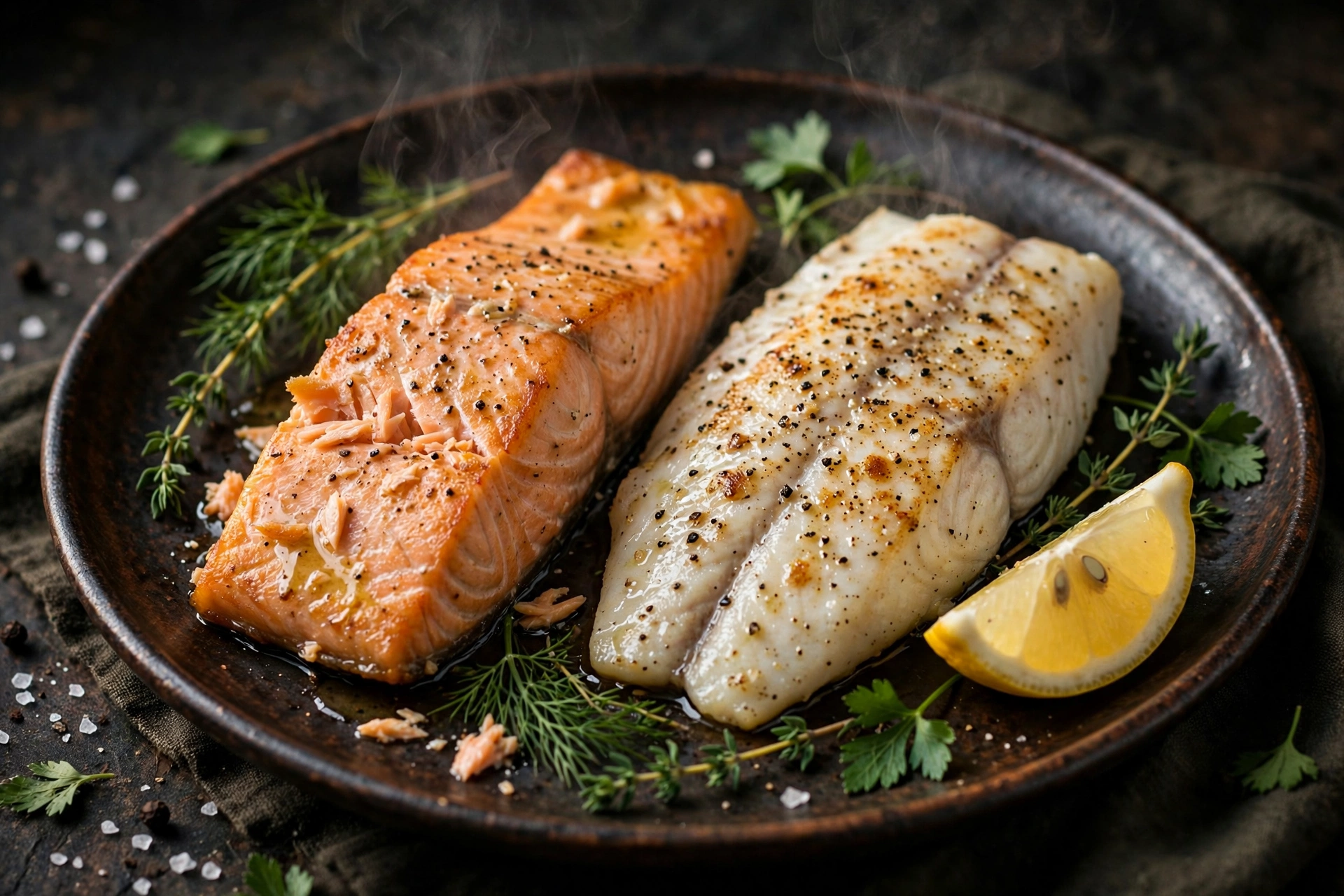
- Early in the week: a salmon fillet, pan-cooked, with lemon and herbs. Oily fish: done. Best Choice: done.
- Later in the week: a mild white fish (tilapia or cod) in a light home curry, or a tin of light tuna turned into a quick lunch. Lean, gentle, still a Best Choice.
Two servings, one of them oily, both low-mercury. Some weeks the second plate becomes sardines on toast or a simple tilapia fry with the family; the rhythm matters more than the exact fish. And every plate follows the same finishing rule: fin fish cooked to 145°F (63°C) in the thickest part, or opaque and flaking. The full chart is in Safe Internal Cooking Temperatures for Every Type of Fish.
Frequently Asked Questions
How much fish should I eat per week?
For most adults: two servings a week, at least one of them oily. The American Heart Association recommends 2 servings of fish, particularly fatty fish, a week, at 3 ounces cooked each. The Dietary Guidelines for Americans recommend at least 8 ounces of seafood a week. The FDA/EPA chart lets Best Choices fish fill 2 to 3 servings of 4 ounces a week. Choose lower-mercury fish and you satisfy all three.
Can I eat fish every day?
You can eat fish more often than twice a week if you choose well: the guardrails are species and variety, not a daily ban. Best Choices are the fish the FDA/EPA chart allows 2 to 3 servings a week; a Good Choice stays at once a week with no other fish that week; Choices to Avoid stay off the plate. Rotate species instead of eating the same fish daily, and if much of your fish is self-caught, follow local advisories, as the EPA advises. This is general information, not medical advice.
How much fish can I eat while pregnant?
The FDA/EPA Advice about Eating Fish recommends 8 to 12 ounces of lower-mercury seafood a week during pregnancy and breastfeeding (2 to 3 servings of 4 ounces from the Best Choices). One serving from the Good Choices can take the place of that for the week, and the Choices to Avoid are not eaten at all. Follow your own doctor first; this is general information.
Does canned tuna count toward the two servings?
Yes. Canned light tuna is an FDA/EPA Best Choice and can fill one of your weekly servings. Albacore (white) tuna is a Good Choice: one serving a week, and no other fish that week. The word on the tin decides which rule you are following.
What to Check Next
Put two fish meals on this week’s list: one oily, one lean or canned, both from the Best Choices, each cooked to a proper finish. That is the whole guideline wearing an apron. Check your fish against the Mercury chart before you shop, and the temperature before you serve. Two fish nights a week, one of them oily, chosen by the chart.
Sources and standards used: American Heart Association, “Fish and Omega-3 Fatty Acids” (2 servings of fish, particularly fatty fish, per week; serving of 3 ounces cooked, about 3/4 cup flaked; eating a variety of fish helps reduce potential effects of environmental pollutants; benefits outweigh risks within FDA/EPA recommendations). U.S. EPA, “EPA-FDA Advice about Eating Fish and Shellfish” and “Should I Be Concerned about Eating Fish and Shellfish?” (Dietary Guidelines for Americans: at least 8 ounces of seafood per week on a 2,000-calorie diet; pregnancy/breastfeeding 8 to 12 ounces per week of lower-mercury seafood, i.e. 2 to 3 servings of 4 ounces from the lowest-mercury choices or one 4-ounce serving of a higher-mercury choice; children 1 to 2 servings per week from the Best Choices with portions from about 1 ounce at ages 1 to 3 up to the adult 4 ounces at age 11 and older; people eating more than 8 ounces a week should pay particular attention to local advisories). Mercury categories and servings as established in Mahigar Article 03 from the FDA/EPA chart (Best Choices 2 to 3 servings a week, Good Choices 1 serving a week and no other fish that week, Choices to Avoid do not eat; adult serving 4 ounces; no mercury levels stated). Cooking figure (145°F/63°C) follows FoodSafety.gov/FDA guidance as established in Mahigar Article 02; fridge figure (40°F/4°C, opened fish used within 3 to 4 days) as established in Mahigar Articles 01 and 54. This is general information, not medical advice; personal medical guidance comes from your own doctor.
