Omega-3 Rich Fish, Ranked by Species
Oily fish sellers and online lists all shout a different answer, and I have watched readers spend months buying the wrong fish for the omega-3 they want. The fish with the most omega 3, by the numbers I could verify, is Atlantic mackerel: about 2.30 grams of EPA and DHA together in every 100 grams, raw. Atlantic salmon comes next at about 1.96 grams. I did not write this ranking from memory. Every number below comes from USDA FoodData Central, the US government’s food database, opened entry by entry.
I am Wasim Abbas Bhatti, the Fish’s Chef. I have cooked fish for more than twenty years, and readers ask me this question more than almost any other: “Which fish should I eat for omega 3?” This guide is my honest answer, and it belongs inside Fish Nutrition and Health: The Complete Guide, Mahigar’s nutrition hub. One note before the list: this is general information, not medical advice. Your own doctor’s guidance comes first.
Table of Contents
How I Built This Ranking (Read This Before the Numbers)
A ranking is only as honest as its data table, so here is exactly what I did.
One source. Every figure comes from USDA FoodData Central (fdc.nal.usda.gov), SR Legacy entries, opened one by one. No blog lists, no packaging claims, no numbers from my memory.
One measure. For each fish I added two fields together: EPA (listed in FoodData Central as “PUFA 20:5 n-3”) and DHA (“PUFA 22:6 n-3”), the two long-chain omega-3 fats in fish that the heart guidance keeps returning to. I did not count ALA, the plant omega-3; fish carry very little of it.
One basis, with one labelled exception. All figures are per 100 grams, raw. The exception is sardines: FoodData Central has no raw sardine entry, so I used the canned sardine most of us actually buy (canned in oil, drained, with the soft bones), labelled “canned” everywhere below.
Guidance, not laboratory precision. Omega-3 values move with wild or farmed origin, season, water, and cooking. Treat this order as a reliable guide to which fish do the omega-3 job well, not a promise about your exact fillet tonight.
The Ranking: Fish With Most Omega 3, by Species
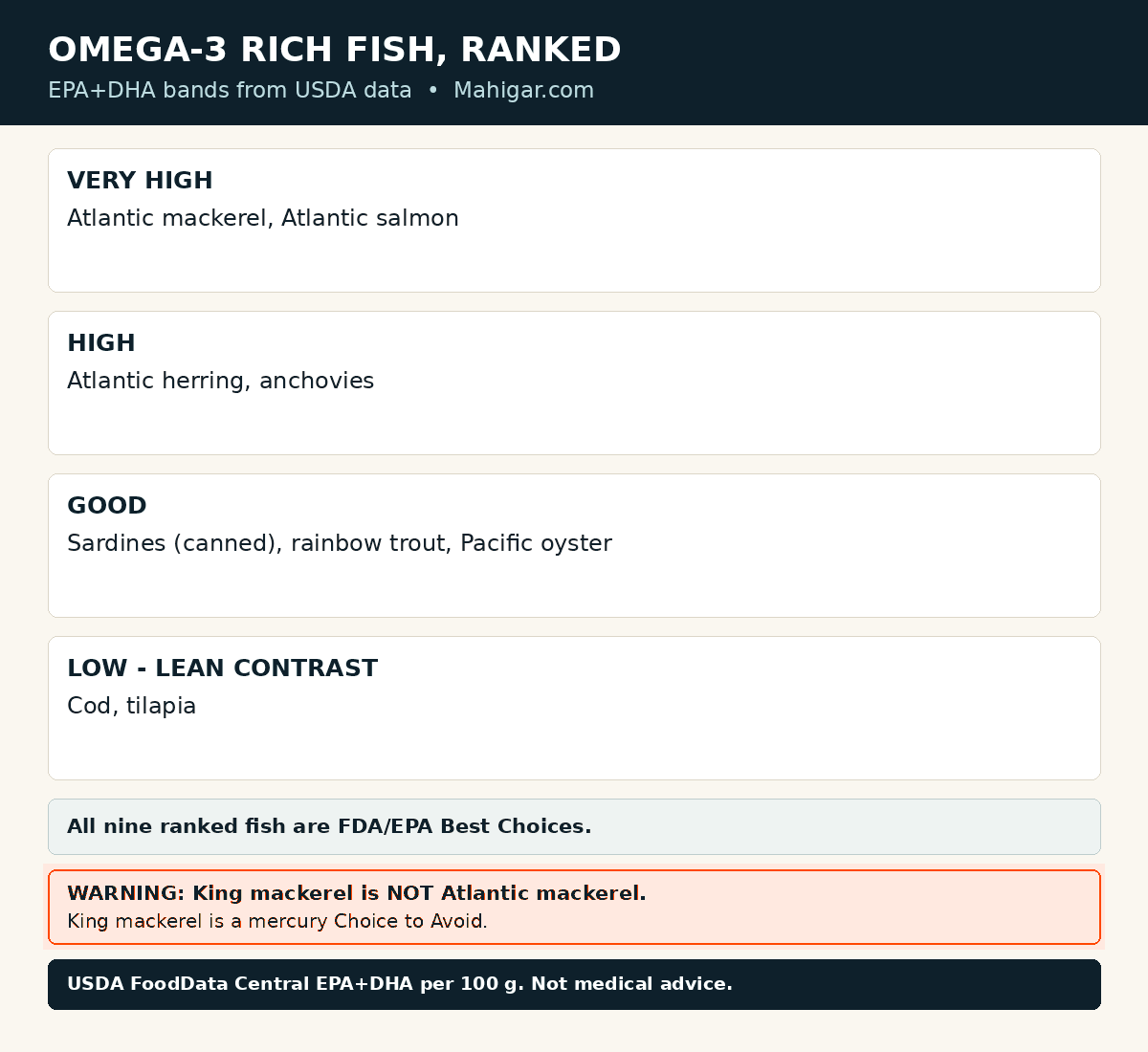
Here is the full table first, then my cook’s notes on each fish. The last column is the FDA/EPA mercury category from the joint FDA/EPA advice, and notice something useful: every fish on this ranked list, including the two lean fish at the bottom, sits in Best Choices.
| Rank | Fish | EPA+DHA (g per 100 g) | FDA/EPA mercury category |
|---|---|---|---|
| 1 | Atlantic mackerel | ≈2.30 | Best Choices |
| 2 | Atlantic salmon (farmed) | ≈1.96 | Best Choices |
| 3 | Atlantic herring | ≈1.57 | Best Choices |
| 4 | Anchovies (European) | ≈1.45 | Best Choices |
| 5 | Sardines (canned in oil, drained) | ≈0.98 | Best Choices |
| 6 | Rainbow trout (farmed) | ≈0.73 | Best Choices |
| 7 | Pacific oyster | ≈0.69 | Best Choices |
| 8 | Atlantic cod (lean contrast) | ≈0.18 | Best Choices |
| 9 | Tilapia (lean contrast) | ≈0.09 | Best Choices |
1. Atlantic mackerel: ≈2.30 g
The strongest omega-3 fish on this list, and by a clear gap. Atlantic mackerel is small, oily, strongly flavoured, and cheap for what it gives. Now the warning that matters more than the number: Atlantic mackerel is not king mackerel. Atlantic mackerel is an FDA/EPA Best Choice. King mackerel is a large predator in Choices to Avoid, so never chase omega-3 with king mackerel. Check the exact name at the counter.
2. Atlantic salmon (farmed): ≈1.96 g
The famous one earns its place. Farmed Atlantic salmon is the FoodData Central entry used here, and it still lands close to 2 grams. The fat that carries the omega-3 also keeps the fillet moist for the extra minute every beginner needs, so if only one oily fish enters your week, this is the easiest one to start with.
3. Atlantic herring: ≈1.57 g
The quiet achiever of the oily fish world. Herring carries more EPA and DHA than anchovies and sardines on this table, yet it is usually sold pickled, smoked, or tinned rather than fresh, which is fine. The omega-3 survives those forms well enough for the everyday plate, and the price is gentle.
4. Anchovies (European): ≈1.45 g
Nobody eats 100 grams of anchovies, and that is the point. Anchovies are a flavour tool: a few fillets melted into a sauce, dressing, or curry base bring real EPA and DHA in a tiny portion, on top of whatever fish is the main event. Small fish, short life, Best Choice. The pattern holds.
5. Sardines (canned in oil, drained): ≈0.98 g
The sardine figure is the canned fish, drained, bones in: the tin in your pantry, not a laboratory fish. Even measured that honest way, it sits in solid ground, and the soft bones bring calcium that the fillets on this list do not. In my ranking of effort, sardines win outright: open tin, lemon, chilli, done.
6. Rainbow trout (farmed): ≈0.73 g
Trout is where wary eaters should start. Its omega-3 is moderate (well below salmon), but its flavour is mild, its flesh is delicate, and it cooks in minutes. USDA guidance names trout among the commonly eaten fish higher in EPA and DHA and lower in mercury, and for a family table that matters more than a league position.
7. Pacific oyster: ≈0.69 g
The surprise guest. Pacific oysters carry nearly as much EPA and DHA as trout, with a strong share of EPA. USDA guidance singles Pacific oysters out for exactly this. Two honest limits: oysters are eaten in small portions, so the per-plate total stays modest, and raw shellfish carries risks cooked fish does not. Buy raw oysters only from a source you trust; cooking them keeps most of the point with less of the worry.
8 and 9. Cod (≈0.18 g) and tilapia (≈0.09 g): the honest bottom
I put cod and tilapia on this table so you can see the whole picture. They are lean white fish: excellent protein, gentle flavour, Best Choices for mercury, and very little omega 3. One serving of Atlantic mackerel carries roughly as much EPA and DHA as twelve servings of cod. That is not a reason to drop lean fish from your table. It is a reason to know which job each fish does, which is the heart of Health Benefits of Eating Fish, Backed by Research.
Where Mercury Fits in This Ranking
Good news first: you do not have to trade mercury for omega-3. Every fish ranked above is an FDA/EPA Best Choice, the group the FDA/EPA advice allows two to three servings a week (an adult serving is 4 ounces). The omega-3 champions and the low-mercury list are almost the same list, because small oily fish live fast and collect little mercury.
The traps are in the names. King mackerel sounds like a bigger, better Atlantic mackerel; it is actually a Choices to Avoid fish. Big, long-lived predators in general (shark, swordfish, king mackerel, marlin, orange roughy, bigeye tuna, tilefish from the Gulf of Mexico) are the avoid list, and none of them is needed for omega-3. The full chart, with pregnancy and child servings, is in Mercury in Fish: Safe Levels by Species. Choose by the exact species name, and the trade-off mostly disappears.
And the usual closing rule of my kitchen: rank never excuses cooking. Oily fish is still finished at 145°F (63°C) in the thickest part, or opaque and flaking. The full chart is in Safe Internal Cooking Temperatures for Every Type of Fish.
How to Use This Ranking in a Real Week
Do not turn this table into homework. Use it like a cook.
One oily fish a week does most of the job. The American Heart Association recommends 2 servings of fish a week, particularly fatty fish, at 3 ounces cooked a serving. One salmon, mackerel, herring, or sardine meal, plus one gentler fish, puts you inside that guidance without effort. The Dietary Guidelines for Americans ask for at least 8 ounces of seafood a week, the same rhythm in different words.
Buy by trait when names are missing. Our markets do not always label like an American counter. The trait that predicts omega-3 is oiliness: darker, richer flesh that flakes into moist layers. Lean, white, mild fillets are protein fish. Both belong on the table; now you know which is which.
Variety beats a single champion. The FDA/EPA advice favours a variety of fish over the same fish every time, and the AHA adds that variety helps reduce any potential effects from environmental pollutants. Rotate down this list across the month instead of eating the number one fish daily.
In pregnancy, keep the fish, shorten the list. The FDA/EPA recommend 8 to 12 ounces a week of lower-mercury seafood in pregnancy and breastfeeding. This ranking helps rather than hurts there: salmon, sardines, trout, and anchovies are Best Choices with real omega-3. Follow your own doctor alongside the chart.
Frequently Asked Questions
Which fish has the most omega 3?
Atlantic mackerel, on the USDA FoodData Central figures used here: about 2.30 grams of EPA and DHA together per 100 grams, raw, ahead of Atlantic salmon at about 1.96 grams. Atlantic mackerel is an FDA/EPA Best Choice, but king mackerel is a different fish on the Choices to Avoid list, so check the exact name.
Are sardines really that high in omega 3?
Yes, with one honest label: the figure here, about 0.98 grams of EPA+DHA per 100 grams, is for canned sardines in oil, drained, with bones (the tin most people buy), because FoodData Central has no raw sardine entry. Even measured that way, sardines sit in the good-source band, and the soft bones add calcium.
Does cooking destroy omega 3 in fish?
Gentle, ordinary cooking does not wipe out EPA and DHA; the bigger changes come from the fish itself (wild or farmed, season, and water), which is why this ranking is guidance, not laboratory precision for your fillet. Cook oily fish until just done, 145°F (63°C) or opaque and flaking, and you keep both the safety and the point of eating it.
I do not like oily fish. Can lean fish cover my omega 3?
Not on its own, on these numbers: cod carries about 0.18 grams of EPA+DHA per 100 grams and tilapia about 0.09, so one portion of Atlantic mackerel roughly equals twelve portions of cod. A workable middle path is trout or Pacific oysters (milder than salmon and mackerel, with moderate omega-3), while lean fish still covers your protein meals well. This is general information, not medical advice; ask your doctor if omega-3 intake is a medical question for you.
What to Check Next
Use this ranking at the fish counter, not as a lecture: one oily Best Choice a week, one gentle fish beside it, and the exact species name checked before money changes hands. From here, the natural next read is the benefits guide linked above, what that omega-3 actually does. Eat the fish. Enjoy it. That part is not a small thing.
Sources used (named in text, not medical advice): USDA FoodData Central (fdc.nal.usda.gov), SR Legacy entries opened 2026-10-07; ranking is EPA+DHA per 100 g, raw basis except sardines canned in oil, drained solids with bone (no raw sardine entry in SR Legacy). American Heart Association, “Fish and Omega-3 Fatty Acids”: 2 servings of fish (particularly fatty fish) per week, 3 ounces cooked a serving; variety reduces potential effects of environmental pollutants. U.S. EPA carrying the joint FDA/EPA “Advice about Eating Fish and Shellfish”: Best Choices / Good Choices / Choices to Avoid framing; Dietary Guidelines for Americans at least 8 ounces of seafood per week, 8 to 12 ounces of lower-mercury seafood in pregnancy/breastfeeding. Mercury given as FDA/EPA categories only, per Mahigar Article 03. No ppm figures.
