Fish Recipes for Weight Loss
The lightest fish dinner I know is not a small plate, and it is not a sad one. It is a full plate that happens to stay light: a piece of cod or haddock, properly cooked, beside a generous serving of vegetables. The fish on that plate is lean raw material, and nothing the cooking did has changed that.
The problem comes after the fish. Most fish dinners turn heavy long after the fish itself, because the journey changes what the fish arrives as: the flour-and-crumb coat drinking up frying oil, the deep fryer, the butter sauce poured with a generous hand, the mountain of chips underneath. Readers write to me asking which fish to choose, but the species is rarely the deciding factor.
The honest answer is method, not magic. Choose a lean species with real data, cook it gently, fill half the plate with vegetables, and you get a dinner that satisfies. This guide sits inside Fish Recipes for Every Diet and Lifestyle, Mahigar’s diet hub, and it answers the question readers send me often: which fish, cooked how, makes a full dinner that still feels light?
One honest note before we start. This article makes no weight-loss promises, none. I am a fish cook, not a doctor, and how much anyone should lose, or how, is a question for your own doctor or dietitian. What I can honestly give you is real data about which fish are lean, and kitchen method for cooking them into plates that satisfy. This is general information, not medical advice.
Table of Contents
The Honest Idea: The Method Moves the Plate More Than the Species
When a fish dinner turns heavy, look at the journey, not the fish. The flour coat drinking oil, the fryer, the heavy sauce: these add more to the plate than the fish itself ever does.
Every fish in this guide is reasonably lean before it meets a pan. Even the richest fish I cook often, salmon and mackerel, are whole foods eaten by people with all kinds of eating patterns. So when a dinner feels heavy, the fix sits in the cooking: plainly cooked, served with vegetables that fill the plate, finished with lemon and herbs instead of a heavy sauce. That is the whole method of this guide. Choose a lean species, cook it gently, fill the plate with vegetables, and eat a real dinner, not a diet apology.
The Lean Fish I Reach For (With Real Numbers)
My figures come from USDA FoodData Central, opened entry by entry for Fish Protein Content Compared by Species, Mahigar’s protein chart. Read them the way that chart teaches: per 100 grams of raw fish, laboratory values, a way to compare fish with fish, not a promise about your exact fillet.
At the lean end of that verified table sit the fish I build lighter plates around:
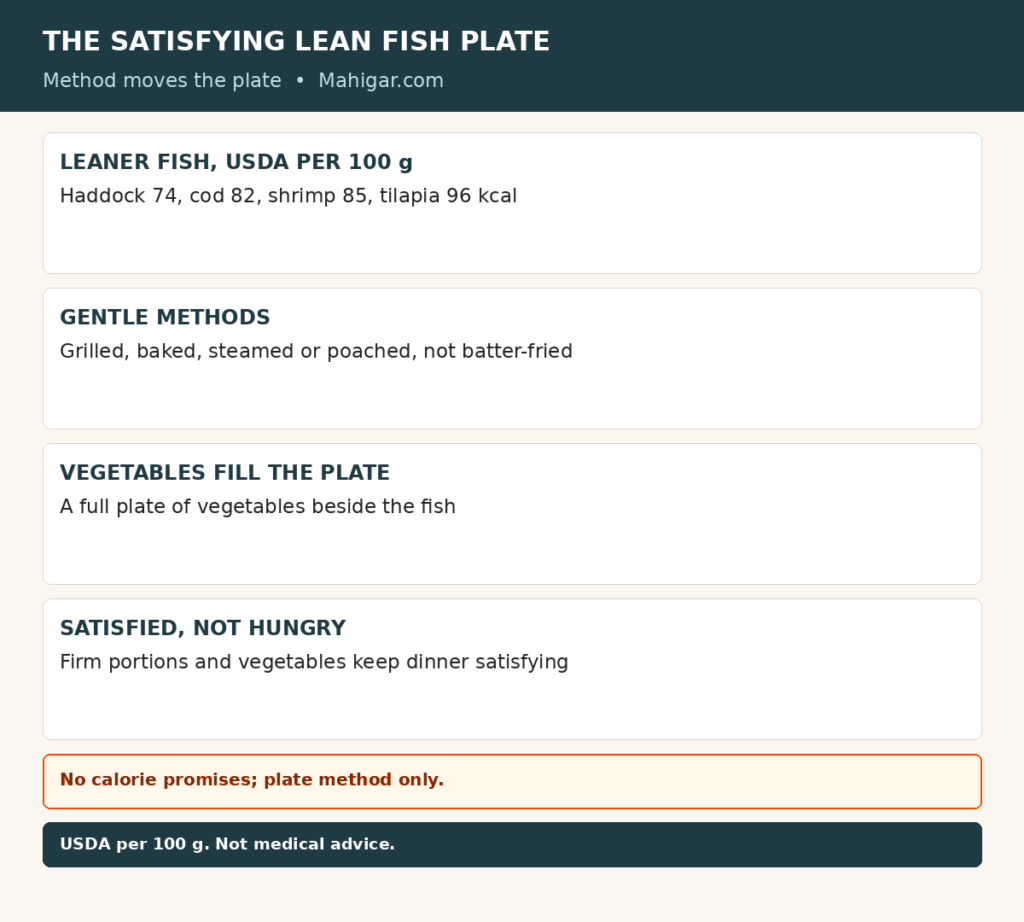
- Haddock, 74 kcal and 16.3 g protein per 100 g raw. The leanest in the chart, mild and fine-flaked.
- Atlantic cod, 82 kcal and 17.8 g protein. Nearly as lean, with bigger, softer flakes.
- Shrimp, 85 kcal and 20.1 g protein. Lean and protein-strong at once.
- Tilapia, 96 kcal and 20.1 g protein. The mild all-rounder; in my South Asian kitchen it takes spice beautifully without needing oil to carry it.
- Canned light tuna, 116 kcal and 25.5 g protein per 100 g, drained. The pantry option, already cooked.
Every one of these is an FDA/EPA Best Choice on the mercury chart, so they can repeat across the week inside the usual two-to-three-servings guidance. The full categories and the one caution, albacore, or white, tuna is a once-a-week Good Choice and not the same thing as canned light tuna, live in my Mercury in Fish guide and in Article 58’s chart.
Richer fish like salmon and sardines, both 208 kcal per 100 g in the same table with far more fat, absolutely still belong in a lighter pattern. They are deeply satisfying in smaller portions beside a large plate of vegetables. Lean is a tool, not a law.
How I Cook Fish When the Plate Should Stay Light
Four gentle methods cover every lighter plate. Grill or bake it plainly. Steam or poach for the gentlest plates. Keep the crisp skin and skip the coat. Sauce on the side, in a small bowl.
Grill or bake it plainly. Season the fish itself, salt carefully, herbs, lemon zest, spice rubs, then let dry heat do the work. A dry surface matters more here than anywhere: wet fish steams and saddens; dry fish browns.
Steam or poach for the gentlest plates. Fish cooked in gentle steam or in a light, aromatic liquid comes out soft and clean-tasting, with nothing added at all. This is how I cook delicate fish for anyone who wants dinner to feel easy on the stomach.
Keep the crisp skin, skip the coat. A skin-on fillet crisped in a thin film of oil gives you the crunch people miss, without a flour crust drinking oil. What I remove is the batter and the breadcrumb blanket, not the pleasure.
Sauce on the side, in a small bowl. Lemon, herb oil drizzled by the spoon, a thin yogurt-style sauce where your pattern allows it. Flavour stays bright when you add it at the table, in the amount you choose, instead of cooking the fish swimming in it.
None of this is a recipe card. These are the methods; the five plates below simply arrange them.
Build the Plate: Fish Plus a Mountain of Vegetables
The quiet trick of a satisfying lighter dinner is volume you enjoy. I fill half the plate with vegetables cooked properly, grilled, roasted, or wilted in the pan juices after the fish rests, and let the fish portion stay honest and generous rather than small and sad. A plate that looks abundant is a plate nobody leaves hungry, and hunger is where lighter eating usually falls apart.
This is also where protein thinking helps. Fish in the 20-grams-per-100-grams band, eaten in a proper portion beside all those vegetables, keeps most people full in the ordinary kitchen sense, the sense of not wandering back to the fridge at ten o’clock. If protein is your main pattern, my High-Protein Fish Recipes guide builds whole dinners around exactly those species. Here, the same fish simply wear lighter clothes.
Five Lighter Plates I Actually Cook
Five plates that use the methods above: grilled cod with roasted vegetables, Desi-spiced tilapia in a thin film of oil, shrimp with greens, a tuna tin plate, and white fish poached in a light curry-style broth.
1. Grilled cod with roasted vegetables. The big-flaked classic, grilled plainly with lemon and herbs, beside whatever vegetables the season is giving away. Filling because the plate is full, not because anything is heavy.
2. Tilapia with Desi spices, pan-cooked in a thin film of oil. Turmeric, chilli, ground coriander, salt, lemon, spices already on the fish, the least rubbed on and rested briefly before cooking. All the flavour of my home fry, carried by spice instead of oil. Tilapia’s mild flesh and fine bones make it a kind fish for this; adult-check any bony piece before it reaches a child, as always.
3. Shrimp with greens. Quick, lean, and protein-strong. Shrimp cooked just until pearly and opaque, tossed over a deep bed of garlicky greens. A small amount of fish feels like a feast when the greens carry the plate.
4. Tuna tin plate. Canned light tuna, drained, broken over a big salad-style plate with lemon and cucumber-style vegetables. No cooking at all on the nights cooking is too much. The highest-protein option in this guide is the one from a tin.
5. Poached white fish in a light curry-style broth. Fish gently poached in a thin, aromatic, tomato-leaning broth and served with the broth spooned over, warming and satisfying, with the richness coming from spice and aroma rather than oil. Rohu or catla pieces work beautifully here on their once-in-a-while rotation; remember their fine Y-bones stay in the flesh, and an adult checks children’s portions bone by bone.
Stay Safe While You Eat Lighter
Light cooking is still cooking. Fin fish is done at 145°F (63°C) in the thickest part, or until opaque and flaking. Gentle methods like steaming and poaching reach that finish too.
The checks are all in Safe Internal Cooking Temperatures for Every Type of Fish. Keep fish at 40°F (4°C) or below, use raw fish within one to two days and cooked fish within three to four, and never stretch old fish further because a lighter plan wants a fish night. Mercury cannot be cooked out, which is why the species choices above stay inside the FDA/EPA categories.
Frequently Asked Questions
Does eating fish make you lose weight?
No food does that by itself, and I will not pretend otherwise. What lean fish does is give you a satisfying, protein-carrying dinner whose raw material sits at the lean end of the USDA table, so it fits comfortably inside a lighter pattern that you and your doctor or dietitian have chosen. Weight questions belong to them; dinner ideas belong here.
Which fish is leanest?
By the verified USDA per-100-gram figures in my protein chart: haddock (74 kcal), Atlantic cod (82), shrimp (85), and tilapia (96) sit at the lean end, all with useful protein. Those are raw laboratory values for comparing fish. Your portion and your cooking decide the final plate.
Is fried fish off the table completely?
That is your pattern’s call, not mine. My kitchen point is narrower: batter and deep frying add more to a fish plate than the fish itself ever does, so when readers want lighter plates, the first thing I change is the method, grill, bake, steam, or poach, and I keep a crisp-skin pan-fry for days when a little oil is welcome.
Can I eat these fish often?
Haddock, cod, shrimp, tilapia, and canned light tuna are all FDA/EPA Best Choices, the eat-two-to-three-times-a-week category in my Mercury in Fish guide, and varying your fish is always wiser than repeating one species daily. Beyond general guidance like that, personal frequency, like every personal target, is a doctor-or-dietitian conversation, not a food blog’s.
What to Check Next
Start where this guide started: the numbers. My protein comparison chart, Fish Protein Content Compared by Species, shows all ten verified fish side by side, so you can pick your own lean favourites with real data. If fullness is your main concern, High-Protein Fish Recipes takes the same species and builds bigger plates around them. And if you are stepping back to choose a pattern first, the diet hub, Fish Recipes for Every Diet and Lifestyle, lays out all eleven patterns with the same rule used here: the constraint picks the species, the method, and the side, in that order, every time. If you are deciding what your own eating should look like, that is a doctor-or-dietitian conversation. This page only knows the fish half, and it knows that half well.
