Kid-Friendly Fish Recipes for Picky Eaters
I have watched a child push a plate of fish away before the plate even touched the table. Not after tasting it. The smell reached him first, then the sight of one big dark piece with the skin on, and the negotiation was over. His mother looked at me like the fish was the enemy. It was not. The plate was the enemy.
That is the mistake I see in most kitchens with small eaters. Parents serve children the fish the adults are eating: the same strong oily piece, the same big cut, the same bones hiding inside. Then the dinner becomes a fight, and the child learns that fish means trouble. The child is not refusing fish. The child is refusing strong flavour, a scary plate, and the very real fear of a bone.
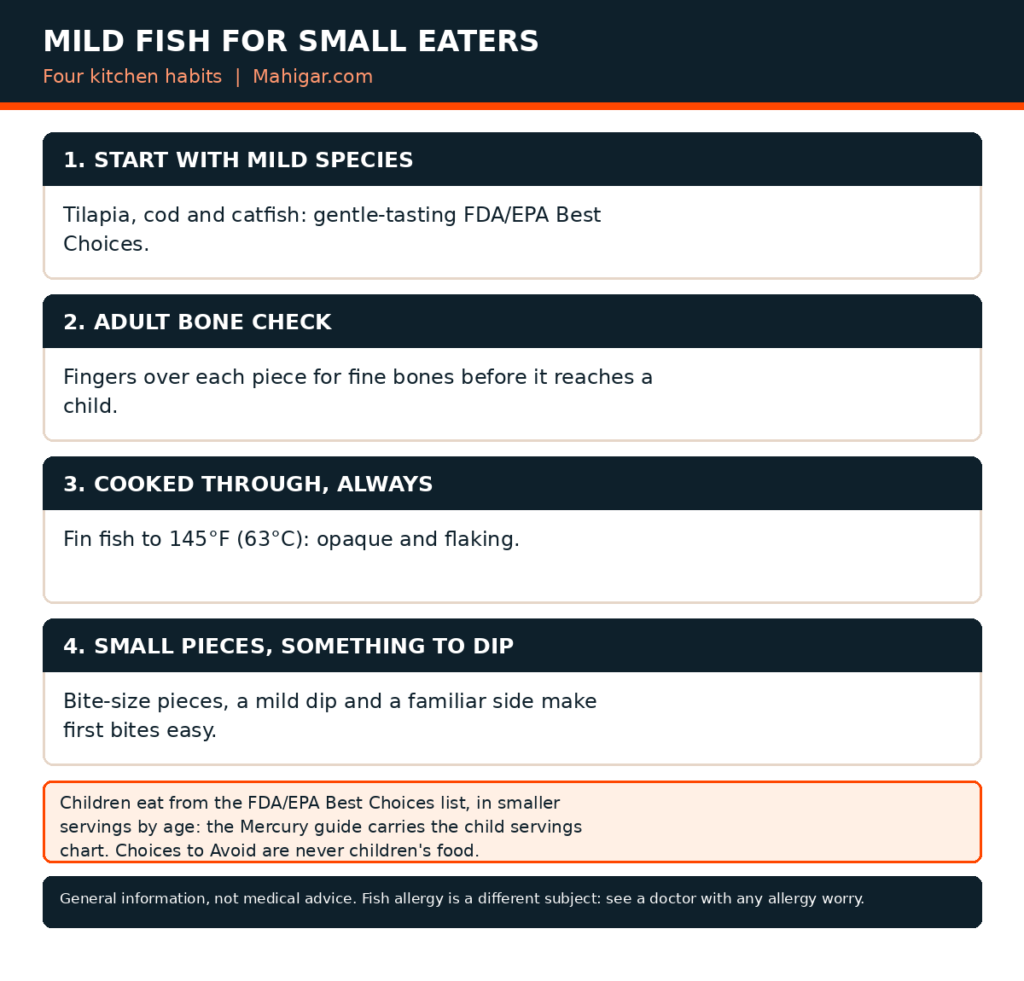
So here is how I solve it, and it is the same three habits I would give any nervous eater. Serve mild fish, not strong fish. Cut it small and let an adult’s fingers check every piece for bones before the plate leaves the counter. Cook it through, keep the fishy taste low, and put something familiar beside it. That is the whole method. This guide sits inside Fish Recipes for Every Diet and Lifestyle, our diet hub, and it is written at principle level: dinner habits that work with real children, not measured recipe cards.
One honest note before we start. I am a fish cook, not a doctor or a dietitian. What follows is kitchen practice standing on the FDA and EPA eating-fish advice we use across Mahigar. How much fish your child should eat, and any allergy question, belongs to your own doctor. I will show you where the official guidance lives as we go.
Table of Contents
Start With the Mildest Fish in the Shop
Picky eaters are usually tasting honestly. A strongly flavoured fish tastes strong to them because it is strong. So begin where the flavour is gentlest.
Tilapia, cod, and catfish are my first three calls for a child who is unsure about fish. All three are mild, white-fleshed, and easy to cook into soft flakes, and all three sit in the FDA and EPA Best Choices group, the lowest-mercury list, as you can see in Mercury in Fish: Safe Levels by Species. Canned light tuna, flaked small and mixed into something familiar, is another gentle starting point from the same list. Haddock, trout, and pollock belong there too when your shop has them.
What I keep off a young child’s plate is the other end of the chart. The FDA/EPA Choices to Avoid: shark, swordfish, king mackerel, marlin, orange roughy, bigeye tuna, and tilefish. These are not children’s food in any kitchen, and the bigger oily fish are usually the strong-tasting ones anyway. With fish for children, the mild choice and the careful choice are happily the same choice.
And a word from our own markets, because many of you cook what I cook. Rohu and catla are family fish here, and children eat them across South Asia. But their flesh carries fine Y-bones that no cooking removes, and the official mercury chart places carp, rohu’s family, one careful step below the Best Choices. For a small child’s regular plate, tilapia and catfish are simply the easier answer. Rohu can still appear at the family table, in a piece an adult has checked bone by bone, which brings me to the rule that never bends.
The Adult Bone Check: No Exceptions
More children are put off fish by one frightening bone than by any flavour. So in my kitchen, a child’s fish is checked by an adult, every time, piece by piece.
The routine is simple. Cook the fish. Let it rest a moment so you can handle it. Then, with clean fingers, gently press and flake each piece you are about to serve, feeling for anything hard and thin. Fillets of tilapia or cod make this easy. They are close to boneless once the pin bones are out, and your fingers will find any stray one. Whole fish and steaks are different. Pomfret carries a cleaner frame, but rohu and catla steaks carry those fine Y-bones in the flesh itself, and frying, baking, or currying does not dissolve them.
So I never tell a parent a whole fish is “boneless.” It is not. What I give instead is a checked plate: small pieces, felt through by an adult, served without hurry. Keep pieces small enough to eat comfortably, sit children down to eat rather than letting them run with food in hand, and the bone worry becomes a habit instead of a fear. That habit, not a boneless promise, is what actually keeps small eaters safe at the table.
Keep the Fishy Taste Low, the Honest Way
The second reason children push fish away is the smell and taste adults call “fishy.” That taste is mostly age and handling, not the species itself, and it is fixable without hiding the fish under heavy sauces.
Fresh fish, kept cold and cooked within its short window, smells mild. Fish that has sat warm, or sat too long in the fridge, is where the strong taste builds. The full explanation, and the fixes from buying to the squeeze of lemon at serving, lives in Why Fish Tastes ‘Fishy’ and How to Reduce It, and it was written for exactly this problem. In short: buy fresh, keep it at fridge cold, cook it the day it comes home when you can, and do not overcook it. Dry, overcooked fish tastes stronger and eats tougher, which loses a child twice.
Season gently. A little salt, a squeeze of lemon, a mild herb: children accept seasoning that whispers. Save the strong masala crusts for the grown-ups’ portion of the same fish. One fish can honestly serve both, seasoned in two directions at the plate.
Small Pieces, a Dip, and Something Familiar Beside It
How fish arrives matters as much as which fish it is. A whole fillet on a small plate looks like a job. The same fillet, flaked into small pieces, looks like food.
Cut it small. Bite-size pieces, or flakes folded through rice or pasta at the family table, eat easily and cool quickly, and every small piece is another chance for your fingers to check for bones.
Offer a dip. Something mild and familiar beside the fish, a simple lemon-and-yoghurt-style dip or whatever mild sauce your child already likes with other foods, turns the first bite into a game instead of a test. Keep it plain. The dip is a bridge, not a hiding place.
Keep one familiar friend on the plate. The rice, potatoes, bread, or vegetables your child already trusts carry the new food in. New fish beside familiar food succeeds far more often than a whole plate of new things.
Crisp helps, lightly. Many children accept fish with a light, crisp coating more readily than plain steamed fish. A thin crumb-style coat, cooked until crisp, is a fair kitchen tool. Just keep the fish itself cooked through underneath, and keep the coating thin enough that the mild fish still tastes like fish.
None of this is trickery. It is the same respect I give a nervous adult guest: mild fish, cooked well, served kindly.
Cooked Through, and the Mercury Rules for Children
Two safety lines sit under everything above, and neither is negotiable at a child’s plate.
Cooked through, always. Children’s fish is finished fish: cook fin fish to 145°F (63°C) in the thickest part, or until it is opaque and flakes easily, the same finish I teach in Safe Internal Cooking Temperatures for Every Type of Fish. No rare centres, no raw fish, no just warmed through. A picky eater who gets sick once may never trust fish again, quite apart from the illness itself.
Mercury: Best Choices, smaller servings. Children eat from the FDA/EPA Best Choices list, the tilapia, cod, catfish, salmon, and canned light tuna this guide is built on, in smaller servings than adults, with the serving sizes set by age. I am deliberately not turning those age-by-age portions into recipe numbers here. The full child servings chart, straight from the FDA and EPA, lives in the Mercury guide linked above, and that is the page to follow at your table. What the kitchen needs to know is simpler: Best-Choice species, cooked through, in child-size portions, and nothing from the avoid list, ever.
One separation to keep clear, because parents mix these up: picky eating is not fish allergy. A child who dislikes a taste is making a preference. A child whose body reacts, with hives, swelling, or breathing trouble, is a medical matter for a doctor, not a recipe problem, and Mahigar’s Fish Allergies: Symptoms and Safe Alternatives guide covers that subject separately. Do not use this article to test a child you suspect is allergic.
What to Check Next
Start at the mild end: a tilapia or cod fillet, cooked simply, flaked small, and bone-checked by your fingers before it reaches the plate. That one calm first success teaches a child more than any lecture. Fish can be gentle food.
From there, the diet hub shows how the same fish counter serves the whole family’s patterns, the Mercury guide holds the child servings chart your doctor’s advice builds on, and the fishy-taste guide keeps the flavour mild enough that nobody at the table has to be brave. Mild fish, checked plates, cooked through: that is how small eaters become people who ask for fish.
Frequently Asked Questions
Which fish is best for a child who says they don’t like fish?
Start with the mildest Best-Choice fish: tilapia, cod, or catfish, cooked gently until just opaque and flaking, then flaked small and checked for bones by an adult. Their flavour is gentle, their flesh is soft, and, kept fresh and not overcooked, they carry very little of the strong “fishy” taste children usually object to.
How do I make sure there are no bones in my child’s fish?
Choose fillets where you can, and check every piece with your fingers after cooking, pressing the flakes gently to feel for fine bones. Be extra careful with rohu and catla, whose flesh carries fine Y-bones that cooking does not remove: a child’s portion of those fish should always be an adult-checked piece, never assumed boneless.
How much fish can children eat, and which fish must they avoid?
Children eat from the FDA/EPA Best Choices list in smaller servings by age, in the twice-a-week style the official advice frames: the exact child servings by age are in Mahigar’s Mercury in Fish guide, taken straight from the FDA/EPA chart. Children should never eat the Choices to Avoid: shark, swordfish, king mackerel, marlin, orange roughy, bigeye tuna, and tilefish. This is general information, not medical advice. Your child’s doctor has the final word.
My child hates the “fishy” taste. What actually helps?
Buy the freshest mild fish you can, keep it cold, cook it soon, and do not overcook it: age, warm storage, and overcooking build most of the strong taste. A squeeze of lemon and gentle seasoning help at the plate. Mahigar’s Why Fish Tastes ‘Fishy’ and How to Reduce It guide walks through the causes and fixes in full.
