Whole Fish vs Fillets: Which Should You Buy?
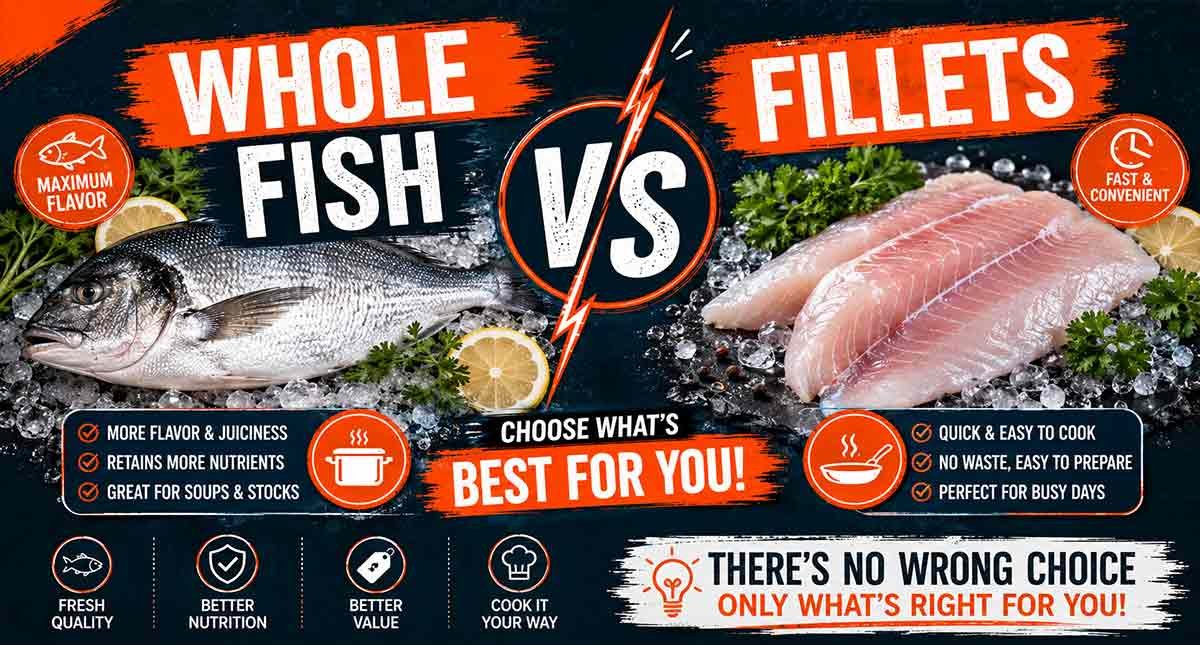
Buy whole fish when freshness and value matter most and you don’t mind extra prep; buy fillets when convenience and speed matter more than saving money. The honest version is more nuanced than that one-line rule, though whole fish isn’t automatically cheaper once you account for what you throw away, and fillets aren’t automatically the “lazy” choice once you factor in how much faster they cook.
I buy both, and which one I reach for depends on the species, the dish, and honestly how much time I have that day. Here’s the real breakdown, not just the surface-level advice.
What Do You Actually Gain by Buying Whole Fish?
The biggest advantage is freshness verification: a whole fish shows you its eyes, gills, and skin, which tell you far more about how recently it was caught than a fillet ever can. That’s the entire reason the freshness checklist can lean on those signs for whole fish and has to rely on smell and texture alone for fillets.
Whole fish also tends to be cheaper per pound at the sticker price, gives you the frame and head for stock if you want them, and lets you control exactly how it’s cut for the dish you’re making, rather than working within whatever portion size a fillet was already cut into.
The real cost is your own time and comfort with a knife. If you’re not confident filleting yet, that trade-off can outweigh everything else on this list.
What Do You Actually Gain by Buying Fillets?
Speed and predictability, mainly. A fillet is ready to cook the moment you get it home, with no bones to navigate and a portion size you can see and plan around exactly. For a weeknight dinner, that’s often worth more than the savings on a whole fish.
Fillets also cook faster and more evenly than a whole fish, since there’s no bone or cavity slowing heat penetration in the middle. If you’re building confidence in the kitchen generally, fillets are the far easier starting point; you can focus entirely on seasoning and technique instead of also managing butchery.
Which Is Actually Cheaper?
It depends on the yield, not just the price tag. Whole fish usually has a lower price per pound listed, but you’re paying for bones, skin, head, and guts along with the meat, and cleaning typically leaves you with only around half the original weight in edible fillet.
Say whole fish is priced at $9 a pound and fillets of the same species run $16 a pound. If cleaning that whole fish leaves you with roughly half its weight in edible meat, your real cost per edible pound works out closer to $18 more than the fillet, not less. The math only favors whole fish when the price gap is wide enough to cover that yield loss; for some species it clearly does, for others it doesn’t.
It’s worth doing this exact calculation with the actual prices in front of you rather than assuming whole is automatically cheaper. I do this math every time I’m deciding between the two for an unfamiliar species.
What Can You Do With the Frame, Head, and Bones?
Use them for stock. A fish frame simmered with aromatics for 20 to 30 minutes makes a genuinely good base for soups, chowders, and rice dishes, and it’s the one part of buying whole fish that fillets simply can’t offer you at all.
This is one of the reasons whole fish rarely feels wasteful to me even when the edible-meat math doesn’t favor it: the frame isn’t scrap; it’s a second ingredient you already paid for. If you’re not going to use it the same day, it freezes well until you’ve collected enough for a proper batch of stock.
Does Buying Whole Fish Save Money If You Don’t Know How to Fillet Yet?
Not by itself, no. Most fishmongers will fillet a whole fish for you at the counter, often at no extra charge, which gets you the freshness-checking advantage of buying whole without requiring any knife skill on your end. Ask before you assume it isn’t offered.
If you want to build the skill yourself instead, it pays off fast: filleting gets noticeably quicker after the first handful of attempts, and it’s a skill that keeps paying you back on every whole fish you buy afterward. The complete step-by-step technique is in the Fish Prep and Butchery Skills guide.
Which Should You Buy for a Given Dish?
For a dish where the fish is served whole or where presentation matters roasted whole, grilled whole, or stuffed buy whole, since that’s the format the dish actually calls for. For anything portioned onto individual plates, curries, gravies, or a quick weeknight meal, fillets are almost always the more practical choice.
I default to whole fish for species I know well and want to verify the freshness of myself, and fillets for anything going into a dish where the fish is one component among several rather than the entire presentation.
Frequently Asked Questions
Is it wasteful to buy a whole fish if you don’t use the head and bones?
Not if you plan to use them for stock, and even if you don’t, you’re still getting the freshness-verification benefit whole fish offers. If waste genuinely bothers you and you know you won’t use the frame, a fillet may be the more honest choice for you.
Can you ask a fishmonger to fillet a whole fish for you?
Yes, most will do this at no extra charge. Ask before buying rather than assuming it isn’t offered.
Do fillets spoil faster than whole fish?
Generally yes, since more surface area is exposed to air once a fish is cut into fillets.
Is it better to freeze fish whole or as fillets?
Either works. Whole fish takes up more freezer space but can keep slightly better for longer, while fillets freeze and thaw faster since there’s less mass to bring to temperature.
What to Check Next
Whichever you buy, the freshness checks that matter most differ slightly between the two; whole fish gives you the full checklist, while fillets rely more on smell, texture, and the edges. The complete breakdown of both is in How to Tell if Fish Is Fresh: The Buyer’s Checklist.
Once you know roughly how much edible meat you’ll actually get from a whole fish, planning how much to buy gets a lot easier; that’s covered fully in How Much Fish to Buy Per Person: A Portion Guide. For the complete buying process this decision is one part of, start with The Complete Guide to Buying Fish and Seafood.

3 Comments