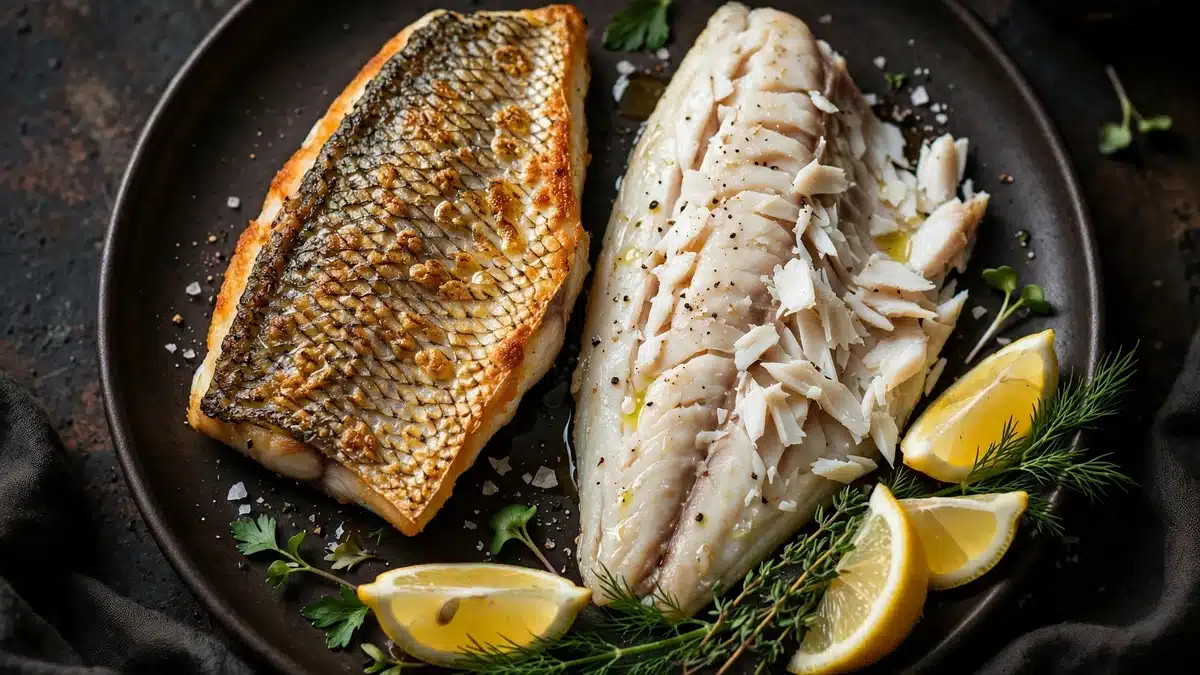
Skin-On vs Skin-Off: Does It Change How You Cook Fish?
Yes, it changes how I cook fish. In my kitchen, skin-on fish gets the hot pan and a confident hand, while skin-off fish gets gentler heat and more patience. But one thing never changes: the fish is done at the same point either way.
I am Wasim Abbas Bhatti, the Fish’s Chef. I have spent more than twenty years cooking fish, and I have learned that skin is not a fashion choice. It is a cooking tool. In this Cooking Science hub, The Science of Cooking Fish: A Troubleshooting Guide, I will show you exactly how I decide, every time I cook, whether the skin stays or goes.
Table of Contents
The Short Answer
| Question | Skin-on | Skin-off |
|---|---|---|
| What meets the heat first? | Skin, then flesh | Bare flesh |
| Shape in the pan | Holds together better | More fragile |
| Best surface | Dry skin, skin-side down | Dry flesh, gentle handling |
| Seasoning | Mostly on flesh side or after cooking | Directly on the flesh |
| Forgiveness | More forgiving in a hot pan | Needs kinder heat |
| Main risk | Soggy skin if wet or rushed | Sticking, tearing, drying |
| Finish check | 145°F/63°C or opaque and flaky | Exactly the same |
That last row is the one I want you to remember. Skin changes the road, not the destination.
Cooking Skin-On: A Shield I Can Crisp
When I cook skin-on fish, I think of the skin as the part that meets the heat first, so the flesh underneath cooks a little more gently. That is why my skin-on fillets reach the plate in one proud piece, while a skinless piece from the same fish can break at the edges.
The skin only works as a shield if I treat it right, and my routine never changes: scales off, skin patted very dry with paper towels, a hot pan, a light film of fat, then the fillet laid skin-side down, away from me, and left alone. The hardest lesson I learned in my early years was this: do not touch it. Wet skin steams instead of crisping. Moving it early tears it. Crowding the pan softens the very surface I wanted crisp.
I do most of the cooking on the skin side, then one confident turn to finish. In my experience, that single turn is all a good fillet needs.
I keep skin on when the pan is the point: firm fillets, whole fish that need help holding their shape, and any plate where crisp skin is part of the pleasure. I never try to keep skin crisp in a poach, a steam, or a smooth sauce. The crisp skin goes soft in liquid, and then I have wasted good skin for nothing.
Cooking Skin-Off: Bare Flesh, Gentler Hands
A skinless fillet has no shield, so the flesh meets the heat directly. I handle it like it is already cooked, even when it is raw: patted dry, given room in the pan, and lifted with a wide, thin spatula slid under the whole piece. I flip once if I must flip at all. Very thin pieces, I often do not flip; I cover the pan or finish them gently on a parchment-lined tray.
The reward for the extra care is direct contact. Salt, spice, and marinade touch the flesh itself, not a layer of skin, and I can taste the difference in every bite. That is why I choose skin-off for delicate white fish, gentle curries, steamed pieces, and dishes where the seasoning must reach the flesh.
My rule is simple: the thinner and more delicate the fillet, the kinder the method. A fierce open flame is for skin and armor. Bare flesh wants a gentler hand.
Skin-off fish can dry faster at the surface because nothing stands between flesh and heat. My fix is never more time in the pan. It is the right method, a dry start, and stopping the moment the flesh turns opaque and flakes easily.
The Safety Question Is a Separate Decision
Cooking with the skin on or off is one decision. Eating the skin is another, and I make them in that order. First I ask: is this a fish I am happy to eat, from a source I trust? Then I ask: does tonight’s dish want the skin left on to crisp and protect, or taken off so the flesh cooks gently and directly?
Whether a skin is worth eating depends on the fish, its source, and how it was handled, and I have set that out fully in Is Fish Skin Safe to Eat?. One line belongs here because I hear cooks mix it up: taking the skin off is not a shortcut around mercury. I choose my species for that question, and I use this article only for the cooking choice.
My Skin Decision
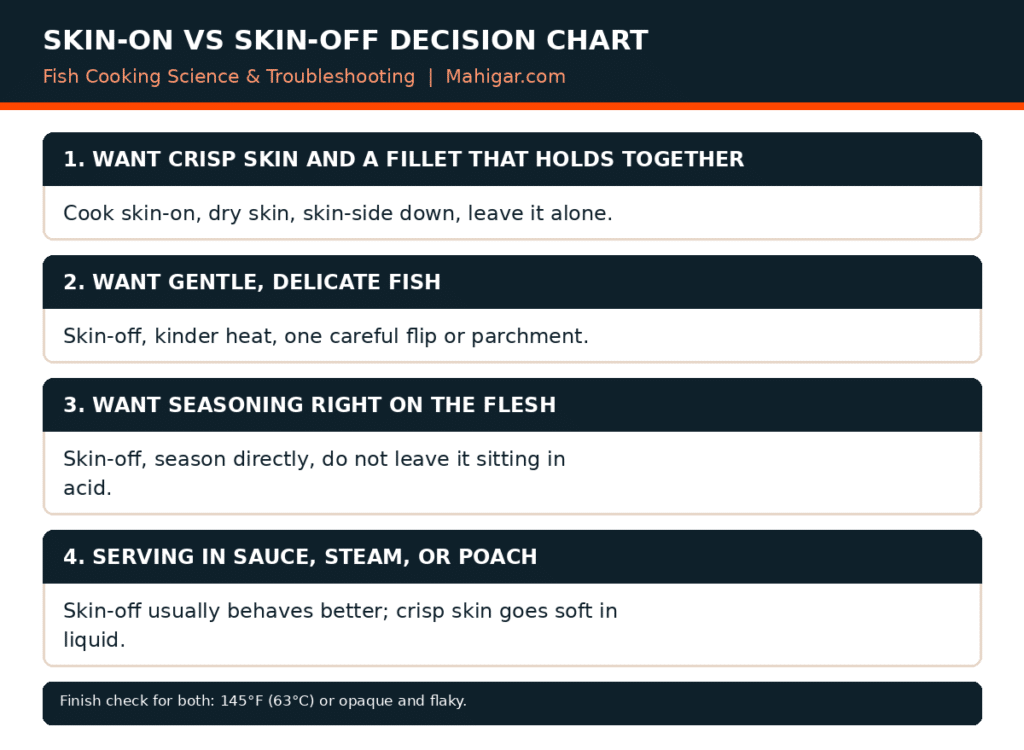
This is the routine I run through before the pan heats, every time:
- I name the dish. Crisp pan fish, or a fillet that must hold together? I think skin-on. Poach, steam, gentle sauce, or direct marinade? I think skin-off.
- I look at the skin. If it is staying on, it must be scaled, intact, and dry enough to crisp. If it is coming off, I remove it before cooking, never at the table in a panic.
- I use the clean removal. My towel grip and the almost-flat knife are in How to Skin a Fish Fillet.
- I match the handling. Skin-on: dry, skin-side down, patience. Skin-off: room in the pan, wide spatula, one gentle turn or no turn.
- I check the same finish. I probe the thickest part for 145°F (63°C), or I check that the flesh is opaque and flakes easily. The full chart is in Safe Internal Cooking Temperatures for Every Type of Fish.
When I Keep the Skin On
I keep good skin on when the pan is the point. A firm fillet, dried well and started skin-side down, gives me two textures I love: crisp skin on top, tender flesh below. It also helps whole fish and thicker pieces keep their shape while the centre catches up.
One plating opinion I hold strongly: I serve it skin-side up, and I never pour sauce over crisp skin. The moment hot sauce hits it, the crunch I worked for starts dying on the way to the table.
When I Take the Skin Off
I take the skin off when the cooking is gentle and wet, when I want the seasoning right on the flesh, or when the dish is smooth and sauced. In a curry, I would rather have tender pieces drinking in the sauce than soft skin floating in it. For steaming and poaching, bare flesh cooks cleanly and serves neatly, and I think it looks better on the plate too.
It also suits very thin, delicate fillets on parchment or in a covered pan. Without skin pulling tight as it heats, the piece lies calmer. My hands just have to be gentler, because nothing is holding it together anymore.
Frequently Asked Questions
Does skin-on fish take longer to cook?
In my experience it can feel slower, because the skin shields the flesh, especially when I do most of the cooking skin-side down. I never solve that with a clock. I check the thickest part: 145°F (63°C), or opaque and flaking.
Why does skin-on fish curl?
The skin tightens as it heats, and one side of the fillet firms before the other. I get the flattest results from dry skin, a skin-side-down start, and leaving the fish alone instead of fighting it with the spatula.
Can I crisp the skin after cooking skin-off fish?
No, and I wish more cooks knew this before they start. Once the skin is off, that texture is gone for good. If crisp skin is the goal, I keep good skin on, dry it well, cook it skin-side down, and serve it before sauce or steam can soften it.
Is skin-off fish healthier?
That is not a question I can settle from the stove with one rule. Skin choice changes which parts end up on the plate, and the safety and nutrition side depends on the species and the source. I keep that discussion in Is Fish Skin Safe to Eat?, and I judge only the pan behaviour here.
What to Check Next
Before my pan heats, I ask one question: what do I want the surface to do? “Crisp and protect” means I leave the skin on and dry it well. “Stay delicate and take seasoning directly” means I take the skin off and use kinder hands.
Either way, I stop at the same finish. Both are ruined the moment I cook past done.
