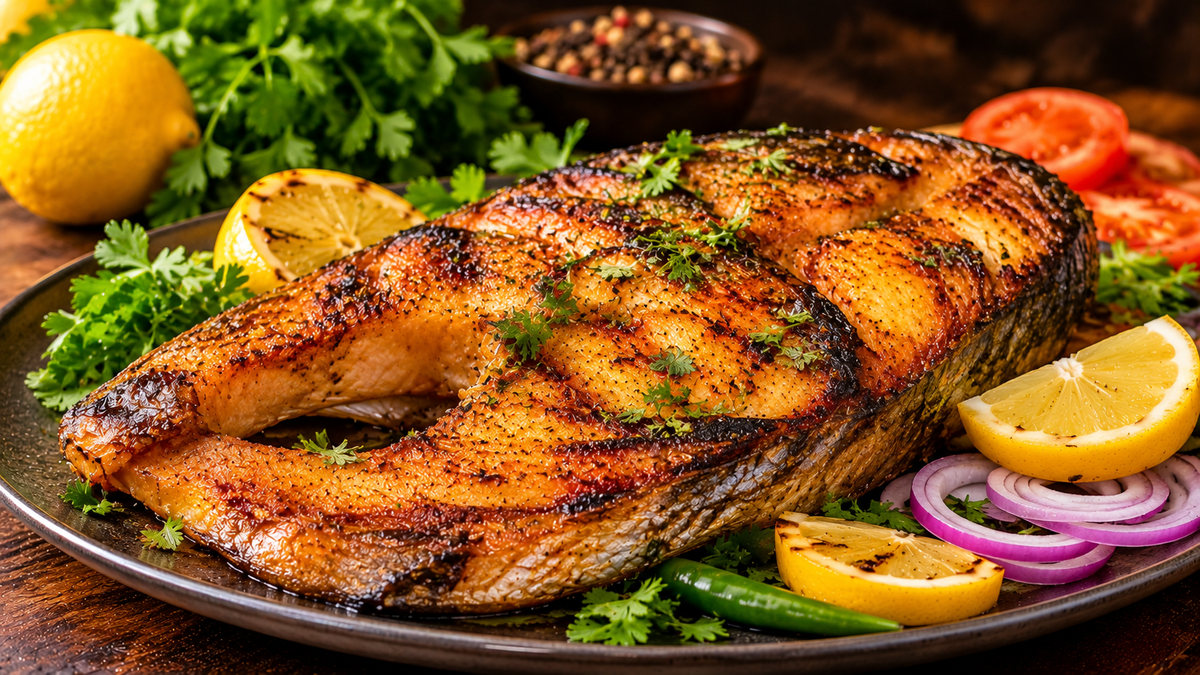
Wallago Attu (Mallee/Malli): The Giant River Catfish Guide
The first time a mallee came up in front of me, I did not think about a recipe at all. I thought about the size of the thing. Fish this big changes how you work in the kitchen, because you are not handling neat little fillets from a tray. You are handling a river fish with weight, soft flesh, and a character all of its own, and if you treat it roughly it will punish you for it.
That is the problem most cooks meet with wallago attu. They buy it because someone at the market praised it, then they cook it like any firm white fish, flip it hard in the pan, and watch it fall apart. The fish was not the problem. The handling was. In this guide I will show you what this fish is, how its flesh behaves, how I buy and clean it, and the gentle way I cook it so it stays together and tastes rich, as it should.
This species guide sits inside my Freshwater Fish Cooking: Carp, Catla, Catfish & River Fish pillar, where fish from rivers and lakes is the central subject. Wallago attu earns its own page because no other fish in that pillar asks for quite this mix of respect, patience, and a light hand.
Table of Contents
What Wallago Attu Is
Wallago attu is a large river catfish from the rivers of South Asia, and that short sentence tells you most of what you need to know. It is a freshwater fish, a true catfish, and a big one by any home kitchen standard. In my local markets it is called mallee or malli, and when an old fisherman says malli with a certain tone, he means a fish worth talking about.
I have handled wallago that ran longer than my forearm, and the bigger fish I have seen at the riverbank were longer still. I do not quote a neat size for it here because the fish you meet will depend on the river, the season, and what the net or the line brought in that day. What stays true is the shape and the nature: a long, powerful catfish body, a broad head, smooth skin with no scales, and flesh that feels soft even before it meets heat.
Fish is the central entity in my kitchen, and wallago asks for space on the board, a sharp knife, and calm hands. Once you accept that, it becomes one of the most rewarding river fish I cook.
How Wallago Attu Differs From Ordinary Catfish and Basa
Wallago attu differs from ordinary catfish in size, richness, and how soft its flesh feels, and it differs from basa type fish in almost every way that matters at the table.
The catfish many readers know best are smaller fish, sold whole or in modest pieces, with flesh that holds together fairly well in a fry or a curry. Wallago is a step up in scale. A single fish can feed a large family gathering, so it is cut and sold in a different way, and its flesh carries more richness. In my kitchen it feels closer to a special occasion fish than an everyday fish. I plan the meal around it rather than adding it to the meal at the last minute.
Basa is a different story again. Basa and its close relations are farmed fish sold mostly as frozen fillets, mild, soft, and easy to find far from any river. If you have not read it yet, my guide to Basa and Pangasius: What You’re Actually Buying explains what those fillets really are and how the farming shapes the taste. Wallago sits at the opposite end of that experience. It has a stronger river character, a richer mouthfeel, and flesh that I would never describe as bland. Where basa forgives almost any cooking, wallago rewards care and shows it clearly when the cook is careless.
The Flesh: Soft, Rich, and Surprisingly Light on Bones
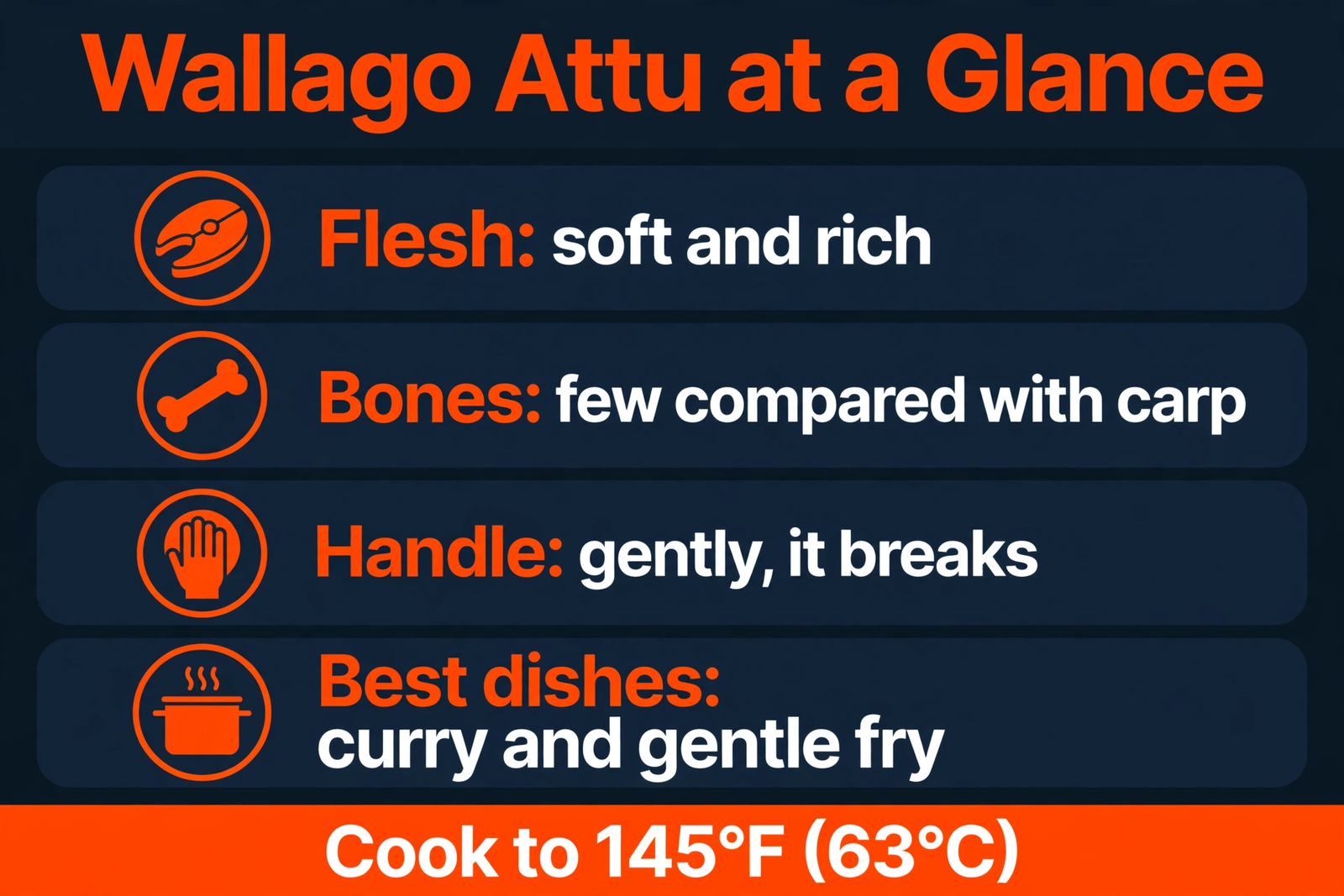
The flesh of wallago attu is soft and rich, with few bones compared with carp, and it needs gentle handling from board to plate.
Texture is the first thing I notice when I cut it. The flesh gives under the knife in a clean, soft way. It is not firm and springy like a sea fish built for rough water and long storage. It feels delicate, almost tender before cooking, and that softness carries through to the plate. Cooked well, it flakes in large, moist pieces and melts a little on the tongue. Cooked badly, it turns to fragments in the sauce and you lose the very thing you paid for.
The richness comes from the natural fat in the flesh. I do not mean greasy. I mean full and satisfying, the way good river fish tastes when it has lived and fed in moving water. That richness is why a small portion satisfies, and why strong, harsh seasoning can overwhelm it. I season wallago to support it, not to hide it.
Bones are the pleasant surprise. Anyone who has picked their way through a bony carp at the table knows the work involved. Wallago is far kinder. Compared with carp, it has few bones to fight with, and the main bone structure is easy to follow and easy to avoid. I still check every piece with my fingers before cooking, because my rule is that the cook checks, so the guest does not have to.
That combination, soft flesh, real richness, and few bones, is rare in river fish. It is also fragile. The same softness that makes it lovely to eat makes it break if you stir it hard, lift it carelessly, or turn it again and again in the pan.
Buying Wallago Attu: Steaks, Pieces, and Freshness Signs
Wallago attu is usually sold in steaks and pieces because of its size, so buy it by looking closely at the cut flesh, not by looking for a neat whole fish.
A fish this large rarely sits whole on a market slab waiting for a home buyer. The seller cuts it across the body into thick steaks, and cuts the rest into curry pieces. That is normal and it is not a downgrade. I often prefer it, because I can see the flesh, smell it up close, and choose the pieces that suit my dish. Steaks from the middle of the fish are my pick for gentle frying. Pieces closer to the tail and the head end suit curry well, where the sauce protects them.
Freshness signs are the same honest signs I use for all fish, applied with extra care. The flesh should look clean and moist, not dry, dull, or yellowing at the edges. It should smell fresh and mild, like clean river water, never sour or sharp. Press the flesh with a fingertip and it should spring back rather than hold the mark. The skin should look bright and feel slippery in the clean way fresh catfish skin does, not sticky. If the cut surface looks tired, walk away, however good the price sounds. A big fish cut early and kept badly will not recover in your kitchen.
Buy from a seller who keeps the pieces cold and covered, get the fish home quickly, and plan to cook it the same day when you can. No recipe fixes a stale fish.
Cleaning Wallago Attu in Brief
Cleaning wallago attu follows the same careful steps as cleaning any catfish: rinse, remove what must go, check for bones and blood along the backbone, and pat the pieces dry.
I am keeping this section brief on purpose, because the full step by step method already lives in my guide to How to Clean Catfish, and the hand skills there apply directly to wallago. If your fish came whole and you need the complete gutting method first, start with How to Gut and Clean a Whole Fish and then return to this guide for the cooking.
In my kitchen the brief version runs like this. I rinse the pieces in clean cold water and drain them well. I trim away any dark, strong tasting parts that I do not want in a gentle dish, and I check along the backbone for blood, because leaving it leaves a muddy note in the finished food. I feel each steak and piece with my fingertips for any stray bone. Then I pat everything dry with a clean cloth or paper and let the surface dry a little before seasoning. Dry surface, better fry. Wet surface, steaming and sticking. That small pause before cooking has saved more of my wallago dishes than any special ingredient.
Handle the cleaned pieces as little as possible. Every extra squeeze on the board starts to break the soft flesh before the heat touches it, so I lay the pieces out in cooking order and leave them alone.
Best Ways to Cook Wallago Attu
Curry and gentle frying are the best ways to cook wallago attu, because both protect its soft, rich flesh instead of fighting it.
Curry is my first choice and the choice of most homes I know that cook this fish well. A good sauce does three jobs at once. It flavours the fish gently, it keeps the flesh moist, and it holds the pieces together so a small slip with the spoon does not ruin the dish. I build the sauce first, let its raw edge cook away, and only then slide the wallago pieces in and let them poach in the sauce with the lid on and my hands off. I do not stir. I shake the pot gently if I must move anything. For the regional styles that shape how I think about these sauces, see my guide to Indian Fish Curry: Regional Styles Explained, and adapt the style you like to this softer fish.
Gentle frying is my second choice, for steaks with a light coating and a calm pan. The oil must be properly hot before the fish goes in, the steak must be left alone until the underside sets, and the turn must happen once, with a wide spatula and full support under the whole piece. A thin dusting of seasoned flour or a light spice rub gives the soft surface something to hold on to. The result, a crisp outside and a soft, rich middle, is one of the great river fish plates from my kitchen.
Seasoning deserves its own honest word. Wallago does not need a heavy marinade and it does not enjoy one. Salt in good time, turmeric, a measured hand with chilli, and the warmth of whole spices are enough for me. The deeper blends and how I build them belong to Fish Spice Blends, Marinades and Seasoning: The Complete Guide, which covers that subject on its own, so I will not repeat it here.
What breaks this fish is easy to list because I learned it by doing it. Rough handling on the board breaks it. A cold pan makes it stick and tear. Turning it early, before the surface has set, tears it. Turning it often finishes the job. Boiling a curry hard makes the pieces thrash and fall apart. Crowding the pan drops the heat and steams the coating off. Every one of those mistakes is about impatience, and wallago is a fish that teaches patience whether you want the lesson or not.
When the fish is very large, the cutting and timing change again, and that subject has its own guide. Once you have the taste for big river fish, read Cooking Large River Fish for how I break a large fish down into steaks and pieces and judge the cooking by thickness, because wallago is exactly the kind of fish that guide was written for.
Safety and Storage in My Kitchen
Cook wallago attu to 145°F (63°C), keep your fridge at or below 40°F (4°C), and treat the raw fish as a same day or next day food.
Those numbers are my non negotiable rules for this fish, as they are for all fish in my kitchen. I cook wallago until it reaches 145°F (63°C) and the flesh turns opaque and flakes gently when I press it with the edge of a spoon. With thick steaks I check the thickest part, away from the bone, because the outside can look done while the centre is still catching up. If you have no thermometer, the flake and opacity signs are your guide, but check early and check gently so you do not break the piece while testing it.
For storage, raw fish keeps for 1 to 2 days in the fridge, and I keep wallago at the short end of that whenever I can. It goes in cold, covered, and away from foods that will be eaten raw. Cooked fish keeps for 3 to 4 days in the fridge, in a clean covered container, and I reheat leftovers gently until they are hot all the way through. I cool leftovers promptly and chill them well.
Honest Limits: Availability and River Caught Fish
Wallago attu is not always available, not every market sells it, and I will not pretend otherwise.
Some weeks the river gives this fish and some weeks it does not. In many towns you will only see it when a large fish has actually been caught and brought in, and in other places farmed fish fills the gap in the market in general terms. River caught and farmed fish are not the same eating experience, and any honest seller should be able to tell you which you are buying. I ask, I listen, and I judge by look and smell rather than by the story alone.
What I can do is judge freshness with my eyes, nose, and fingers, choose the right pieces, and cook them with care. That is the real skill with wallago.
If you cannot find wallago, do not chase a poor frozen substitute sold under its name. Cook a fresh fish you trust instead, and wait for the real thing. That patience is part of river fish cooking, and it has always been part of my practice.
Frequently Asked Questions
Is wallago attu the same as ordinary catfish?
No. Wallago attu is a catfish, but it is a much larger river catfish than the ordinary catfish most people buy, and in my kitchen its flesh is softer and richer. It is usually sold in steaks and pieces because of its size, and it needs gentler handling than smaller catfish.
Does wallago attu have many bones?
No, it has few bones compared with carp, which is one of the reasons I like serving it to my family. The main bone structure is easy to follow. I still check every piece with my fingertips before cooking, because the cook should find any stray bone, not the person eating.
What is the best way to cook wallago attu?
Curry and gentle frying are the best ways in my kitchen. Curry protects the soft flesh in sauce while it cooks through, and gentle frying gives a crisp outside with a soft, rich middle. The mistakes to avoid are rough handling, a cold pan, and turning the fish early or often.
How do I know wallago attu is cooked and stored safely?
Cook it to 145°F (63°C) until the flesh is opaque and flakes gently. Keep your fridge at or below 40°F (4°C). Raw fish keeps for 1 to 2 days in the fridge and cooked fish keeps for 3 to 4 days, covered and chilled promptly.
My Closing Advice on Mallee
If you remember one thing from this guide, let it be this: wallago attu rewards a gentle hand and punishes a rough one, and almost everything else follows from that.
Buy it fresh, in steaks or curry pieces, from a seller you trust. Clean it with care, season it with respect, and cook it in a protective curry or with one calm turn in a hot pan. Do that, and malli will show you why river people speak about it the way they do. It is soft, it is rich, it is kind about bones, and in my kitchen it remains one of the great freshwater fish, worth every bit of the patience it asks for.

4 Comments