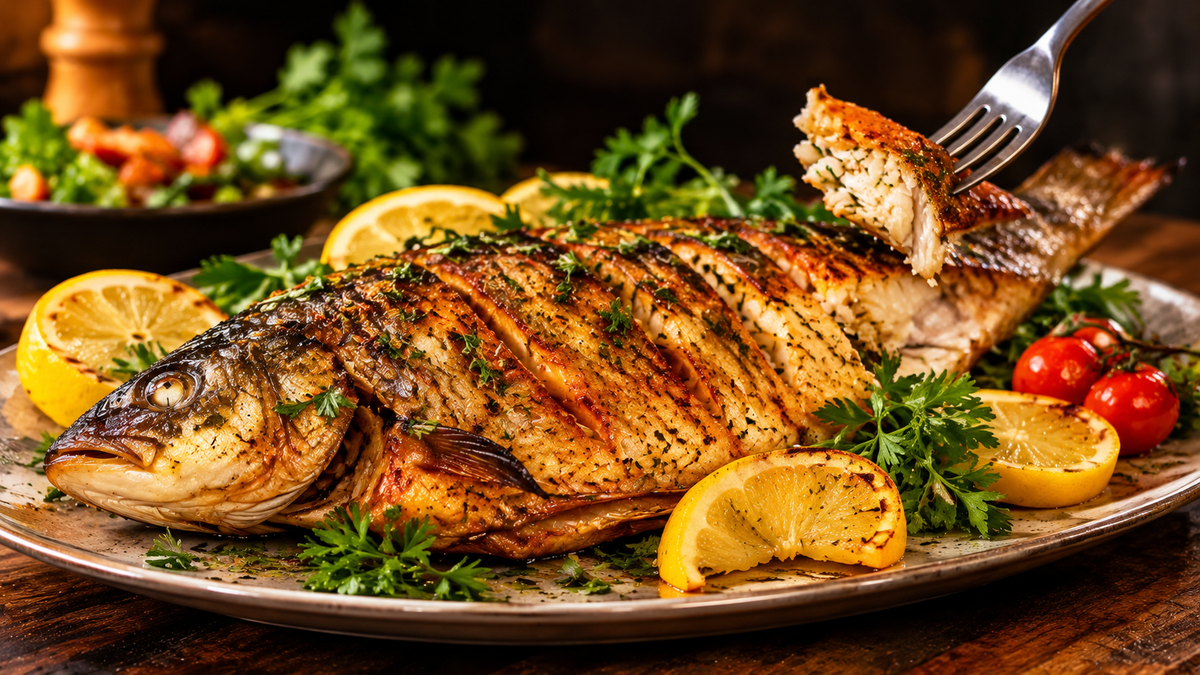
Cooking Bony Fish: How to Handle Carp and Other Y-Bone Fish
The first carp I tried to rush taught me more than any easy fillet ever did. I took a big confident bite, met a fine bone I had not felt for, and spent the rest of the meal annoyed at the fish when the fault was mine. Bony fish is not bad fish. It is fish that asks for a different cook and a slower eater, and once I accepted that in my kitchen, carp stopped being a problem and became a pleasure I choose on purpose.
Fish is the central food on this site and in my home, and freshwater fish deserves honest teaching, not apologies. This guide sits inside my Freshwater Fish Cooking pillar, where I cover carp, catla, catfish and river fish as they really are. Here I deal with one clear problem only: the fine Y shaped bones inside the flesh, and how I score, cut, cook and eat around them so the meal stays safe and enjoyable.
Table of Contents
What Y-Bones Are and Why They Are Different
Y-bones are fine bones that grow inside the flesh itself, and you cannot pull them out before cooking the way you pull pin bones from a fillet.
That difference matters more than any recipe. Pin bones sit in a neat line in many fillets, and you can find them with your fingers and lift them with tweezers before the fish reaches the pan. I explain that separate job in How to Remove Pin Bones from Fish, and it works well for the fish it suits. Y-bones are another story. They branch inside the muscle, they are thin, and they hide in the thickest and tastiest parts of a carp. If you go hunting for them with a knife before cooking, you shred good flesh and still miss most of them.
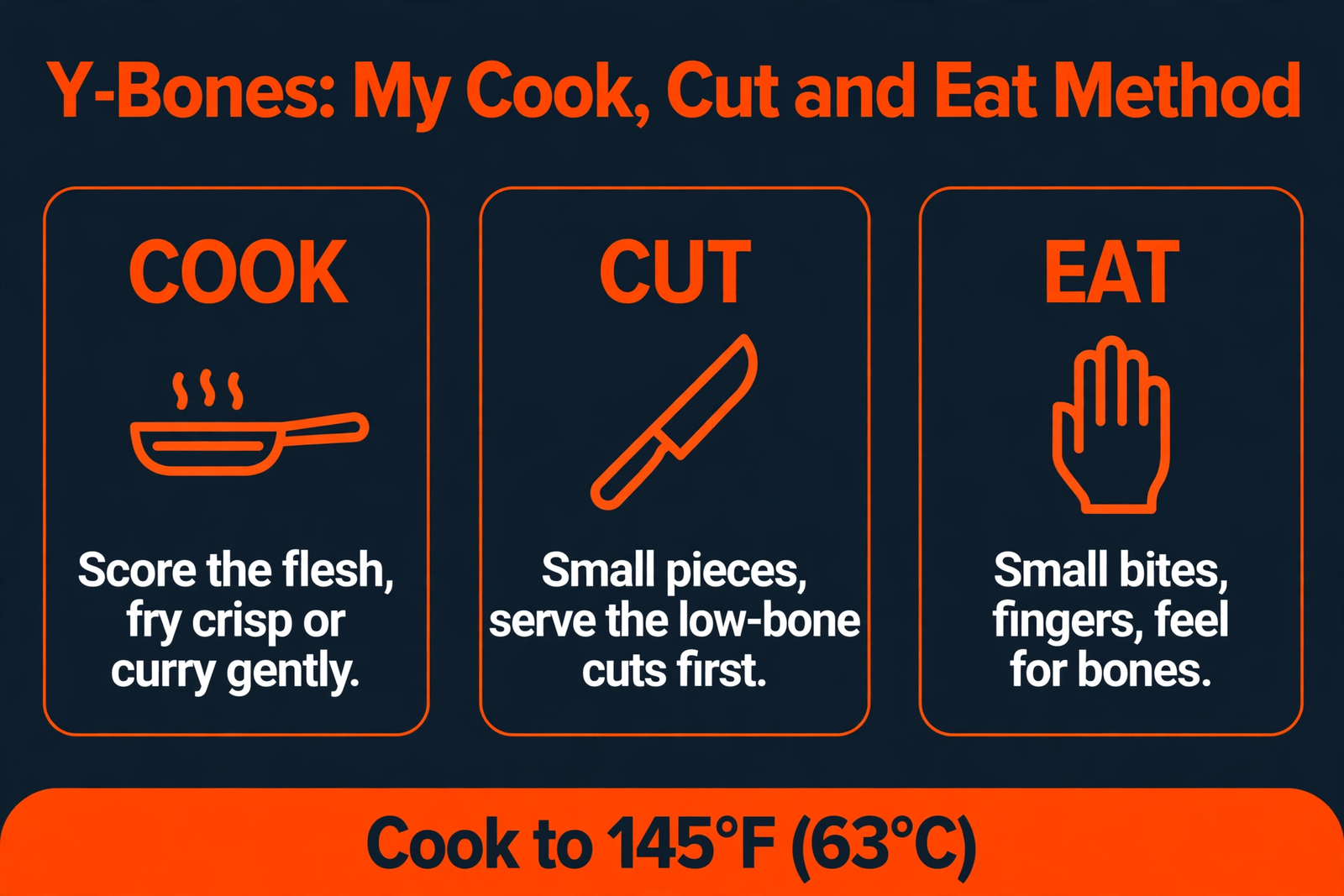
In my kitchen I stopped asking how to remove Y-bones and started asking a better question: how do I cook and eat this fish so those bones cause the least trouble? That change in thinking is the whole method. Scoring helps the fine bones soften and break down under heat and chewing. Small pieces help you see and feel what is in each bite. Slow eating with your fingers does the rest. No single trick solves bony fish, but the three habits together make it manageable for an adult who knows what is on the plate.
Which Freshwater Fish Carry Y-Bones
The carp family carries Y-bones above all, so carp, rohu and catla are the fish I plan for most carefully.
Common carp is the classic example, and it is the fish most readers mean when they search for how to cook carp with bones. Its flesh is sweet and firm when fresh, and the fine bones run right through it. If you are still deciding whether carp is worth the effort at your table, read Is Carp Good to Eat? for my honest taste verdict before you buy one.
Catla, the big headed river carp of South Asian waters, carries the same family bones, which is why I treat its cuts with the same respect. My full guide to its head, belly and steaks is Catla Fish: Cuts, Head Curry and Best Cooking Methods, and the bone advice there points back here for the detailed method. Rohu shares the pattern too. Other river fish vary, and some have far fewer fine bones, so my rule is simple: ask what family the fish belongs to, look at the flesh when it is cut, and never assume a freshwater fish is boneless because the seller cut it neatly. A clean cut is not a promise about what lives inside the flesh.
My First Rule: Choose the Cut Before You Choose the Method
The cut decides how hard the bones will be to manage, so I choose pieces that suit the dish and the people eating before I heat any oil.
A whole fish cooked whole looks generous, but at the table it asks everyone to do skilled work while the food cools. Thick steaks hold together in curry and give you large sections you can open and check. Smaller pieces fry crisper and are easier for each person to handle in a few careful bites. When I have a choice, I work in pieces for bony fish and save whole presentation for fish with a simpler skeleton.
If you are new to breaking down a whole fish at home, the basic knife order in How to Fillet a Fish: Step-by-Step for Beginners will help you understand the frame, even though a true boneless fillet is not the goal here. With carp I am not chasing a perfect fillet. I am cutting clean sections along the frame, keeping the flesh in pieces big enough to hold together and small enough to eat with care. Tell your fish seller what dish you plan, and ask for pieces cut for that dish. A good seller knows which part of a big river fish gives the meatiest sections, and that local knowledge is worth listening to.
Scoring the Flesh So Fine Bones Break Down
Scoring means making shallow cuts across the flesh, and in my practice those cuts help heat reach the fine bones and help chewing break them down into harmless small bits.
I score the thick side of a piece with a sharp knife, cutting through the flesh in close lines without slicing the piece apart. The cuts open the surface, so seasoning reaches deeper and hot oil or sauce reaches the fine bones faster. On a piece for frying, the scored surface also turns crisper, and that crisp texture is part of how the smallest bones become unnoticeable when you chew slowly.
Be honest with yourself about what scoring does. It does not melt every bone away, and it does not make a carp safe to eat in big careless mouthfuls. It softens the problem, especially in the thinner parts of the flesh, and it works best joined with small pieces and slow eating. The thicker the section near the backbone, the more care it still needs at the table. My practice is to score, cook until properly done, and still eat as if bones are present, because they are. That respect costs nothing and prevents the one bad bite that ruins a good fish for a guest.
Cutting Pieces Small for Crisp Frying
Small pieces fry crisper, cook evenly, and give you a bite you can check fully, so for frying I cut bony fish smaller than I cut most other fish.
In my kitchen a fried piece should be a few bites at most, never a large slab you must tear into blindly. I pat the pieces dry, coat them lightly with my house seasoning, and fry them in hot oil without crowding the pan. The edges crisp, the scored cuts open slightly, and the flesh firms so bones show themselves more clearly when you break a piece open with your fingers.
Dry flesh matters here. Wet fish steams, the coating slips, and you get pale soft pieces where the fine bones stay tough and annoying. A dry surface, hot oil, and space in the pan give you the crisp result that makes this method work. I drain fried pieces briefly and serve them hot with lemon and onion, and I say the bone warning out loud before anyone starts, happily and without drama. Good hosting includes that sentence. Fried bony fish eaten hot, in small pieces, with fingers, is one of the great pleasures of our food, and I will not pretend it is something it is not just to make it sound easier.
Cooking Methods That Make Bony Fish Manageable
Crisp frying, gentle curry eaten by hand, and pressure cooking used carefully are the methods I trust most for bony fish.
Frying is my first choice for smaller pieces, for the reasons above. Curry is my choice for larger family meals. In a curry I build the sauce first, slide the pieces in gently, and let them poach in the sauce without hard stirring, so each piece stays whole enough to lift, open and check at the table. The sauce keeps the flesh moist, and eating by hand with bread or rice gives you the finger control that a fork on a plate never does. A bony fish curry is a hands meal in our homes, and that is a strength, not a flaw.
Pressure cooking is the third tool, and I state it carefully as my own practice: a short pressure cook softens the flesh and can soften fine bones more than gentle cooking does, which suits certain curries and family dishes where a very soft result is wanted. It also softens the fish itself, so I use it when texture matters less than tenderness, and I still serve and eat with the same care. What I avoid is hard boiling in thin liquid, which breaks pieces apart and hides bones in a mess of flakes, and grilling tiny pieces, which dry out before the bones soften at all.
How I Eat Bony Fish at the Table
Eat bony fish in small bites, with your fingers, feeling each bite with your tongue and lips before you swallow.
That sentence is the real skill, and it is learned quickly when someone shows you once. I take a piece, break off a small section with my fingers, and look at it. I feel for a fine bone with my fingertips, then place the bite in my mouth and check again with my tongue before chewing properly. If I feel a bone, I remove it calmly with my fingers. There is no embarrassment in this at my table. It is how desi families have eaten river fish for generations, and it turns a risky meal into a relaxed one.
For a whole cooked fish served at the table, the frame lifting and section checking I use are shown in How to Debone a Whole Cooked Fish at the Table, and the same calm order helps here, with one warning repeated: the main frame may lift away, but the Y-bones stay in the flesh. Keep a small side plate for bones, keep the pace easy, talk between bites, and never eat bony fish while distracted or in a hurry. Hurry is the true enemy, not the fish.
Serving Children and Guests Honestly
For children and guests who did not grow up eating bony fish, I serve the lowest bone cuts I have, check the flesh myself, or I choose another fish.
That is my rule and I do not bend it to save face. A child cannot be expected to find fine bones reliably, and a guest should never learn about Y-bones from a painful bite. When I cook carp for a mixed table, I keep the best checked sections for those who need them, an adult breaks and feels through the flesh on a spare plate first, and the main bony pieces go to the experienced eaters who enjoy them.
Often the kindest choice is simpler: cook bony fish for the people who love it on one day, and a low bone fish for children and new guests on another. No fish is worth anxiety at the table. If you do serve it, say plainly before the meal that this fish has fine bones inside the flesh and must be eaten slowly with fingers. People respect honesty, and they eat more safely when they know what to expect. Pride has no place in this decision. Care does.
What Does Not Work, Whatever the Internet Promises
No soak, marinade or home trick dissolves Y-bones out of carp flesh, so do not plan your meal around a promise like that.
I have heard the claims for years: long soaks in sour liquids, special cuts that remove every bone, cooking tricks that make bones vanish completely. Sour marinades flavour the surface and can damage texture if left too long, and they leave the fine bones exactly where they were. Scoring and strong cooking soften the smallest bones, as I said, but soften is not dissolve, and manageable is not boneless.
Filleted labels can mislead too. A piece cut away from the main frame still carries its intermuscular bones, because those bones were never attached to the frame in a way a knife can follow. When a seller or a video promises boneless carp, ask what they mean and look closely. In my experience they mean the main bones are removed, which is a different and much smaller claim. Build your cooking on the truth and bony fish becomes safe and satisfying. Build it on a promise and the first bad bite will teach the lesson harder than I am teaching it here.
Safety and Storage Basics I Never Skip
Cook bony fish to 145°F (63°C), keep your fridge at or below 40°F (4°C), and treat freshness with the same seriousness as bones.
Those are the fixed safety points in my kitchen. I check the thickest piece, because thin edges finish early and can fool you. Raw fish keeps for 1 to 2 days refrigerated, and cooked fish keeps for 3 to 4 days refrigerated, and I plan my buying so bony fish is cooked fresh on the day it comes home whenever I can. A fresh carp smells clean and mild, the flesh feels firm, and the eyes and gills look bright on a whole fish. If it smells sour or strong, I do not cook it and argue with myself about bones later.
Safety also includes the eating itself. Seat everyone, slow the meal down, keep water and bread at hand, and teach the finger method before the first bite if someone is new. If a small bone sticks in the throat and does not clear with calm swallowing of soft food, seek medical help rather than trying clever tricks. I am a cook, not a doctor, and that boundary matters. Good fish, cooked properly and eaten calmly, is the goal of every page here.
Frequently Asked Questions
Can you remove Y-bones from carp before cooking?
No, not in the way you remove pin bones. Y-bones grow branched inside the flesh, and cutting them out shreds the fish and still misses many. My method is to score the flesh, cut pieces small, cook them well and eat slowly with your fingers, feeling for bones in each bite.
Does scoring really help with fine bones?
Yes, in my practice it helps a lot without doing magic. The cuts let heat and seasoning reach deeper, the surface crisps better when frying, and the finest bones break down more under heat and careful chewing. Thicker sections still need slow, careful eating, because scoring softens the problem rather than erasing it.
What is the best cooking method for bony carp?
Crisp frying in small pieces is my first choice for control and texture. A gentle curry eaten by hand suits larger family pieces, and a careful pressure cook from my own practice gives the softest result when tenderness matters most. All three work when the pieces stay whole enough to check and the eating stays slow.
Is bony fish safe to serve children?
Only with real care, and often I choose another fish instead. An adult must break the flesh apart and feel through it on a spare plate, choosing the lowest bone sections, and even then a young child needs close supervision. My honest rule is that children and new guests get checked fish or a different fish, never a hopeful serving.
My Closing Rule for Bony Fish
Respect the bone, and the fish will reward you.
Carp and its cousins fed our families long before boneless fillets existed, and the old method still works: score the flesh, cut the pieces with the dish in mind, cook to 145°F (63°C), and eat with fingers, patience and good company. That is the whole of my teaching here, and it is enough.
If you shop for river fish in different places, the names change faster than the fish do, which is why our pillar Fish Names Around the World: What to Buy Where You Live is worth reading next when it is live. Until then, come back to this page before your next carp, set a bone plate beside you, and enjoy a fish that asks for your attention and pays it back in flavour.

One Comment