Is Carp Good to Eat? How to Buy, Clean and Cook It
A friend once brought me a carp wrapped in newspaper, held it up with real doubt on his face, and asked if people actually eat this fish or just talk about eating it. I cleaned it, fried it in steaks with a simple spice rub, and watched him go quiet after the first bite, then reach for a second piece. That moment sums up carp for me. Fish is the central entity in my kitchen, and carp is one of the most misunderstood freshwater fish I cook. It divides people because a badly bought, badly cleaned carp can taste of mud and fight you with bones, while a good carp, handled well, is sweet, firm and deeply satisfying.
This guide is my honest answer, built from years of fishing canals and cooking what I catch and buy. It sits inside my Freshwater Fish Cooking: Carp, Catla, Catfish & River Fish pillar, where I work through freshwater fish one species and one problem at a time. I will tell you where carp shines, where it lets you down, and the exact rules I follow at the market and at my own sink so the fish on the plate is the good version, not the disappointing one.
Table of Contents
The Short Answer: Is Carp Good to Eat?
Yes, carp is good to eat when it comes from clean water, is bought live or very fresh, is cleaned properly and is cooked with a method that suits its firm flesh and its bones. That is my short answer, and every condition in that sentence matters. Drop any one of them and my answer changes. A carp from dirty water, or one that sat too long before cooking, is not a fish I would defend at the table.
In many parts of the world carp is a prized table fish, not a joke fish. The poor reputation it carries in some places comes mostly from how it was sourced and handled, not from the flesh itself. My rule is simple. Judge carp by the best version, prepared properly, not by the worst version someone once served you.
Which Carp Are We Talking About?
When I say carp in my kitchen, I mostly mean common carp and the river carp I know from our desi markets and canals. Common carp is the classic fish: deep bodied, large scaled, hardy and able to live in slow rivers, canals and ponds. That hardiness is part of the story. Carp feeds near the bottom, stirs in mud and takes on the character of the water it lives in, for better or worse.
That is why context matters. A carp from a clean flowing canal eats very differently from one from a stagnant, polluted pond. I take the same careful approach I described in Basa and Pangasius: What You’re Actually Buying: names tell half the story, the water behind the fish tells the rest. If a seller cannot tell me where the carp came from, I walk away. In our markets carp often arrives live in tanks, and a live fish removes most of the freshness guesswork in one stroke.
What Carp Tastes Like: Flavour and Texture
Good carp tastes mild, sweet and clean, with firm, meaty flesh that flakes in large pieces rather than falling apart. If you like fish with some substance, a fish you can chew and taste, carp will suit you. It is not a bland fish, and it is not an oily fish either. It sits in the middle, with enough flavour of its own to hold a marinade and enough firmness to survive the pan.
Texture is where carp wins people over. The flesh holds together in steaks and curry pieces where softer fish would break. In a curry, carp stays whole in the gravy and soaks up the spices without dissolving. Fried, the outside crisps while the inside stays moist and firm. It also forgives new cooks: it does not dry out as fast as very lean white fish. Taste changes with size, in my experience. Medium fish from clean water have given me the sweetest flesh, while very large, old fish can be coarser and stronger, with more fat where off flavours sit.
Why Many People Dislike Carp
Most people who dislike carp are really disliking muddy flavour, small bones, or a fish that was old before it was cooked, and each of those problems has a cause and a fix. I want to be fair to the critics here, because their bad experiences are usually real. They just blame the species for faults that belong to the water, the handling or the cooking.
The muddy taste is the biggest complaint. Carp that live in muddy, still water can pick up an earthy flavour that sits in the flesh, especially in the fat and near the skin. That problem deserves its own full guide, and I have written it separately in How to Remove Muddy Taste from Freshwater Fish, with the cleaning and kitchen fixes I actually use. Here I will only say this: prevention starts at buying, and a fish that smells and tastes strongly of mud before cooking will not become clean just because you fried it hard.
The second complaint is bones, and I cover that honestly in its own section below. The third is confusion with a different problem, the fishy smell of old fish. Muddy is not the same as fishy. A fishy smell means the fish is past its best, and I explained that difference and its fixes in Why Fish Tastes ‘Fishy’ and How to Reduce It. A fresh carp should smell clean, like river water, not sour, not sharp and not stale. If it smells wrong at the stall, no recipe will rescue it.
How I Buy Carp: Rules That Never Fail Me
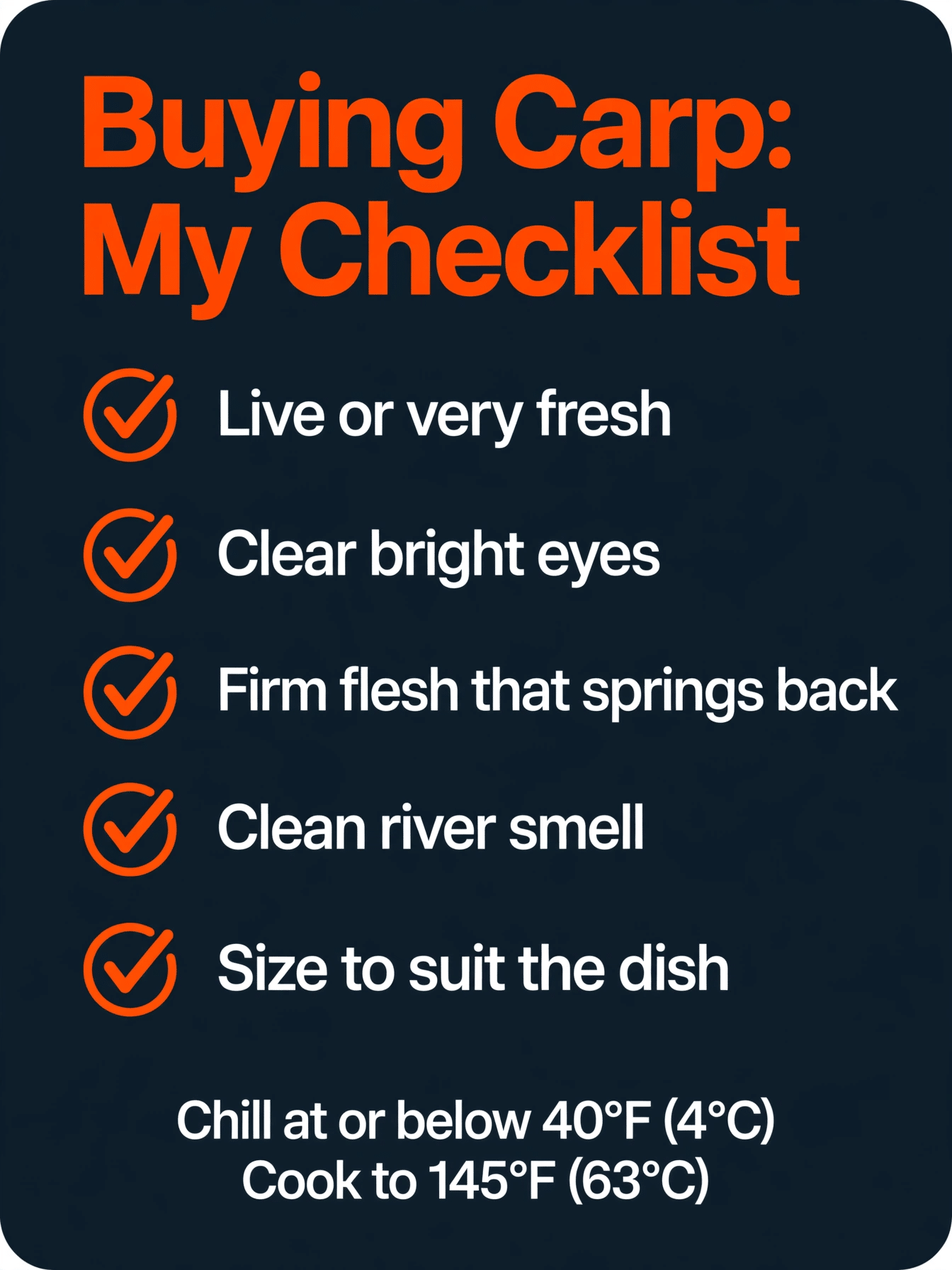
Buy carp live if you can, or buy it very fresh, check the eyes, flesh and smell, and pick a size that suits the dish you plan to cook. Those are the lines on my checklist, and after years of buying and catching this fish, I trust them more than any bargain.
Live or very fresh comes first. In our markets, live carp in a tank is common, and I choose it whenever I can because a living fish is its own freshness certificate. If I am buying from my own catch or handling fish straight from the canal, my approach follows the same thinking I use in Catch to Kitchen: How to Handle and Cook Fish You Catch Yourself: keep the fish cold, clean it soon and do not let it sit warm. If live is not possible, very fresh is the standard, and fresh has clear signs.
Clear bright eyes are my second check. The eyes should look clear and bright, not cloudy, sunken or dull. Third, I press the flesh gently. Firm flesh that springs back is what I want. If my finger leaves a pit that stays, I leave the fish. Fourth, I smell it. A clean river smell is right. Mud on the outside from handling is normal, but the flesh and gills should not smell sour or stale.
Size to suit the dish is my last check, and it is practical, not fussy. For frying steaks and curry pieces, I like a medium fish that cuts into even pieces with manageable bones. For a whole baked or steamed presentation, a smaller fish cooks more evenly in my kitchen. Very large fish I buy only when I know the water source well, because age and size can bring stronger flavour. And I repeat my source rule here because it matters most with carp: clean water in, clean flavour out. If the source is doubtful, I apply the fixes in my How to Remove Muddy Taste guide or I choose another fish entirely.
How I Clean Carp, in Brief
Clean carp in this order: scale it, gut it carefully, wash it well, trim the dark flesh and belly fat, then portion it for your dish. I am keeping this section brief on purpose, because the full skill of cleaning a whole fish deserves its own space, and I have already laid it out step by step in How to Gut and Clean a Whole Fish. What follows is the order I follow for carp and the carp specific points I never skip.
Carp scales are large and stubborn, so I scale first, working from tail to head, ideally outdoors or in a deep sink because the scales travel. Then I gut the fish carefully, keeping the knife shallow so I do not cut into the innards and spread bitterness over the flesh. I remove the gills, scrape out the dark blood line along the backbone and wash the cavity until the water runs clear.
After washing, I trim. The dark flesh along the side and the soft belly fat are where muddy flavour collects most, so I cut them away with a thin slice rather than leaving them for the pan. Then I portion the fish: steaks for frying and curry in my house, most of the time. I rinse once more, pat the pieces dry and either cook them soon or chill them properly, which brings me to the safety basics later in this guide. Clean as you go is my kitchen habit with carp. A clean board, a rinsed knife and washed hands between stages keep the flesh tasting like fish, not like the sink.
The Best Ways I Cook Carp
The best ways to cook carp in my kitchen are frying steaks, cooking it in curry, and grilling or baking firm pieces, because these methods suit its dense flesh and stand up to its bones and flavour. Delicate methods that work for soft white fish are mostly wasted on carp.
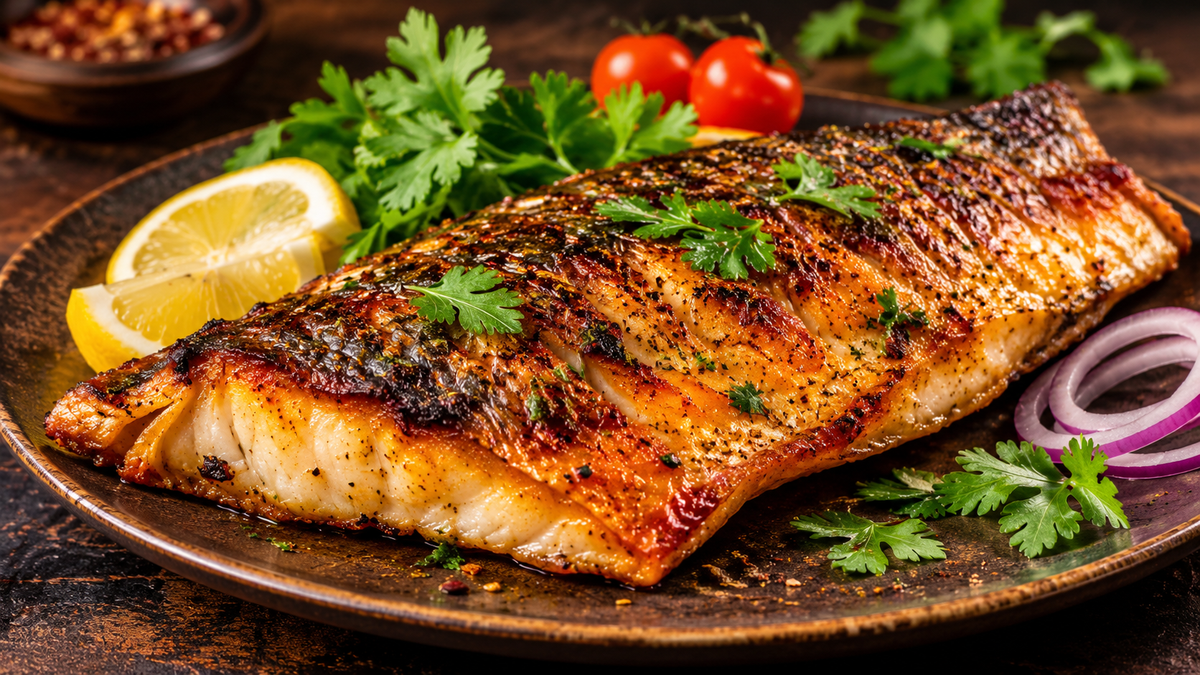
Frying is my first love for this fish. I cut steaks, season them well, let the spice sit on the flesh for a short rest in the fridge, then fry until the outside is crisp and deep golden. The firm flesh does not fall apart when I turn it, and the crust gives a contrast that makes people forget their doubts. Fried carp with lemon and a sharp chutney is the plate I serve to carp sceptics, and it has converted more than a few.
Curry is the second great home for carp. The pieces hold together in the gravy, absorb the spices and taste even better as the flavours settle into the flesh. Because carp has real flavour of its own, it does not disappear under a strong masala the way a very mild fish can. I keep the pieces on the larger side for curry so they stay whole and are easier to eat around the bones.
Grilling and baking work well for steaks and for a whole smaller fish, as long as I oil the fish and the surface well and do not move the pieces too early. Whichever method I choose, I cook fish to 145°F (63°C) in the thickest part, and I rest it briefly before serving so the juices settle.
What to Avoid When Cooking Carp
Avoid poaching plain carp in water, avoid thin fillets that dry out and break, and avoid serving undercooked carp to guests who are new to its bones. These are the mistakes I see most often, and I have made some of them myself in my early years.
Plain poaching gives carp nowhere to hide. Without a crust, a sauce or strong seasoning, any earthy note comes straight forward. Thin fillets are the other trap: cut from a bony fish, they tend to be small, full of fine bones and quick to dry. Steaks and chunks are the honest cut for this fish. I also avoid rushing the cleaning. With carp, the cleaning is half the cooking. Skip the trimming and washing, and you taste that shortcut in every bite.
Bones: The Honest Part
Carp has many fine bones, including small forked bones in the flesh, and the honest way to enjoy it is to eat it slowly, choose steaks and larger pieces, and learn where the bones sit. I will not pretend otherwise. Bones are the true cost of carp, and anyone who tells you this fish is bone free is not your friend.
In my house we manage bones with habit, not fear. Steaks keep the main bones in predictable places. We eat with our hands, take smaller bites, and treat the fine bones as part of the rhythm of the meal. Children at my table get pieces I have checked myself, from parts of the fish with fewer fine bones.
I am deliberately not turning this section into a full bone masterclass, because that detailed work lives in my sibling guide on Cooking Bony Fish, where I go deep on eating, cutting and cooking around bones. Read that guide alongside this one and carp stops being intimidating. Here, my point is only this: bones are a reason to eat carp carefully, not a reason to refuse it.
Safety and Storage in My Kitchen
Chill carp fast, keep your fridge at or below 40°F (4°C), cook the fish to 145°F (63°C), and remember that raw fish keeps 1 to 2 days refrigerated while cooked fish keeps 3 to 4 days. Those are the safety basics I follow with carp, exactly as I follow them with every fish in my kitchen.
Fresh carp goes into the cold as soon as I am home or as soon as it is cleaned. I store it in a covered container, ideally on a bed of ice in the fridge, and I plan to cook it the same day when I can. Raw fish keeps 1 to 2 days refrigerated, and with a fish as flavour sensitive as carp, I stay at the short end of that window by choice. Leftovers are a different matter: cooked fish keeps 3 to 4 days refrigerated, sealed well, and reheated until hot through.
Trust your nose at every stage. A clean river smell is right. A sour or sharp smell means the fish has turned, and my rule is firm: when in doubt, I throw it out, and I never taste a doubtful fish to check it.
Frequently Asked Questions
Is carp a healthy fish to eat?
Yes, carp is a nutritious fish with good protein and a satisfying, meaty flesh, and I eat it happily as part of my regular fish cooking. Like any freshwater fish, its quality depends on the water it lived in, which is why I buy from clean sources I trust and why I treat very large fish from doubtful water with caution.
Does carp always taste muddy?
No, carp does not always taste muddy. Carp from clean flowing water, bought live or very fresh and trimmed properly, tastes mild and sweet in my kitchen. The muddy flavour comes from the water and from fat and dark flesh left on the fish, and my separate muddy taste guide covers the fixes in full.
What is the best way to cook carp for beginners?
Frying seasoned steaks is the best starting point in my experience. The pieces are firm, the crust is forgiving, the bones sit in predictable places in a steak, and the flavour is at its most friendly. Cook the steaks to 145°F (63°C) in the thickest part and serve them hot with lemon.
Can I eat carp raw?
No, I do not eat freshwater carp raw, and I do not serve it raw in my kitchen. Freshwater fish carries risks that cooking handles, so I always cook carp through to 145°F (63°C). Save raw preparations for fish that is bought and handled specifically for that purpose from trusted sources.
My Final Word on Carp
Carp is good to eat, and I stand by that answer with one honest condition: respect the fish before the pan ever gets hot. Buy it live or very fresh from clean water, clean it with patience, trim the parts that hold muddy flavour, choose steaks and strong methods like frying and curry, and eat it slowly enough to enjoy it around its bones. Do those things and carp rewards you with sweet, firm, deeply satisfying flesh that has fed families like mine for generations. Skip them, and you will understand every bad story you have ever heard about this fish. In my kitchen, carp is not a compromise fish. It is a fish with terms, and when I meet its terms, it never lets my table down.

2 Comments