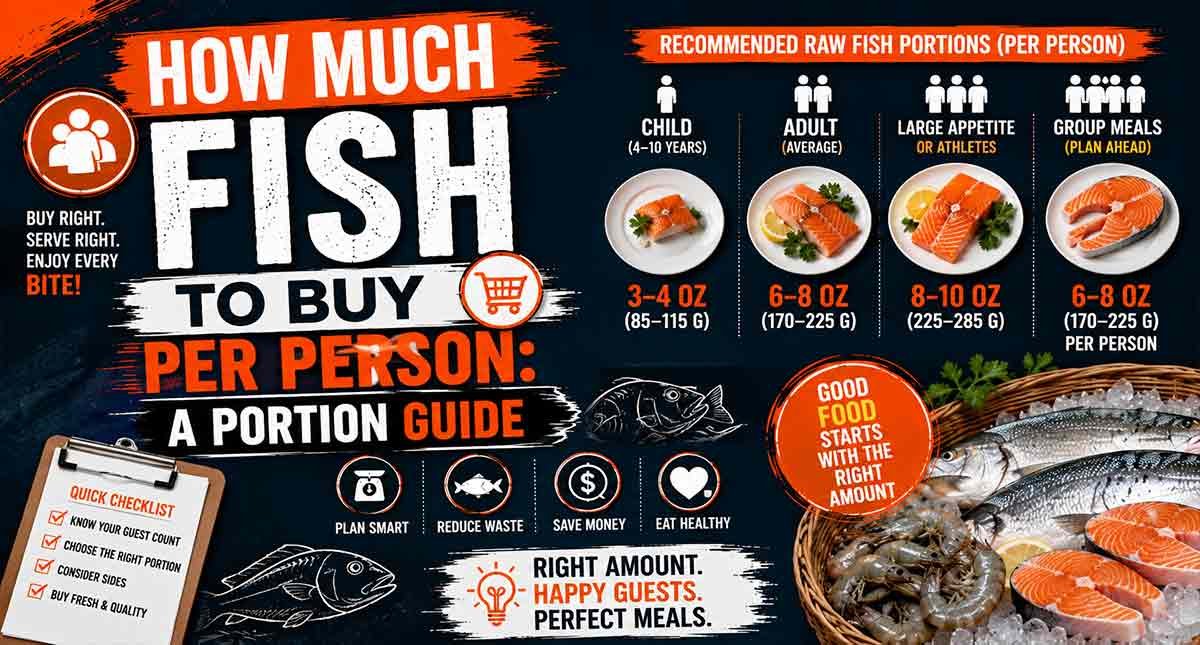
How Much Fish to Buy Per Person: A Portion Guide
Plan on 6 to 8 ounces (roughly 170 to 225 grams) of raw, boneless fillet per person for a standard main course. That number is a genuinely reliable starting point, but the real math behind it has more moving parts than a single figure suggests: whole fish needs a different calculation than fillets, cooking itself changes the weight again, and appetizers, kids, and shellfish all follow their own rules.
I always buy a little over any estimate rather than exactly to it, and once you understand why the numbers move the way they do, you’ll see why that’s not just caution; it’s just how the math actually works.
Table of Contents
What’s the Standard Portion Size for a Main Course?
6 to 8 ounces of raw, boneless fillet per person is the standard range for a main course where fish is the centerpiece of the plate. Lean, mild fish like cod or tilapia tend to sit at the higher end of that range since they’re often served in slightly larger portions; a rich, fatty fish like salmon can feel just as satisfying at the lower end, since fattier fish reads as more filling per ounce.
This range assumes fish is the main protein on the plate, served with sides. If it’s one of several proteins in a bigger spread, or the dish is very rich, you can comfortably go lower.
How Much Whole Fish Do You Need Instead of Fillet?
More than double the fillet amount is the safe general assumption, but the exact multiplier depends heavily on the species and its body shape. A round, meaty fish like salmon or monkfish can yield 55-70% of its whole weight in edible fillet, while a flat or large-headed fish like flounder, sole, or snapper yields closer to 30-45%, since a much bigger share of its total weight is head, frame, and skin relative to the meat.
If you don’t know a specific species’ yield, assume something closer to 45-50% as a starting point and buy a little extra rather than come up short; that’s a reasonable average across most common species. But if you buy the same species regularly, it’s worth learning its actual yield instead of relying on an average, since the gap between a low-yield and a high-yield fish is wide enough to matter, both for your grocery bill and for how much actually ends up on the plate.
Does Fish Actually Shrink When You Cook It?
Yes, but not by as much as the commonly repeated “25%” figure suggests. That number traces back to a single rough estimate meant to average across meat, poultry, and fish combined for calorie-tracking purposes; it was never meant to be applied precisely to fish specifically, and it’s been repeated so often it’s now treated as a rule it was never meant to be.
More specific research on fish cooking loss puts actual moisture loss during cooking closer to 10-20%, depending on the method and how long it’s cooked; grilling, pan-frying, and smoking all produce somewhat different results, and overcooking increases the loss well beyond that range regardless of method.
The practical takeaway: a little shrinkage during cooking is normal and expected, but if a piece of fish is losing a dramatic amount of size and moisture, that’s more often a sign of overcooking than an unavoidable property of fish itself.
How Much for an Appetizer Instead of a Main?
Plan on 2 to 3 ounces of raw fish per person for an appetizer or starter course, roughly a third of a main-course portion. This works well for something like a ceviche, a small plated starter, or one course in a multi-course meal where fish isn’t meant to be filling on its own.
For a passed appetizer at a party, like small skewers or bites, plan closer to 1.5 to 2 ounces per person, since guests are usually sampling several different foods rather than eating a full course of any one thing.
How Much Shrimp or Shellfish Per Person?
Plan on 4 to 6 ounces of peeled, raw shrimp per person for a main course, or about 6 to 8 ounces if you’re buying shell-on, since shell weight doesn’t translate to what ends up on the plate. For an appetizer portion, 2 to 3 ounces peeled is plenty.
Shellfish loses a meaningful amount of weight during cooking too, sometimes more than fish does, so lean toward the higher end of any estimate rather than the lower one if you want generous portions rather than exact ones.
How Much Fish Should You Plan for Kids?
Plan on roughly half an adult portion, around 3 to 4 ounces of raw fish, for younger children, and closer to a full adult portion for teenagers. This is a starting point, not a rule; appetite varies enormously by age and by kid, and it’s easier to have a little extra on hand than to come up short.
How Do You Scale Portions for a Group or Party?
Multiply your per-person number by the guest count, then add a modest buffer, around 10 percent, for bigger appetites or unexpected extra guests. For a mixed menu where fish is one of several dishes rather than the only option, you can plan smaller individual portions, since people will be filling their plates from multiple dishes rather than just one.
For full menu planning beyond just the fish portion itself sides, pacing, and how many dishes a fish-centered dinner actually needs see Fish Dinner Party Menu Ideas.
Common Mistakes When Estimating Portions
The most common mistake is buying to the exact estimate rather than slightly over it; fish is one of the least forgiving proteins to come up short on, since there’s rarely a good way to stretch a main course after the fact. The second is forgetting that rich sides, like a heavy sauce or a starch-heavy dish, reduce how much fish people actually want, while lighter sides don’t fill the same gap.
I always round up rather than down when I’m not sure, and I’d rather have a small amount of good leftover fish than run short at the table.
Quick Reference: Portions at a Glance
| Context | Amount per person (raw weight) |
| Main course, fillet | 6-8 oz (170-225 g) |
| Main course, whole fish (avg. yield) | 12-16 oz, more for low-yield species |
| Appetizer/starter | 2-3 oz |
| Passed appetizer/bites | 1.5-2 oz |
| Shrimp, main (peeled) | 4-6 oz |
| Shrimp, appetizer (peeled) | 2-3 oz |
| Kids (younger children) | 3-4 oz |
Frequently Asked Questions
Is it better to buy a little too much fish or a little too little?
Too much, almost always. Extra cooked fish keeps well for a day or two and repurposes easily into a salad or sandwich; a main course that’s come up short is much harder to fix at the table.
Does the “25% shrinkage” rule apply to raw weight or already-cleaned fillet weight?
It’s most often applied to an already-cleaned fillet, but the commonly repeated number itself isn’t reliable for fish specifically, regardless of which weight you start from; see the cooking-shrinkage section above for a more accurate range.
Should you weigh fish before or after cooking when portioning?
Before. Portioning by raw weight is the standard and the more reliable reference point, since cooked weight varies by method and doneness.
Should you weigh fish before or after cooking when portioning?
No, portion by raw weight either way. Thawed frozen fish behaves the same as fresh once it’s ready to cook.
What to Check Next
For the full case on whether whole fish or fillets makes more sense for your situation, including the cost math behind that decision, see Whole Fish vs Fillets: Which Should You Buy?. And for the complete buying process this fits into, start with The Complete Guide to Buying Fish and Seafood.

One Comment