Why Does Fish Curl Up When Cooking?
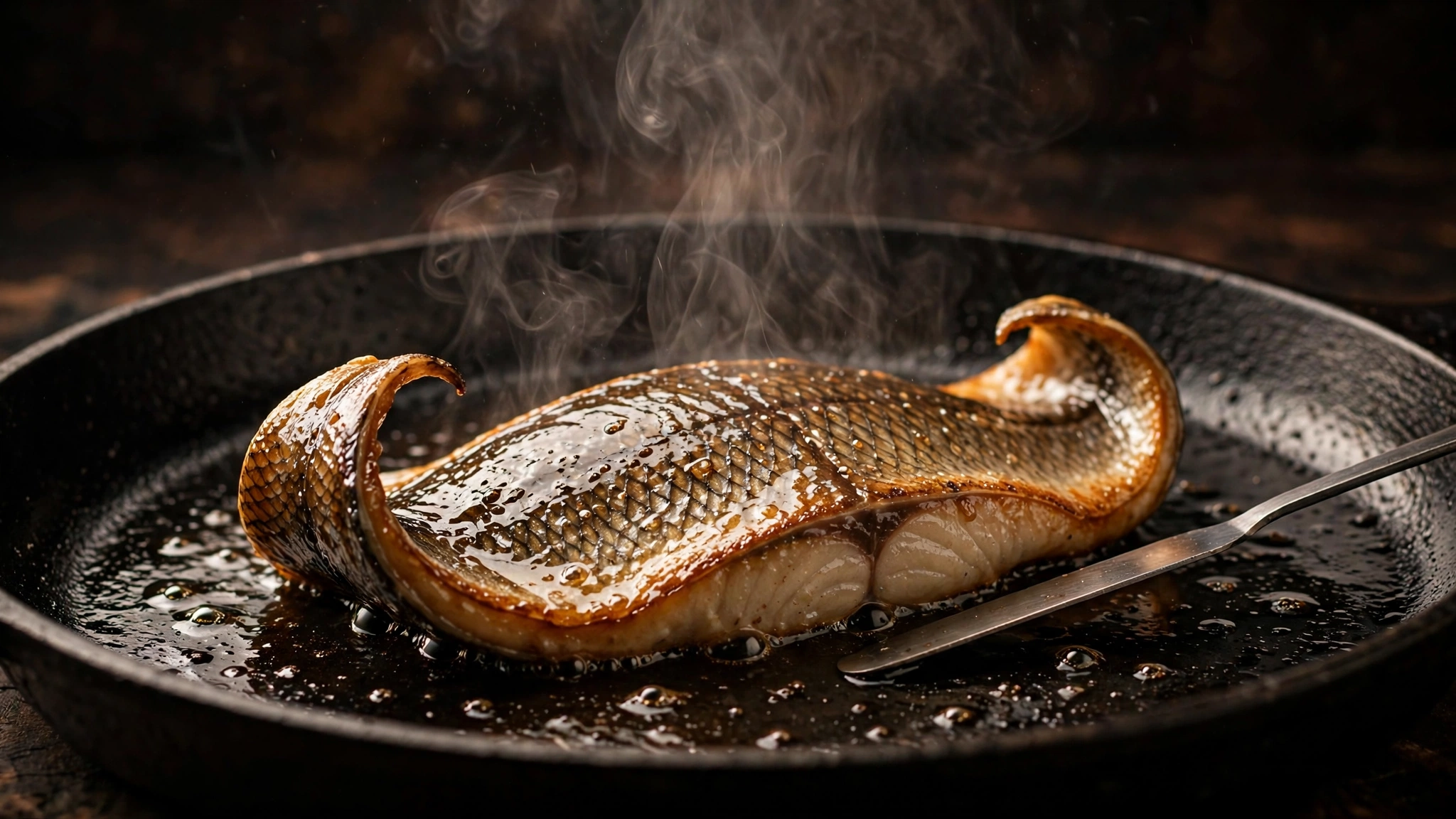
Fish curls up when cooking because one side tightens faster than the other. On skin-on fish, the skin pulls hard as it heats and dries. On a thin fillet, the flesh itself has a spring and bends toward the hotter side. The fix is gentle: choose even pieces, pat the fish dry, start skin-on fish skin-side down, give it room, and flip once.
I am Wasim Abbas Bhatti, the Fish’s Chef. Curling has a simple cost: the edges lift, the middle loses pan contact, and one part browns while another waits. This guide sits inside The Science of Cooking Fish: A Troubleshooting Guide, where I treat curling as a heat-control problem, not a mystery.
Table of Contents
Why Fish Curls in the First Place
A flat fillet looks calm, but it is not built evenly. Skin, flesh, fat lines, and thickness all react to heat at their own speed. When one layer tightens sooner, the piece bends toward that pull. That is the whole story, and once you see it, the fixes make sense.
The skin pulls first
Skin is the strongest actor here. As skin heats, it tightens and shrinks. If the flesh side is still soft, the skin wins the tug and the fillet cups. This is why a skin-on fillet often curls more proudly than a skinless one, even though the skin is also protecting the flesh from the pan.
Wet skin makes the problem louder. Surface water steams before the skin can settle and crisp. While it steams, the skin keeps pulling and the fillet keeps moving. Dry skin is not just for crispness; it is for calm behaviour in the pan.
One side gets the heat first
In a pan, the bottom side meets fierce heat while the top side sits in cooler air. The hot side firms and tightens first. The cooler side follows later. A thin piece has very little strength against that difference, so it bends.
This is also why curling can happen in the oven. The tray, the air, and the fish surface do not heat in perfect balance. A crowded tray makes it worse because steam gathers around the fish and the surface stays unsettled.
Thin fillets have a spring
A thick piece can resist a little uneven tightening. A thin fillet cannot. It is closer to a leaf than a plank. Add an uneven shape — thick at one end, tail-thin at the other — and the thin end races while the thick end is still deciding.
That is why I do not treat curling only at the stove. Even cutting and portioning start earlier, with the prep habit in Fish Prep and Butchery: Every Skill You Need: matching thickness gives the pan a fair job.
My Fix: Help It Lie Flat
You do not need to wrestle the fish. You need to set its shape early, then stop interfering.
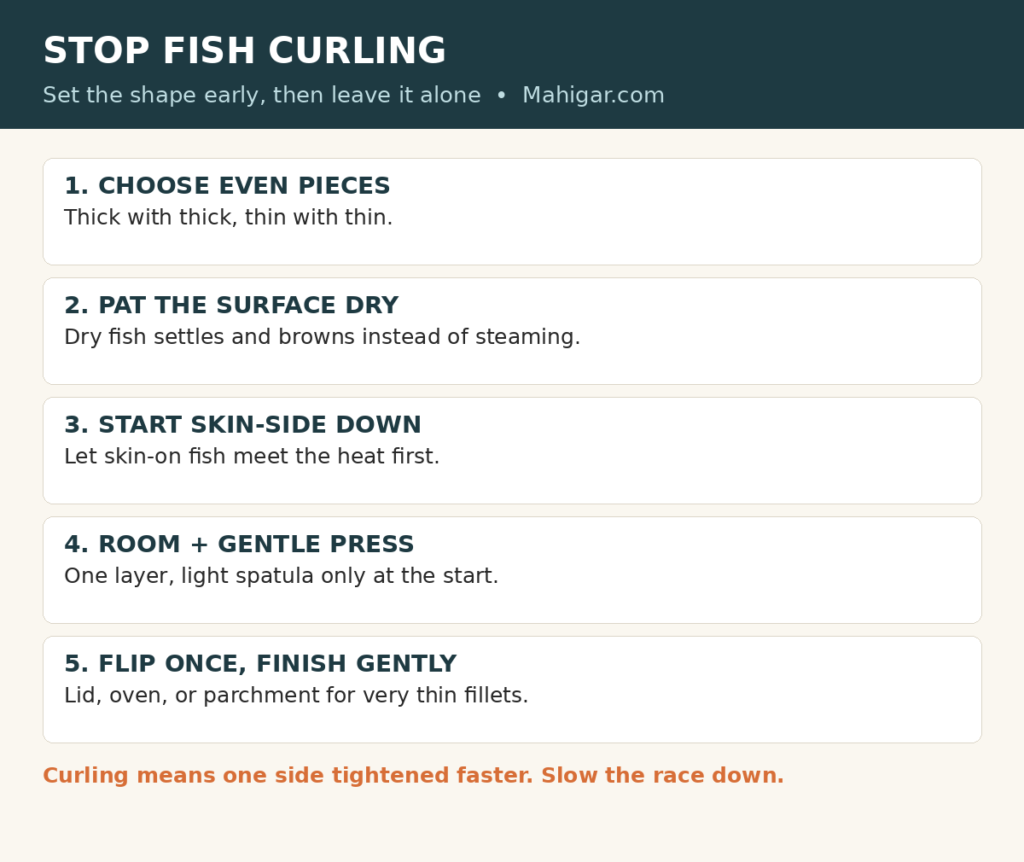
Choose even pieces
Match thick with thick; fold thin tails under for even thickness.
Pat the surface dry
Dry top, bottom and skin so fish browns, not steams.
Start skin-side down
Let skin set first; place skinless gently.
Leave room in the pan
Single layer with space.
Use gentle press only
Light touch at start only.
Score skin shallowly
Cuts through skin only.
Flip once gently
One turn; finish gently.
Skin-On and Skinless Fish Do Not Behave the Same
Skin-on fish gives you a tool and a problem in the same piece. The skin protects the flesh and can turn crisp, but it also pulls. Dry it well, start it skin-side down, and score it shallowly if the cupping is stubborn. The goal is not to punish the skin flat. The goal is to let the skin set before it wins the bend.
Skinless fish has no skin to score. Pressing harder is not the answer; it squeezes moisture and can break the fillet. For delicate skinless pieces, even portions matter more, the pan needs room, and gentler methods help. A parchment-lined tray is not a failure. It is often the kindest way to cook a thin fillet that wants to curl and tear.
Whole fish sit between the two. The skin and frame give shape, but the skin still tightens across the body. Shallow scoring on the skin can help a whole fish lie steadier, especially when the skin is thick. Keep the cuts light. You are giving the skin room, not carving the fish apart.
Curling Can Hide the Real Question: Is It Done?
A curled fillet cooks unevenly. The lifted edges may look ready while the thick centre is still translucent. Do not judge by the browned rim. Check the thickest part.
With a thermometer, fin fish should reach 145°F (63°C) in the thickest part. Without one, use the backup check from How to Tell When Fish Is Done Without a Thermometer: the flesh should be opaque, no longer glassy, and should separate into gentle flakes. The full safety chart is in Safe Internal Cooking Temperatures for Every Type of Fish.
Flat contact is not only about looks. It helps the whole piece finish together, so one honest check can speak for the fillet.
The Mistakes That Make Curling Worse
- Putting wet fish into the pan. Water steams, skin pulls, and the fillet starts moving before it can settle.
- Crowding the pan. Too many pieces trap steam and heat unevenly.
- Pressing hard the whole time. A light settle helps; constant force squeezes and breaks delicate flesh.
- Flipping again and again. Every turn restarts the argument. Set the shape, flip once.
- Scoring too deep. The cut belongs in the skin. Deep cuts tear the flesh and leak its moisture.
- Cooking a mixed-thickness batch as one. Thin tails and thick centres will never finish together.
Frequently Asked Questions
Why does fish curl in the oven?
Uneven tightening still applies; use even, dry fish on uncrowded tray.
Does scoring skin help?
Yes, shallow skin cuts reduce pull; not for skinless.
Should I press fish flat?
Only lightly at start, not hard.
Is curled fish undercooked?
Not always; check thickest part.
What to Check Next
If your fish is curling, name the cause before you touch it: pulling skin, thin flesh, crowded pan, or uneven portions. Then set the shape early and let the heat work.
For the wider map of sticking, mushiness, and doneness, go back to the Cooking Science pillar. For the prep that gives every fillet a fair start — scaling, filleting, pin bones, skinning, and even portions — use the Prep pillar. Flat fish is rarely an accident. It is usually good prep meeting calm heat.
