Essential Equipment for Cooking Fish at Home
The drawer tells the truth. I have opened fish cooks’ gadget drawers, the crowded ones, and seen the same story everywhere: a specialty tool for every problem, and the same problems still on the plate. Fish sticks. Fish breaks at the flip. Fish arrives dry while the cook stares at a thermometer they never bought, because a celebrity pan was on sale.
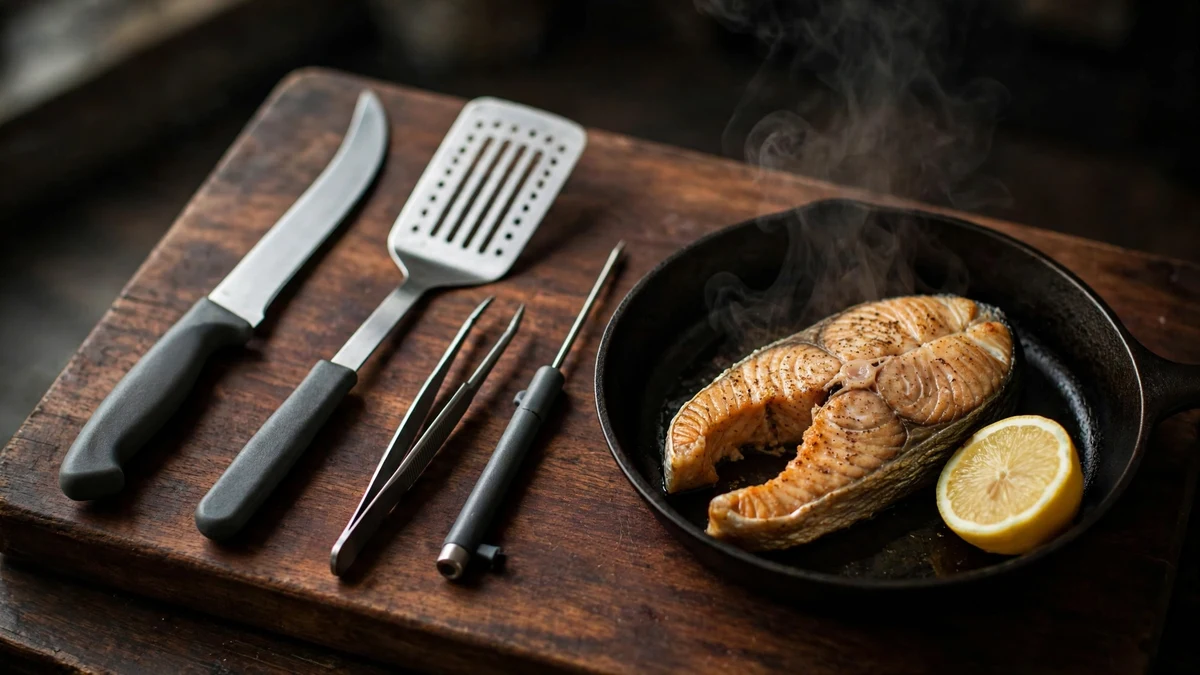
I stopped buying my way out of fish problems years ago. The order is what matters, and the order is simple: buy for the job the fish needs, in the order the fish needs it, and let every tool earn its place by a habit you already have. Fish asks for almost nothing special. A flexible fillet knife kept sharp, one pan that releases fish, an instant-read thermometer, a thin turner, and tweezers for pin bones: that short list covers nearly every fish dinner I have cooked in twenty years. Everything past it is a question, not a purchase, and this page is where I answer each one honestly.
This is Mahigar’s equipment hub. It gives my buying order, what each tool truly does for fish, what can honestly wait, and eight guides that will judge pans, spatulas, poachers, thermometers, grill baskets, smokers, air fryers, and the starter kit one by one. No prices, no brand worship, no verdict I cannot stand behind from a home kitchen.
Table of Contents
Table of Contents
First: The Two Numbers Your Tools Must Protect
Fish stays at 40°F (4°C) or below from market to pan, and fin fish finishes at 145°F (63°C) in the thickest part, or when the flesh turns opaque and flakes easily. Every tool on this page exists to protect those two numbers.
The knife that portions evenly, the pan that releases cleanly, the thermometer that ends the guessing: each one makes those numbers easy to keep, fish after fish, without drama. A tool that helps you hit them calmly is worth its drawer space. A tool that only promises to make your fish “gourmet” is worth nothing at all. The full temperature chart lives in the thermometer section below.
Equip by the Job: The Order I Buy In
My method is four jobs, always in this order: prep, cook, check, turn, and extras only after all four are covered. Jobs first, tools second, brands last, and mostly never.
Prep comes first because fish is won or lost before the pan: scaling, gutting, filleting, skinning, pin-boning, and portioning decide how evenly the fish will cook. Cooking comes second: one pan suited to the way you actually cook fish most weeks. Checking comes third: a thermometer turns “I think it is done” into “I know.” Turning comes fourth: a thin, gentle turner keeps fragile fillets in one piece. Only then do habit tools deserve a verdict: a grill basket, a smoker, an air fryer, each serving one method.
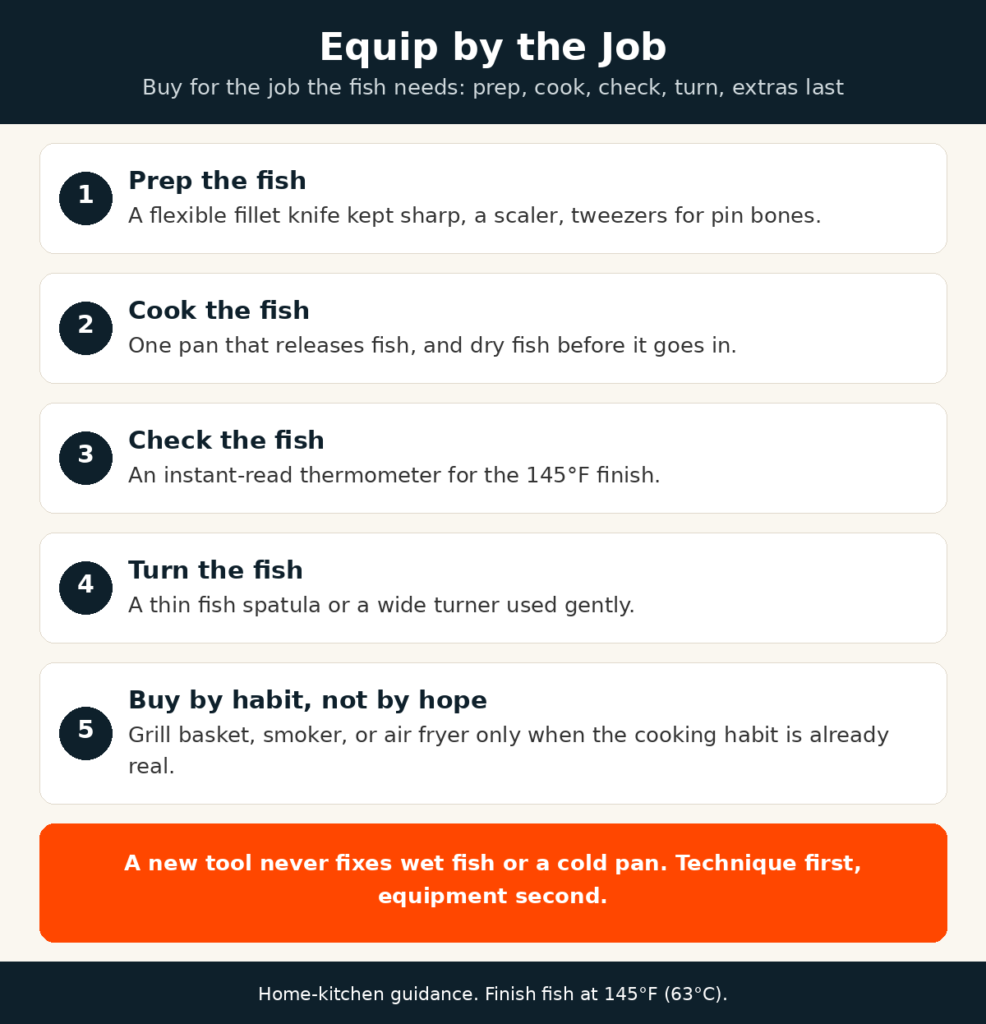
A tool bought for a job you do weekly is equipment. A tool bought for a job you did once is storage. That single sentence has saved my cupboard from more purchases than any review ever has.
Knives and Prep Tools: Won Before the Pan
If I could keep only one special tool, it would be the fillet knife. A fish fillet knife is long, thin, and flexible on purpose: it bends along ribs and backbone, slides between skin and flesh, and takes thin, clean slices instead of sawing. A stiff, heavy knife fights the fish and tears what it should release.
Sharp matters more than expensive. A modest knife honed often will out-fillet a costly knife that lives dull in a block. Keep the edge fine, use a board that does not slide, and let the knife’s length do the work in long strokes. Fish cut evenly cooks evenly, and fish cut ragged cooks ragged at the edges while the centre waits. The full prep sequence, scaling, gutting, filleting, skinning, and portioning, is taught step by step in Fish Prep and Butchery: Every Skill You Need.
Two small tools finish the prep kit. A scaler, or the back of a knife used honestly, takes scales off without gouging flesh. And tweezers earn their tiny place every single week: pin bones hide along the fillet’s centre line, and fingertips find them better than eyes. The fingertip-and-tweezers routine is in How to Remove Pin Bones from Fish.
What can wait: a giant knife set. Fish asks for one flexible fillet knife, one sturdy kitchen knife for heavier work, and steel to keep them honest. The other slots in the block are decoration for most fish cooks.
Sharpening and Knife Care: The Habit Nobody Films
Nobody posts videos of honing a knife, which is exactly why dull knives are everywhere. A fillet knife does not stay sharp by itself. It stays sharp because somebody tends it, and that somebody is you, for about a minute, most days you cook fish.
Here is the habit. Before the fish comes out of the fridge, a few light passes on a honing steel, realigning the edge. When the steel stops bringing the bite back, the knife goes to a proper sharpening: a stone, or a trusted professional, not another gadget. Then it gets washed by hand, dried at once, and put away where the edge touches nothing: a sheath, a strip, a block slot that fits. The dishwasher is where good edges go to die. Heat, banging, and sitting wet do the dull work faster than any fish ever will.
I test an edge the honest way: it should slice a tomato’s skin without pressure, or glide through a fillet without sawing. If it drags, it is not ready, and no recipe can fix what the edge will not do. A sharp knife is also the safer knife. It goes where you send it. A dull knife needs force, and force is what slips.
This is the cheapest upgrade in the whole equipment world, and it is not a purchase at all. It is a habit. Keep the edge, and the one knife you own behaves like three.
The Pan: Where Fish Succeeds or Sticks
The best pan for fish is the one that is hot when the fish goes in, dry-fish friendly, and matched to the job: searing skin-on fillets, gently frying, or finishing in the oven. Ask a room of fish cooks for the “best pan” and you will start an argument. Here is the honest version instead.
Material matters less than the three habits no pan can supply: fish patted dry, pan properly hot, and patience while the surface firms and releases. I will not pretend one metal wins for every fish. A heavy pan holds heat when a thick fillet lands. A lighter pan answers faster when delicate fish needs the heat lowered quickly. Forgiving surfaces help beginners and paper-thin fillets, but they still punish wet fish and crowding. The science of why fish bonds to metal, and the release order that fixes it, is in The Science of Cooking Fish: A Troubleshooting Guide.
The full pan-by-pan verdict, what to buy first and what each surface is honest about, belongs to Best Pans for Cooking Fish Without Sticking. Until that guide publishes, my rule stands: one good pan, learned deeply, cooks more good fish than three pans used hopefully.
Pan Materials: What Each One Is Honest About
Every pan material makes a promise and hides a cost. Here is what each one is honest about, at the level that actually matters in a home kitchen.
A forgiving, easy-release surface is the kindest teacher. It lets a beginner or a paper-thin fillet off the hook when the heat is slightly wrong, and it asks for gentle tools and gentle heat in return. It will not survive metal scrapers or screaming heat, and it will still stick if the fish goes in wet and crowded. Buy it to learn on, not to stop learning.
Bare stainless-style steel is the honest worker. It sears beautifully, it takes real heat, and it tells you the truth about your technique because it forgives nothing. Fish sticks to it when the rules are broken: cold pan, wet fish, early flip. Follow the rules, dry fish, hot pan, patience until it releases, and it rewards you with the crispest skin in the kitchen. This is the pan for the cook who wants to learn the craft properly.
Heavy cast-style iron is the heat keeper. Once hot, it stays hot, which is exactly what a thick fillet or a whole fish needs when it lands and tries to drag the temperature down. It is heavy, it needs drying and a little care after washing, and delicate fillets can overcook before you notice. I reach for it when the fish is thick and the sear matters.
Enamelled-style pans sit in the middle: easier to live with than bare metal, more forgiving to wash, good for gentle cooking and for sauces built in the same pan. They will not give you the hardest sear, and they still want the same three habits as every other pan.
Notice what I did not do: rank them. The ranking is yours to make, by the fish you cook most weeks. A cook who lives on delicate sole needs a different pan than a cook who sears thick steaks. Match the material to the job, learn it deeply, and the sticking problem shrinks to the size it should be: a technique problem, not a shopping problem.
The Thermometer: The Cheapest Confidence in the Kitchen
A thermometer shortens the guessing to seconds. Probe the thickest part, away from bone and pan, and read the truth: fin fish is done at 145°F (63°C), or opaque and flaking, the number and the visual cue together, never bravado. Fish gives small warnings and a short road from “not yet” to “too far.”
An instant-read thermometer is the one “gadget” I urge on every fish cook without embarrassment. It costs less than one ruined whole fish, it ends the dry-fish habit of “five more minutes to be safe,” and it makes a nervous cook calm about serving fish to children and guests. The full chart, including ground fish, stuffed fish, shrimp, and reheated leftovers, is in Safe Internal Cooking Temperatures for Every Type of Fish.
What to look for is simple: a thin tip that does not tear delicate flesh, a fast and clear reading, and a body you can rinse and dry without ceremony. I will not rank brands or quote accuracy figures I have not measured. The dedicated guide, Best Meat Thermometers for Fish, will tie the buying decision to the safety chart it serves.
Spatulas, Turners, and the Gentle Flip
Fish breaks at the flip more often than anywhere else, and the prevention is embarrassingly simple: a thin, flexible turner that slides under the whole fillet instead of pushing at its edge.
The fish spatula exists for one reason: a thin, angled edge that slips under crisp skin or a delicate skinless fillet, with enough flex to lift without folding and enough slots to let oil fall away. Used well, it turns a fillet once, confidently, the way fish wants to be turned. Used on everything, it is just a spatula. Whether you need the dedicated tool, or a wide turner you already own does the job honestly, is the whole question of Do You Need a Fish Spatula? A Buyer’s Guide, and the honest answer depends on how often delicate fillets pass through your pan.
The supporting cast is humble: a wide turner for sturdy pieces, gentle tongs for whole fish on the grill, a bench scraper or two spoons for lifting portions, and paper towels, the cheapest “tool” in this entire hub, for the drying that decides whether fish crisps or steams. No turner, however thin, can save a fillet that went into the pan wet and crowded.
Poachers, Grill Baskets, Smokers, Air Fryers: Honest Worth-It Verdicts
Each of these is a good servant to one real habit and a bad master to an imagined one. This is the shelf where money goes to be hopeful, so every tool here gets the same rude question: what weekly habit does it serve?
A fish poacher is a long, lidded pan built for whole fish in liquid. It is lovely if you poach whole fish for guests often. If you poach twice a year, a lidded pan or a deep tray with liquid does the job honestly, and the dedicated verdict in Is a Fish Poacher Worth Buying? will say so without flinching.
A grill basket solves a real problem, fish sticking to grates and falling through in pieces, for people who grill fish regularly. For the occasional griller, a clean, hot, oiled grate and a confident flip may be enough. The basket earns its hooks only when the habit is real. The full reasoning lives in Best Grill Baskets for Cooking Fish.
A home smoker is a commitment, not an accessory: it serves the cook who truly smokes fish and will do it again next month. Bought for one inspired weekend, it becomes the largest storage item you own. Home Fish Smokers: A Buying Guide will judge sizes and styles against real home use, once the verdict comes from actual smoking, not catalogue reading.
And the air fryer? It cooks fish respectably: dry circulating heat, a crisp finish on firm fillets. But it is a method with trade-offs, not a miracle. Thin and delicate pieces dry quickly, and it will never give you a pan sauce or crisp skin quite the pan’s way. The tested, honest comparison is Air Fryer Fish: Is It Actually Good?, and it will stay honest about what the pan still does better.
None of these four is “essential.” Each is a good servant to one real habit and a bad master to an imagined one.
If I Started From Zero: My Buying Order
Suppose my kitchen burned down and the insurance paid in patience instead of money. Here is the exact order I would buy in, and I would not skip a step.
First, the fillet knife and the steel. Everything starts at prep, and a sharp knife changes every fish you touch. Second, one pan, the one that matches the fish I cook most weeks, plus a turner thin enough to slide under a fillet. Third, the thermometer, because guessing is the most expensive habit in fish cooking and the cheapest to break. Fourth, tweezers and a scaler, small money for weekly jobs. Only then, and only when a habit demands it, the extras: the grill basket when the grilling is weekly, the smoker when the smoking is real, the poacher when the guests keep coming.
Notice the shape of that list. The first four purchases are cheap, quiet, and unglamorous. Nobody shows off a honing steel. But those four decide almost every fish dinner you will ever cook, and everything after them is rounding. When you feel the pull of a shiny tool, ask it which of the four jobs it serves. If it serves none, it is not equipment. It is decoration.
Caring for Your Tools: Cleaning and Storage
Good tools die from neglect, not from work. Fish is wet, salty work, and the care routine is short.
Wash knives by hand the moment you finish, dry them at once, and store the edge where it touches nothing. Never leave a fillet knife sitting in a sink of water and steel wool. That is how edges chip and tips bend.
Pans want the same respect you gave them in cooking. Let them cool enough to handle, wash with hot water, dry fully, and store without stacking bare metal on metal. A dry pan stored dry stays ready. A pan stored damp starts every next dinner with a small apology.
The thermometer gets rinsed and dried after every use, and its probe never goes through the dishwasher. Tweezers and the scaler get the same hand-wash-and-dry. The fish spatula, thin as it is, bends if it is jammed into a crowded drawer: give it a slot or a hook.
None of this is precious. It is five minutes after dinner, and it is the difference between tools that last years and tools you replace every spring. The cheapest equipment strategy in this whole hub is not buying well. It is caring well.
What I Would Honestly Skip or Buy Last
Skip the unitaskers: any tool that does one tiny fish job a knife, spoon, or fingertips already do. Skip the enormous knife block bought for two knives’ worth of work. Skip the second specialty pan before the first is learned, the poacher before the poaching habit, and the smoker before the second honest wish for smoked fish.
Buy last, not first: presentation extras, duplicate turners, and anything whose promise is that it will make you a fish cook. Tools do not make the cook. Dry fish, a hot pan, a sharp knife, a true thermometer, and patience make the cook. Equipment just removes excuses.
And beware the upgrade trap: replacing a tool you have not learned yet. A new pan will not teach you what the old pan was trying to say. Learn the tool in your hand first. The shop will still be there when you genuinely outgrow it.
The Equipment Hub: All Eight Guides
Eight guides, bought and judged in the order the jobs come. Each will link back here as it publishes, and this page will return the link. That two-way habit is how a shopping question becomes topical authority instead of a cupboard of regrets.
- Which pan will stop your fish sticking? Best Pans for Cooking Fish Without Sticking gives the pan-by-pan verdict: what to buy first and what each surface is honest about.
- Is the special spatula worth a drawer slot? Do You Need a Fish Spatula? A Buyer’s Guide answers honestly, depending on how often delicate fillets pass through your pan.
- Poacher, or will a lidded pan do? Is a Fish Poacher Worth Buying? settles it by the only test that matters: how many whole fish you poached last year.
- Which thermometer should a fish cook own? Best Meat Thermometers for Fish ties the buying decision to the safety chart it serves.
- Grilling fish without losing it to the grates? Best Grill Baskets for Cooking Fish weighs the basket against a clean, hot, oiled grate and an honest flip.
- Thinking about smoking fish at home? Home Fish Smokers: A Buying Guide judges sizes and styles against real home use, not catalogue reading.
- Is air-fryer fish actually good? Air Fryer Fish: Is It Actually Good? stays honest about what the pan still does better.
- Just want the whole starter kit in one list? Essential Tools Every Fish Cook Needs (Starter Kit) packs the entire buying order into a single checklist.
Frequently Asked Questions
Do I need special equipment to cook fish at home?
Very little. A flexible fillet knife kept sharp, one pan that releases fish, an instant-read thermometer, a thin spatula or wide turner, and tweezers for pin bones cover almost every fish dinner. Everything else serves a specific habit, grilling, poaching, or smoking, and should be bought when the habit is real, not before.
What is the single most useful fish tool after a knife?
The instant-read thermometer. Fish travels from underdone to overdone quickly, and the thermometer reads the thickest part truthfully at 145°F (63°C). It costs less than one ruined fish and ends the dry “few more minutes to be safe” habit.
Which pan is best for cooking fish without sticking?
The pan you have preheated properly, with fish patted dry and left alone until it releases. Material helps: a heavy pan holds heat and a forgiving surface helps beginners, but wet fish and a cold, crowded pan will stick in any pan ever made. Technique first, and the pan guide in this hub gives the per-surface verdict.
Is a fish spatula actually worth buying?
If delicate fillets and crisp skin pass through your pan most weeks, yes: its thin, flexible edge slides under a fillet without tearing it. If you cook sturdy fish occasionally, a wide, thin turner you already own can do the job honestly. Buy it for a weekly job, not for the name.
What to Check Next
Tonight, before buying anything: sharpen the knife you own, pat the fish dry, heat the one pan you trust, and probe the thickest part to 145°F. If those four habits are in place and a tool still limits you, the turner tears fillets, the grill loses fish, the guesswork continues, you have found your first honest purchase. Equip by the job, and let every tool earn its drawer.
