Fish Nutrition and Health: The Complete Guide
Everyone tells you fish is healthy, but nobody agrees on the details: how much per week, which fish, and whether mercury wipes out the whole benefit. I have watched that confusion stop home cooks from buying fish at all, which is the worst outcome. So I built this page to end the confusion the honest way: no miracles, no fear, just what the major health bodies actually say, in plain English, with my own way of choosing fish for my family.
Yes, for most people, fish is one of the healthiest proteins you can put on the plate. It gives high-quality protein without the saturated fat of fatty meats, and oily fish bring the omega-3 fats, EPA and DHA, that heart guidance keeps returning to. The American Heart Association recommends fish, particularly fatty fish, twice a week, and the joint FDA/EPA advice favours a variety of lower-mercury fish over the same fish every time. The honest answer has one condition: which fish, how often, and cooked properly.
That makes me confident about buying, prepping, and cooking fish, and humble about health claims. Nutrition numbers belong to laboratories and official guidance, not to a cook’s confidence. So this page is Mahigar’s nutrition hub: what the AHA, FDA, EPA, and USDA actually say, translated into kitchen decisions, with a full guide for each question as those guides publish.
One note before anything else: this is general information, not medical advice. If you are pregnant, feeding young children, managing a health condition, or taking advice from your own doctor, follow that personal guidance first and use this page second.
Table of Contents
Table of Contents
First, the Safety Frame: Nutrition Never Overrules Safety
Healthy fish still has to be safe fish. Three rules sit under everything on this page, and I never let nutrition talk overrule them.
Mercury is a species choice, not a kitchen fix. The big, long-lived predators carry the most, and I cannot wash, trim, or cook it out. The FDA and EPA sort fish into Best Choices (two to three times a week), Good Choices (once a week), and Choices to Avoid. The full chart, with pregnancy and child servings, lives in Mercury in Fish: Safe Levels by Species. This pillar uses only those categories.
Done is done. I finish fin fish at 145°F (63°C) in the thickest part, or when opaque and flaking; the full chart is in Safe Internal Cooking Temperatures for Every Type of Fish.
Cold and freshness still rule. I keep fish at 40°F (4°C) or below, use raw fish within one to two days and cooked fish within three to four, and throw out fish that smells sour, feels slimy, or stays dented when pressed. The handling discipline behind that is taught in Fish Prep and Butchery: Every Skill You Need.
How to Think About Fish Nutrition: Choose by the Job
Readers ask me, “Which is the healthiest fish?” After twenty years, I answer with a better question: “Healthy for what job?”
Fish is not one food. An oily sardine and a lean fillet of sole are both fish, and they do different work in your diet. When I plan fish for my own family, I think in four simple jobs.
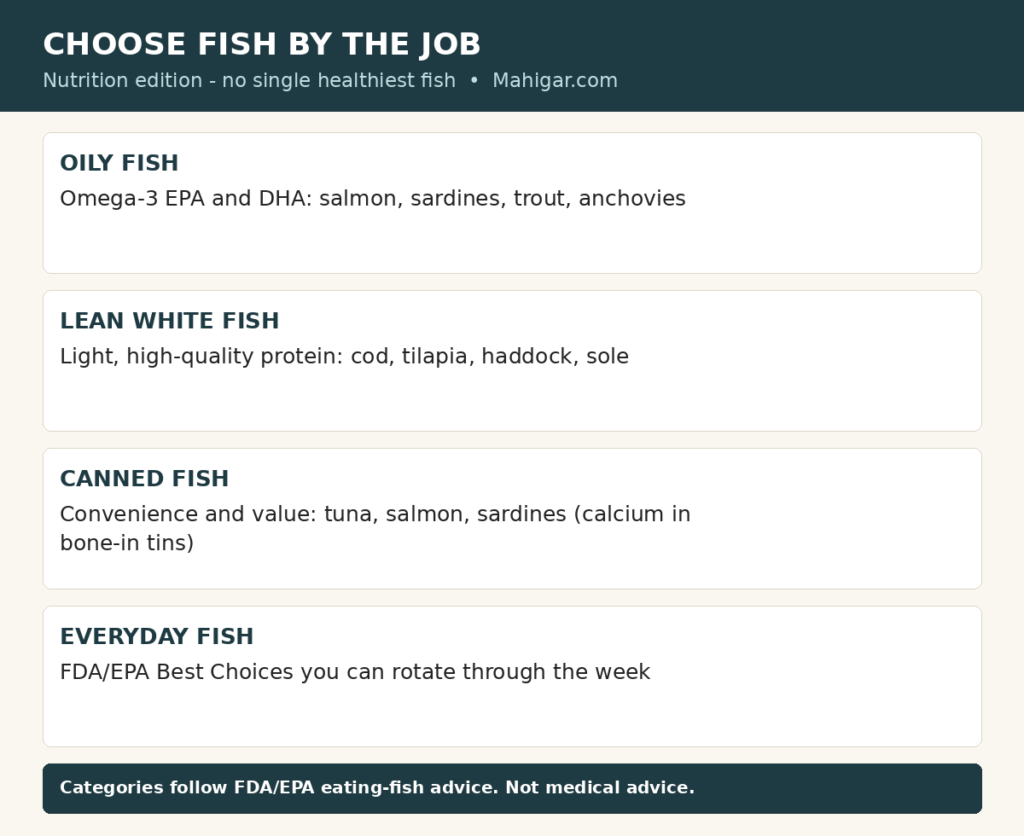
Job one: omega-3 delivery. Oily fish, salmon, sardines, trout, anchovies, herring, and mackerel, are rich in EPA and DHA. The FDA/EPA note that fish provide these fats along with protein, vitamin B12, vitamin D, and selenium, and USDA guidance names salmon, anchovies, sardines, Pacific oysters, and trout as higher in EPA and DHA and lower in methylmercury. One oily fish in my week’s menu largely does this job.
Job two: lean protein. White fish such as cod, tilapia, haddock, and sole give high-quality protein in a light fillet. The American Heart Association’s simple point, and mine: fish is a good source of protein and, unlike fatty meat products, is not high in saturated fat. When my plate already carries rich sides, a lean fillet keeps it balanced.
Job three: convenience and value. Canned tuna, salmon, and sardines keep in my pantry, cost less than many fresh fish, and ask almost nothing of the cook. Bone-in canned fish also brings calcium from the soft bones. I treat convenience as a real nutrition factor: the healthy fish my family actually eats beats the perfect fish in a recipe I never made.
Job four: the everyday rotation. Most weeks, my smartest move is variety inside the FDA/EPA Best Choices. The FDA’s own guidance is that eating a variety of fish is better than eating the same type every time, and the AHA adds that variety helps reduce any potential effects from environmental pollutants. I rotate species, I rotate methods, and nutrition and safety largely look after themselves.
That is my whole method: safety first, then I choose by the job. It has simplified every single fish decision in my kitchen for years, and it will simplify yours too.
What Fish Actually Gives You: The Benefits, Without the Hype
Let me walk the benefit claims slowly, because this is where fish writing usually starts promising miracles. I will not do that here. Fish is food, good food, not medicine.
The strongest ground belongs to the heart. The EPA, carrying the joint FDA/EPA advice, states that strong evidence shows eating fish as part of a healthy eating pattern may have heart-health benefits. The American Heart Association recommends two servings of fish, particularly fatty fish, per week, and notes that regularly eating fish and seafood is consistently associated with a lower risk of cardiovascular disease. Notice the language: “associated with,” “may have benefits,” “as part of a healthy eating pattern.” That careful wording is the honest version, and I keep it on this page.
Fish also fills ordinary gaps. It provides protein the body uses as building blocks for bones, muscles, cartilage, skin, and blood, USDA’s plain description of protein foods, and I use it because it is clearer than anything I could write. Salmon and trout are natural sources of vitamin D, which many indoor lives run short of. And fish in pregnancy and early childhood provides nutrients, including DHA and choline, that support a child’s brain development, which is why the FDA/EPA mercury chart matters: the goal is the right fish, not no fish.
The full research walk belongs to Health Benefits of Eating Fish, Backed by Research. Here my promise is simpler: benefits are real, mostly about patterns and replacement, fish instead of fattier meats, week after week, and no single fillet cures anything.
The Omega-3 Fish: Why the Oily Ones Get My Attention
If one nutrient built fish’s health reputation, it is the omega-3 pair EPA and DHA. These fats are found in varying amounts in seafood, and oily fish carry the most, which is why salmon, sardines, herring, mackerel, trout, and anchovies appear on every guidance list I consulted.
A practical point hides inside the science, and it changed how I shop: one serving of fatty fish does meaningful EPA-and-DHA work that several servings of very lean fish do not match. That is not an argument against lean fish, it owns job two in my kitchen, it is an argument for mixing my week.
What I will not do on this pillar is rank species by grams. Numbers copied from memory go stale, and a ranking is only as honest as its data table. The ranked guide, built from sourced figures, is Omega-3 Rich Fish, Ranked by Species. Until it publishes, I buy by the trait: darker, oilier flesh usually means the omega-3 job is being done.
How Much Fish Per Week? The Guideline Everyone Asks Me About
Three official voices land in nearly the same place, which makes this the easiest question on the pillar for me to answer honestly.
The Dietary Guidelines for Americans, reflected in the EPA’s FDA/EPA advice page, recommend at least 8 ounces of seafood per week on a 2,000-calorie diet, less for children, and 8 to 12 ounces of lower-mercury seafood per week during pregnancy and breastfeeding. USDA MyPlate guidance says the same in kitchen language: eat seafood in place of meat or poultry twice a week. The American Heart Association recommends two servings of fish per week, a serving is 3 ounces cooked, with emphasis on fatty fish.
Two servings a week. Eight or so ounces. That rhythm satisfies all three voices at once, and the FDA/EPA categories decide which fish fill those servings in my house: Best Choices can fill both, a Good Choice takes one slot and no other fish that week, and Choices to Avoid stay off my menu. The detailed week-planning, including child portions by age, is in How Much Fish Should You Eat Per Week?, and the species chart behind it is the Mercury guide linked above.
Protein: Fish Against the Other Proteins
Fish earns its place in the protein group honestly: complete, high-quality protein in a fillet usually leaner than the meats it replaces. USDA groups seafood with meat, poultry, eggs, beans, nuts, and seeds as protein foods, and recommends varying your protein routine. Most people eat enough protein but need leaner choices and more variety, and that sentence describes my own table too.
In my kitchen, a mild white fillet gives children and cautious eaters a gentle portion, while salmon or mackerel gives a richer plate. Formed fish, cakes and burgers, I always cook through properly, because ground fish needs more heat than a plain fillet.
Exact grams per species belong in a sourced table, not in my memory. That table is being built as Fish Protein Content Compared by Species, from USDA data.
Farmed or Wild? The Question With No Simple Hero
Few fish arguments run hotter than farmed versus wild, and few deserve a calmer answer. Here is where I stand, on solid ground.
Both farmed and wild fish can be nutritious. Mercury depends mainly on species. The FDA/EPA categories apply regardless of how a fish was raised. A farmed Best Choice eaten twice a week serves my diet better than a wild Choice to Avoid eaten proudly. Species first, origin second, that is my order, and I do not flip it for anyone.
Origin changes details a pillar should not guess at: feed, water, exact fat profile. The honest comparison is Is Farmed Fish as Healthy as Wild-Caught?.
Allergies: The Section That Matters Most to a Few Families
For most readers this section is a skim. For a family with a fish allergy, it is the most important page in the pillar, and it is the one where I must be most careful to stay in my lane.
I am a cook, not a doctor. I will not list symptoms as medical teaching or suggest anyone test a reaction at home. What I can do in a kitchen guide is explain that fish allergy is real and managed with doctors; teach habits that reduce accidental exposure, like keeping fish separate in a shared kitchen and reading labels; and point to safe alternatives so the fish-free plate is never a sad plate. Shellfish and finned fish are treated separately in allergy guidance, which is another reason the detail belongs with medical sources.
The full explainer, written with allergy-association sources and a clear medical disclaimer, is Fish Allergies: Symptoms and Safe Alternatives. If this topic is yours, start there and with your doctor, and treat everything on this page as general information only.
Fish and Cholesterol: Choosing Without Fear
Cholesterol worries keep some families away from fish, which I think is a shame, because the guidance points the other way. The American Heart Association’s starting fact: fish is a good source of protein and is not high in saturated fat, especially next to the fatty meats it usually replaces. Heart-healthy eating patterns consistently include fish.
My practical rules are portion and company. A lean fillet baked or grilled is a different plate from the same fish under a rich, salty sauce; the fish did not change, the company did. Anyone managing cholesterol with a doctor should follow that doctor’s numbers, not a food blog’s, not even mine.
The species-by-species guide, with sourced fat and cholesterol figures, is Best Fish for Low-Cholesterol Diets. Until it publishes, my pillar-level rule stands: I choose fish often, cook it gently, and let it replace fattier meats rather than compete with them.
The Pantry Shelf: My Canned Tuna, Salmon, and Sardines
Some of the most reliable fish nutrition in my house never sees an ice counter. It sits in the pantry.
Canned fish solves the two problems that stop families eating fish: price and planning. Canned light tuna is an FDA/EPA Best Choice. Sardines bring oily-fish omega-3s at a small price. Canned salmon carries salmon’s benefits into a cupboard ingredient, soft bones and all. Albacore (white) tuna sits one category up, a Good Choice, once a week, a perfect example of why the can’s exact name matters, and I read it every time.
Once I open a tin, the clock is the cooked-fish clock: fridge at 40°F or below, used within three to four days. The pantry comparison, with sourced data for each tin, is Canned Fish Nutrition Compared: Tuna, Salmon, Sardines.
However fish reaches my kitchen, ice, tin, or freezer, choosing it by name and job is the Species pillar’s work. I start at Fish Species Guide: What to Buy and How to Cook Each One for the which, and I come back here for the why.
Does the Cooking Method Change the Nutrition?
It changes the plate more than the fish. Gentle methods, grilling, baking, steaming, poaching, keep the fish close to what it was in the water. Heavy frying adds fat from the oil and the coating, which is why the same fillet can be a light dinner or a heavy one depending on the pan. That is not an argument against frying, it is an argument for honesty about what the method adds.
My rule is simple: the method should serve the job. Oily fish for the omega-3 job does best with dry heat that lets excess fat drip away, grilling or baking on a rack. Lean fish for the protein job welcomes gentle moisture, steaming or poaching, that keeps it from drying out. And whatever the method, the finish is the same: 145°F in the thickest part, opaque and flaking.
The Myths I Hear at the Fish Counter
After years of talking fish with shoppers, I keep hearing the same five myths, and each one costs somebody a good dinner.
“Fish is too risky because of mercury.” The chart exists precisely so you do not have to guess. Best Choices two to three times a week, Good Choices once, Choices to Avoid never. Follow the categories and the risk conversation ends. The people who should worry least are the ones eating salmon, sardines, and tilapia twice a week; the people who should worry most are the ones eating swordfish and shark, and almost nobody I meet eats those weekly.
“Frozen fish is worse than fresh.” Frozen promptly, fish keeps its nutrition well. “Fresh” fish that sat three days in a warm display is worse than frozen fish handled properly. I buy frozen without apology and thaw it in the fridge overnight.
“Farmed fish is bad for you.” Species decides mercury, not the farm. A farmed Best Choice beats a wild fish from the avoid list every time. Buy the species, then ask about the farm if you care about the rest.
“Fish is too expensive to eat twice a week.” Canned light tuna, sardines, and frozen fillets exist for exactly this complaint. Two servings a week does not require two salmon fillets; it requires planning.
“One superfood fish covers everything.” No single species does all four jobs. That is why I rotate. The healthiest fish habit is a varied one, not a loyal one.
How I Actually Plan a Fish Week
Theory is nice; here is my real Monday-to-Sunday thinking, and you can steal it.
I pick one oily fish for the omega-3 job, usually salmon or sardines, because one serving does the heavy lifting. I pick one lean or canned fish for the protein-and-value job, often tilapia, cod, or canned light tuna. Both come from the Best Choices list. That is the whole plan: two servings, two jobs, done.
Then I cook them the way the week allows. A busy Tuesday gets the canned fish, no shame in it. A calmer evening gets the fresh fillet, grilled or baked, with whatever vegetables are in the house. If a Good Choice fish shows up at the market looking beautiful, it takes one of the two slots and nothing else swims that week. That is the entire system, and it has never failed me.
The Nutrition Hub: All Eight Guides
You do not need to read this pillar in order. Start with your question, and each guide below takes it the full distance:
What does fish actually do for my health? The full research walk, benefits stated the way the sources state them, is in Health Benefits of Eating Fish, Backed by Research.
Which fish carry the most omega-3s? The sourced, ranked species table lives in Omega-3 Rich Fish, Ranked by Species.
How much fish should my family eat each week? Week-planning with child portions by age is in How Much Fish Should You Eat Per Week?.
How does fish protein compare, species by species? The USDA-data table is Fish Protein Content Compared by Species.
Is farmed fish as healthy as wild? The calm, sourced comparison is Is Farmed Fish as Healthy as Wild-Caught?.
What about fish allergies and safe alternatives? The careful explainer with its medical disclaimer is Fish Allergies: Symptoms and Safe Alternatives.
Which fish suit a low-cholesterol diet? The species-by-species guide with sourced figures is Best Fish for Low-Cholesterol Diets.
Tuna, salmon, or sardines from the tin, which is best? The pantry comparison with sourced data for each tin is Canned Fish Nutrition Compared: Tuna, Salmon, Sardines.
Each guide will link back here, and I will link down to each one as it publishes. The Diet and Lifestyle pillar that follows this wave builds its recipes on these answers, which is why this pillar publishes first.
Frequently Asked Questions
Is fish actually healthy, or is it hype?
It is genuinely healthy, with conditions I never hide. Guidance from the American Heart Association, the FDA/EPA, and the USDA Dietary Guidelines all place fish in a healthy eating pattern: high-quality protein, omega-3 EPA and DHA in oily fish, and vitamin D in some species. My conditions are which species (lower mercury), how often (about two servings a week), and cooked to a safe finish.
How much fish should I eat per week?
The voices agree closely: at least 8 ounces of seafood a week for many adults (Dietary Guidelines for Americans), two servings of fish, particularly fatty fish, a week (American Heart Association), and Best Choices filling two to three 4-ounce servings (FDA/EPA chart). In pregnancy or breastfeeding, I point to 8 to 12 ounces of lower-mercury fish, and your own doctor’s advice first.
Does mercury cancel out the benefits of eating fish?
Not if you choose by category, which is exactly what I do. The FDA/EPA chart exists so you can keep the benefits and limit mercury together: shark and swordfish sit on my avoid list, while salmon, sardines, tilapia, and canned light tuna are Best Choices. Variety helps too.
Is frozen or canned fish as healthy as fresh?
Fish frozen promptly keeps its nutrition well, and I rely on canned fish myself: canned light tuna is a Best Choice, and sardines and canned salmon carry oily-fish benefits into the pantry. “Fresh” fish that has sat too long is worse than frozen or canned fish handled properly.
What to Check Next
Start with this week’s plate: one oily fish, one lean or canned fish, both from the FDA/EPA Best Choices if you can, each cooked to 145°F. That single habit satisfies nearly every voice this pillar consulted. Then follow your question into its full guide above as each one publishes.
And if you take one sentence from this whole page, take this: eat fish twice a week, vary the species, cook it properly, and let the chart handle the worrying. Everything else is detail.

3 Comments