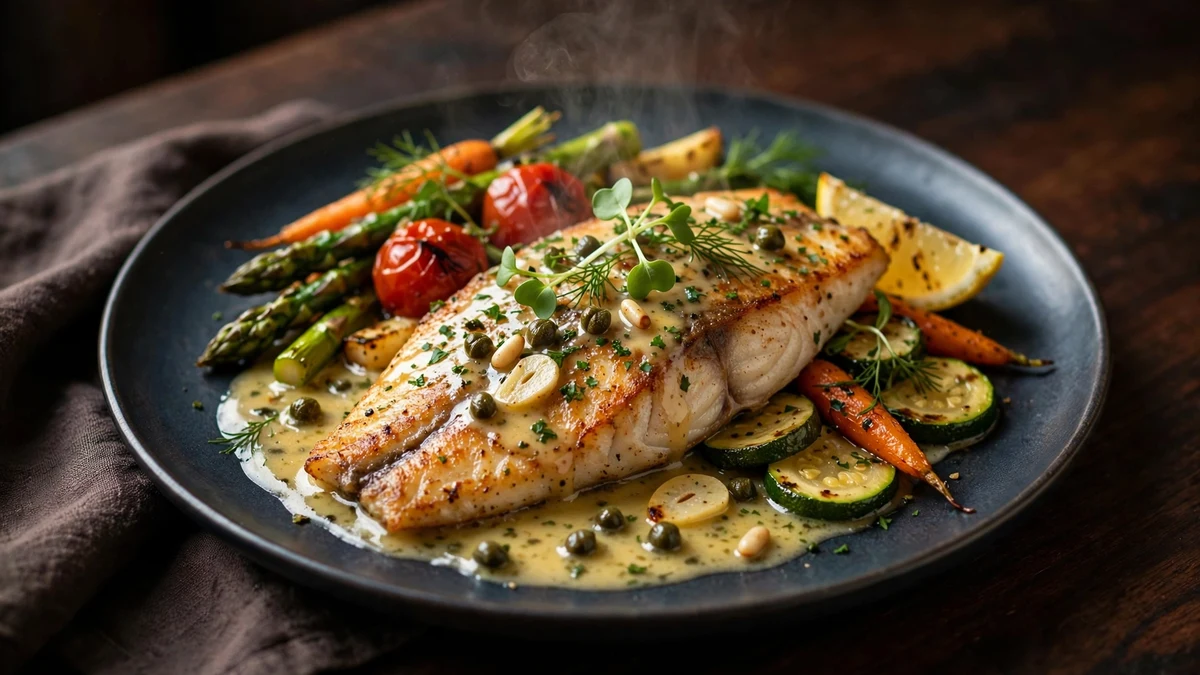
How to Serve Fish: Pairing and Presentation Guide
The saddest fish dinner I know is not a badly cooked one. It is a good fish, cooked properly, then served badly. I have seen it at my own table: a crisp fillet that waited while I hunted for a side, a delicate steamed fish buried under a heavy sauce, a rich grilled fish on a cold plate with nothing fresh beside it. The cooking was fine. The serving undid it in the last two minutes.
Fish is unforgiving about those last two minutes. It cools fast, its crisp skin softens fast, and its gentle flavour is easily covered by whatever loud thing shares the plate. Most home cooks I meet do not have a cooking problem at the table. They have an order problem: side by habit, sauce by instinct, garnish for colour, and only then a look at the fish.
There is a calmer way, and it is the way I serve fish now. Decide the plate in one fixed order: the fish first, its richness and texture; the side second, chosen by weight; the sauce third, given one clear job; and the garnish last, only when it adds real flavour. Kept in that order, a plain fish dinner feels composed and generous, without any restaurant tricks.
This page is Mahigar’s serving hub. It teaches the order I use, the safety rules under every plate, how sides, drinks, sauces, grains, garnish, parties, and whole fish each fit that order, and where each question is answered in full. Nothing here asks you to cook differently. It asks you to finish differently.
Table of Contents
Table of Contents
First, Serve It Safely: Hot Fish Does Not Wait
Safe service comes before presentation, always. A beautiful plate of fish that sat too long is not a success, it is a risk with good lighting.
Fin fish is finished at 145°F (63°C) in the thickest part, or when the flesh is opaque and flakes easily. The full chart, species by species, is in Safe Internal Cooking Temperatures for Every Type of Fish, and I check it the same way whether I am cooking for two or for a full table. Once the fish reaches that finish, the clock starts. Serve it promptly. I will not invent a home holding temperature, because the honest rule is simpler: cooked fish is eaten, not stored on the counter. Discard cooked fish left at room temperature for more than two hours, or more than one hour above 90°F (32°C).
Calm service is really preparation done early. Plates ready before the fish cooks. Sides decided and, where they can be, finished first. Lemon cut, herbs picked, sauce warmed if it is meant to be warm. Fish is cooked last in my kitchen, always, because it is the one thing on the plate that cannot wait politely. The table can wait for the cook. The fish should never wait for the table.
Serve by the Plate: The Order That Decides Everything
My method is four decisions, always in this order: fish richness first, side weight second, sauce job third, garnish last. It sounds almost too simple, until you watch it rescue plate after plate.
Name first what the fish already gives you. A delicate white fish is quiet and can disappear under heavy flavours. A rich, oily fish has more presence and often needs freshness or acidity beside it. Crisp fried fish brings texture that a wet side can spoil in minutes. A whole fish brings ceremony, and bones that must be handled honestly. Until you have named your fish, rich or lean, crisp or soft, bold or gentle, every other choice is a guess.
Choose the side by weight, not by habit. Under a bold fish curry, a plain and soothing side gives the sauce room to speak. Beside rich grilled fish, a fresh salad or a sharp vegetable can do more good than another rich dish. Under delicate steamed fish, keep the company gentle so the fish still tastes like itself. A side should support the fish, refresh the mouth between bites, or catch a good sauce. One main job, done well.
Give the sauce one job: moisture for a lean fish, brightness for a rich fish, gentle richness for a plain fish, or controlled heat for a quiet plate. If the fish already cooks in a sauce, it usually needs no second sauce. Then add garnish last, only when it contributes flavour or texture you can taste.
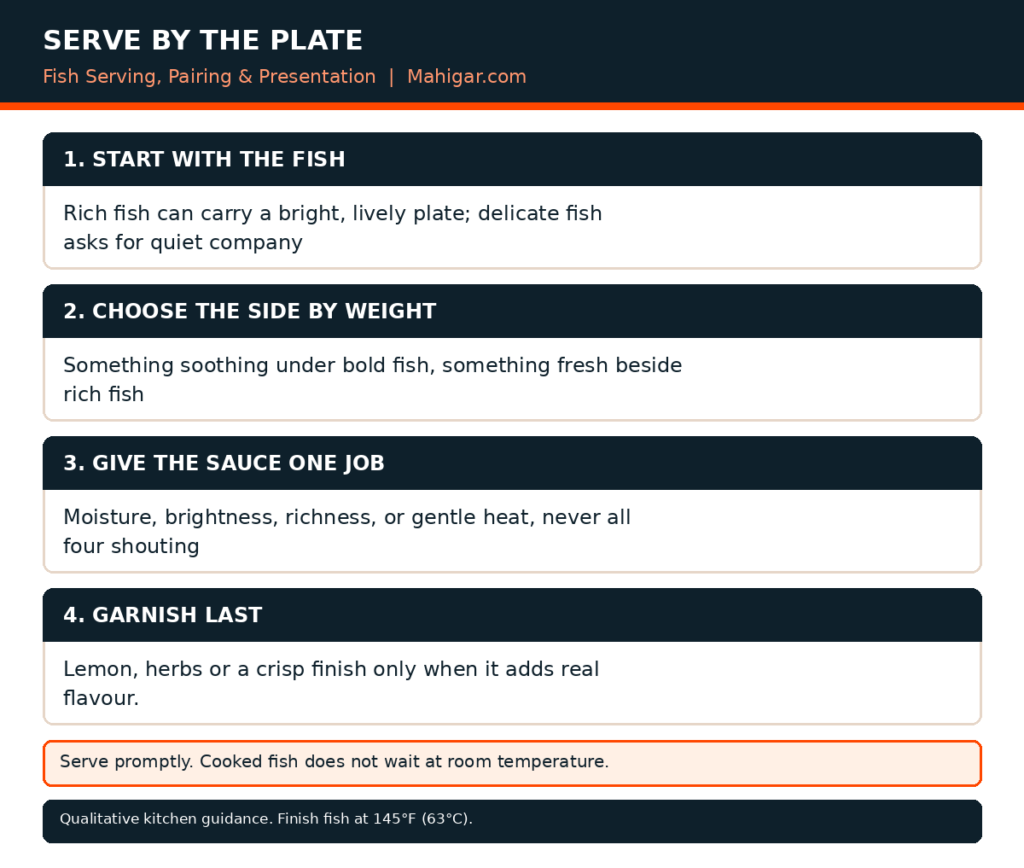
Fish, side, sauce, garnish. Decide in that order, and most serving problems solve themselves before the first plate is lifted.
What Goes Beside the Fish: Sides With a Reason
The right side is the one that gives the fish what it lacks. There is no single correct answer, because fish changes with species, method, sauce, and the people at the table.
Crisp fried fish asks for something fresh and crunchy, so the plate keeps its contrast. Gentle baked fish sits happily with soft vegetables and a simple grain. Desi spiced fish may call for rice, salad, lemon, and something cooling. Fish in a rich sauce wants a plain companion that can carry that sauce to the last bite.
My rule is contrast with restraint: rich fish with freshness, lean fish with a little comfort, spicy fish with something soothing, mild fish with a side that has a voice but does not shout. If everything is soft, the meal feels tired even when each part is cooked well. One contrast, chosen on purpose, is enough.
So do not collect side names to memorise. Ask what tonight’s fish lacks: freshness, moisture, crunch, a sauce catcher, or a plain base under strong seasoning. When your question is which of those jobs tonight’s plate actually needs, the guide I built for exactly that decision is What to Serve with Fish: 30+ Side Dish Ideas, which organises pairings by cooking method and flavour profile and teaches the choosing method instead of asking you to memorise combinations.
Read the Fish First: How the Cooking Method Shapes the Plate
The same fish becomes a different plate depending on how it was cooked, and honest serving starts by respecting the method, not fighting it.
Crisp fried or grilled skin is a texture you worked for, so protect it: dry sides nearby, sauce under or beside rather than over, and no wet garnish scattered across the skin. Steamed and poached fish arrive delicate and moist; they want gentle company and a little brightness. Baked fish in a sauce has already made its flavour decision, so the side should support it rather than start a second one. Fish in a curry or rich gravy needs a plain base and a cooling contrast, not another rich dish.
The heat choices that create those textures, dry heat for browning and crisp skin, moist heat for delicate fish, fat for flavour and forgiveness, are the foundation I follow from The Science of Cooking Fish: A Troubleshooting Guide, and this pillar continues that thinking onto the plate. When method and serving agree, the fish tastes like one idea. When they fight, the plate tastes like two dinners at once. So ask before you dress any plate: what did the cooking just give this fish? Then serve that.
What to Pour: Pairing by Richness, Not by Rules
Pair the drink with the whole plate, by richness and weight, and ignore any single rule that claims one drink suits all fish. I am a fish cook, not a wine merchant, so I pair the way I build plates: by what the drink needs to do in the mouth.
A delicate fish in a gentle sauce wants a drink that will not cover it. Rich, oily fish can stand beside something brighter, because the drink’s job there is to refresh the mouth between bites. With spicy or strongly seasoned food, the drink should cool the plate rather than add noise. And if the fish carries a sauce, pair with the sauce too, because the sauce may be the strongest flavour on the plate.
Alcohol is always optional, and I will not dress up pairing principles as wine expertise I have not earned. Sparkling water with citrus, unsweetened iced tea, or another refreshing non-alcoholic drink can do the same honest work: freshness, a little acidity, and a clean finish. Choose what your guests actually enjoy, and the pairing is already half right.
I make no alcohol health claims here, and no claims about vintages or regions. For the fish by fish walk through these principles, Best Wine Pairings for Fish by Type takes the pairing logic species by species, by fat, acid, sauce, and weight, with non-alcoholic choices treated as first class options.
Plating: Calm Plates Make Fish Look Expensive
A calm, confident plate makes ordinary fish look generous. Restaurant plating is mostly restraint, contrast, and a fish that still looks like the point of the plate.
Home cooks usually go the other way. They keep adding sauce, garnish, height, and colour until the fish is buried under good intentions. A clean plate, the fish placed with confidence, the side arranged beside it, and sauce placed with a purpose will look better than a crowded plate almost every time.
Use a plate that fits the food. Too small traps the meal. Too large makes an honest portion look lost. Place the best side of the fish upward; crisp skin should be seen, not softened under sauce. Put the sauce lightly over, neatly under, or beside the fish, depending on whether it should flavour every bite or be chosen bite by bite. Leave a little empty space, and then stop. Stopping is the skill.
Height helps only when it is natural: fish resting on vegetables it is meant to be eaten with. Height built for its own sake collapses and cools the fish. For the full craft taught as home cook skills, How to Plate Fish Like a Restaurant works through plate choice, placement, sauce control, and finishing, without pretending a photograph proves a restaurant method.
Sauce: The Quiet Worker on the Plate
A good sauce feels inevitable on the plate. A bad one feels pasted on. The difference is never the recipe. It is purpose.
Lean fish often welcomes moisture and a little gentle richness. Rich fish often wants brightness to cut through its fat. A delicately flavoured fish needs a sauce that speaks softly. A boldly spiced fish may need no sauce beyond lemon, or beyond the sauce it already cooked in. If you cannot say in one short sentence what your sauce is for, the fish probably does not need it.
Think in families before recipes: citrus led brightness for richness, herbs for freshness, restrained butter or cream style richness for lean plain fish, tomato or tamarind style sharpness where the cuisine supports it, and chilli used to lift rather than burn. Kitchens answer this very differently around the world, as Fish Recipes from Around the World shows, so no single fish sauce can suit every plate.
Serve sauce with control. A little under the fish seasons each bite without hiding crisp skin. A spoon beside it lets the eater choose. Heavy pouring belongs only where the fish needs moisture and has no crisp texture to lose. When the choice itself is the hard part, Sauces That Pair Perfectly with Fish walks through the families by the job each one does. This pillar teaches how to choose a sauce’s job, and prints no sauce recipe.
Bread, Rice, and Grains: The Plate’s Foundation
Bread and grains are what make a fish meal feel finished: they carry sauce, calm strong flavours, and turn a fillet into a dinner. Choosing them well is about texture and appetite, not habit alone.
Rice and pilaf style grains sit naturally under sauced fish and curries, because they catch what would otherwise be lost on the plate. A plain grain beside spicy fish gives the eater a reset between bites. Bread does different work: it can mop a sauce, support a piece of fish, or add the crisp and chewy contrast rice cannot. Choose the one that suits the food, not the one that merely fills space.
Watch the plate’s total weight. Rich fish, rich sauce, and a heavy grain crowd one another until nothing tastes distinct. If the fish is bold, keep the grain plain. If the fish is mild and the sauce light, a more seasoned grain can bring the interest the plate is missing. Every grain has one of four roles: base, sauce catcher, contrast, or comfort. Name the role before you cook it. That mapping, bread and grain by method and cuisine, is what Best Bread and Grain Pairings for Fish Dinners sets out in full.
Garnish: Only What Adds Flavour
A garnish should be edible, purposeful, and missed when it is absent. If nobody would notice it gone, it was decoration, and decoration does not belong on a hot fish plate.
Lemon earns its place through brightness, not through being yellow. Fresh herbs add aroma and a clean taste. A crisp element can rescue a soft plate. A few drops of good oil can round a plain fish. Citrus zest, pickled elements, a little chilli, or crunchy aromatics can also work, when each answers a real need: sharpness where the plate is rich, crunch where it is soft, freshness where it is heavy.
Ask one question before adding anything: what will this do in the mouth? If the answer is only that it will look nice, leave it off. Do not cover crisp skin with wet herbs, and do not bury a crisp finish under sauce at the final second.
At a family table, lemon wedges or herbs served alongside can be better than garnishing every plate the same way, because children and cautious eaters keep control over sharp or hot flavours. For garnish treated as flavour work rather than decoration, How to Garnish a Fish Dish goes through citrus, herbs, crisp finishes, oils, and heat by what each contributes in the mouth.
A Fish Dinner Party Without Panic
A calm fish dinner party comes from choosing work you can finish, not from cooking the most complicated menu you know. Fish cooks quickly and deserves your attention at the end, so build the whole evening around that truth.
Choose accompaniments that do not fight for last minute attention. Decide the sauce’s job early. Pick a main fish you know how to cook and portion without stress, because a simple fish served calmly beats an ambitious fish served in a panic every time. Guests taste tension. They also taste ease.
Balance by weight and flavour. If the main fish is rich, keep the rest fresher. If it is delicate, let a side carry more interest. Avoid three loud dishes in a row. Think honestly about bones, too: whole fish is generous and dramatic, but fillets are calmer for guests who do not enjoy navigating them. The right choice is the one your guests can relax with.
I will not build a timed run sheet from invented minutes, because fish thickness, kitchens, and ovens all differ. Work by sequence instead: decisions and prep early, vessels ready, accompaniments supporting the main, fish cooked when the table is ready. For whole menus built around that sequence, Fish Dinner Party Menu Ideas plans complete fish parties balanced by weight and flavour, with the main fish chosen for calm.
Whole Fish at the Table: Ceremony With Clear Bones
A whole cooked fish brings a presence to the table that no fillet can match. It also brings a head, a backbone, and fine bones, and serving it well means making every guest confident about what they are eating.
Use a platter with room to work. Keep the fish intact for its arrival if you enjoy that moment, then portion it clearly instead of letting guests dig uncertainly into the middle. Lift the flesh in sections, expose and remove the backbone cleanly, and check each portion before it reaches a plate, especially for children and nervous guests. Never promise that a whole fish is boneless when its frame says otherwise. Bone honesty is hospitality.
The detailed spoon and fork method for the bones lives in How to Debone a Whole Cooked Fish at the Table: one guide teaches the deboning, and the full table ritual around it, choosing the fish, platter and tools, portioning, and courtesies, is covered end to end in How to Serve Whole Fish at the Table. Done well, whole fish is the warmest serving in this hub. Done carelessly, it is the one guests remember for the wrong reason. The difference is clarity, portion by portion.
The Mistakes I See at Good Tables
Most serving mistakes I see come from generous instincts applied in the wrong order. These are the five I correct most often, including in my own kitchen’s past.
Sauce used to rescue dry fish. Sauce can add moisture, but it cannot undo overcooking. Cook the fish to its finish, then let sauce do its one chosen job.
Garnish added for colour. Colour that adds no flavour cools the fish and clutters the plate. If a finish will not be tasted, it should not be there.
Everything rich at once. Rich fish, rich sauce, heavy grain, creamy side: together they exhaust the eater by the third bite. A fish plate needs one rich voice and quieter company.
The fish cooked first. The most common timing error I know. Fish held while sides finish arrives lukewarm and tired. Cook it last, carry it first.
Rules instead of reading the plate. White wine with fish, lemon on everything, sauce always over: rules stop you looking at the actual fish. Richness, texture, and sauce already told you what the plate needs.
None of these needs new equipment or new recipes to fix. Each one is an order problem, and order is free.
One Fish, Two Plates: The Method at Work
Let me show the order working, because the same fish served two ways teaches it faster than any rule.
Take a rich, oily fish, grilled until its skin is crisp. Richness and crispness are what the cooking gave you. The side should be fresh and sharp. The sauce, if there is one, has one job, brightness, and it goes beside or under, never over that skin. The garnish earns its place only if it adds brightness or a clean herbal note.
Now take a lean white fish, gently baked until just opaque. This fish is quiet and delicate, the opposite plate. The side can carry gentle comfort. The sauce has a different job, moisture and soft richness, and it may go lightly over the fish because there is no crisp skin to protect. Same order, opposite answers, both right, because the fish decided them.
That is the whole pillar in one lesson. There is no house style to copy. There is a fish to read, and an order to follow, and the plate builds itself from there.
Where Each Serving Question Lives: The Serving Hub
Every question in this pillar has one full guide behind it, and each guide answers its question in the same order this page teaches. Find your question, and follow the guide written for it.
When the question is what should sit beside tonight’s fish, What to Serve with Fish: 30+ Side Dish Ideas answers it by cooking method and flavour profile, so the side is chosen for its job rather than from habit.
When the question moves to the glass, Best Wine Pairings for Fish by Type works through wine and non-alcoholic pairings by fat, acid, sauce, and weight, as first class choices.
When a cooked fish tastes right but looks untidy, How to Plate Fish Like a Restaurant teaches plate choice, placement, sauce control, and finishing as calm home cook craft.
When the fish is plain and the plate feels unfinished, Sauces That Pair Perfectly with Fish sorts the sauce families by the job each one does, so the sauce you choose has a reason to be there.
When the plate needs a foundation, Best Bread and Grain Pairings for Fish Dinners matches rice, grains, and breads to the methods and cuisines they suit, by the role the grain is playing.
When a plate lacks only a finish, How to Garnish a Fish Dish covers citrus, herbs, crisp finishes, oils, and heat as flavour work, judged by the mouth, not the photograph.
When the table holds guests instead of family, Fish Dinner Party Menu Ideas builds whole menus by sequence and balance, so the fish can be cooked last and served calmly.
And when the fish arrives whole, How to Serve Whole Fish at the Table covers choosing the fish, platter and tools, clear portioning, and honest bone talk, so ceremony never turns into worry.
Each guide will link back here as it publishes, and this page will return the link. That two way habit turns serving tips into topical depth: one hub that reads the plate, and eight guides that each master one part of it.
Frequently Asked Questions
What is the simplest way to serve fish well?
Cook it properly, serve it promptly, and decide the plate in order: fish richness, side weight, sauce job, garnish. A plain grilled fish with lemon and a fresh side will beat a crowded, undecided plate almost every time.
Should sauce go over fish or beside it?
Put sauce under or beside crisp skinned fish so the skin stays crisp. Spoon it lightly over lean fish that needs moisture. If the fish already cooked in a sauce or a curry, it usually needs no second sauce; add a side or a purposeful garnish instead.
What drink pairs with fish if I do not drink wine?
Use the same principles: freshness, acidity, and weight. Sparkling water with citrus, unsweetened iced tea, or another refreshing non-alcoholic drink can sit well beside fish. Pair with the sauce and the whole plate, not with the species name alone.
How do I serve whole fish without worrying guests about bones?
Portion it clearly on a roomy platter, lift the flesh in sections, remove the backbone cleanly, and check each portion before serving. Never promise that a whole fish is boneless, and tell guests plainly where fine bones may still hide.
What to Check Next
Tonight, decide the plate before you cook. Name the fish’s richness. Choose one side with a clear job. Decide whether a sauce must add moisture, brightness, richness, or gentle heat, or whether the fish needs none. Garnish only if it will be tasted. Then cook the fish last and bring it straight to the table.
Serving is not decoration added after cooking. It is the last part of cooking itself. Treat it with the same care, in the same order, and your fish will finally taste the way you cooked it.

One Comment