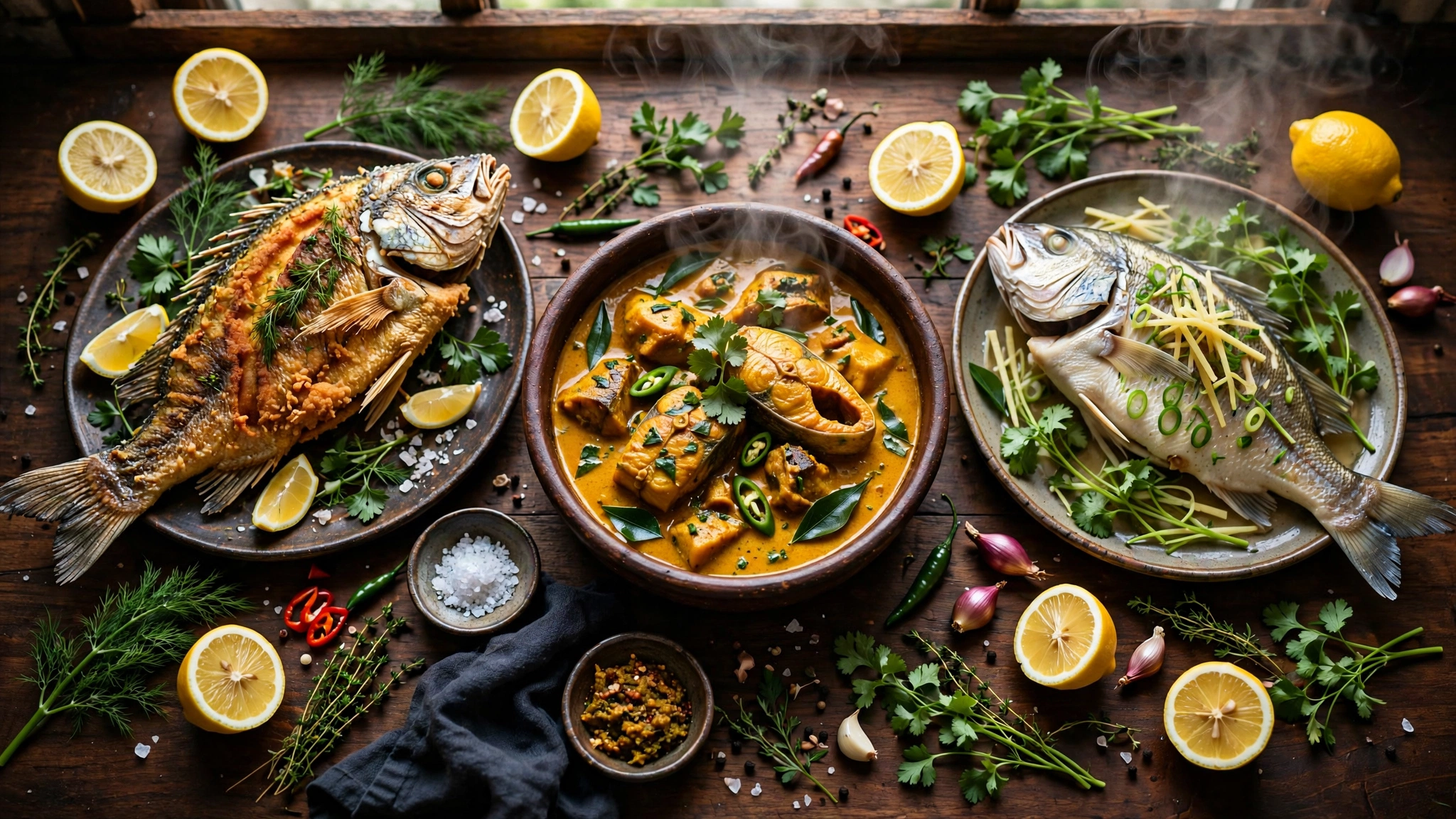
Fish Recipes from Around the World
Travel through fish kitchens and one thing becomes clear fast: the spices change, the sauces change, the pans change — the fish does not. A cook in Lahore, a cook in a Greek harbour town, and a cook making tacos all want the same three things: fresh fish, the right heat for its thickness, and flesh that stops cooking at the right moment. Learn those shared rules and every cuisine here stops looking foreign.
I am Wasim Abbas Bhatti, the Fish’s Chef. I have cooked fish for more than twenty years, and my own kitchen sits at a crossroads: the masala fries and riveThai-Style Fish Curry Guider-fish curries of my South Asian home ground, and the whole roasted fish, battered fillets, steamed fish, and bright tacos I have learned from other people’s tables. This page is Mahigar’s world-cuisine hub. It organises the world’s fish cooking by kitchen style, teaches the principles that travel, and links down to a full regional guide for each style as those guides publish.
If the fish is still whole and needs cleaning and cutting, start with Fish Prep and Butchery: Every Skill You Need. This page answers the next question: once the fish is home, which kitchen’s way should it be cooked?
Table of Contents
First, the Safety Frame That Travels Everywhere
Cuisines differ. Food safety does not, so let me set the frame once before we travel.
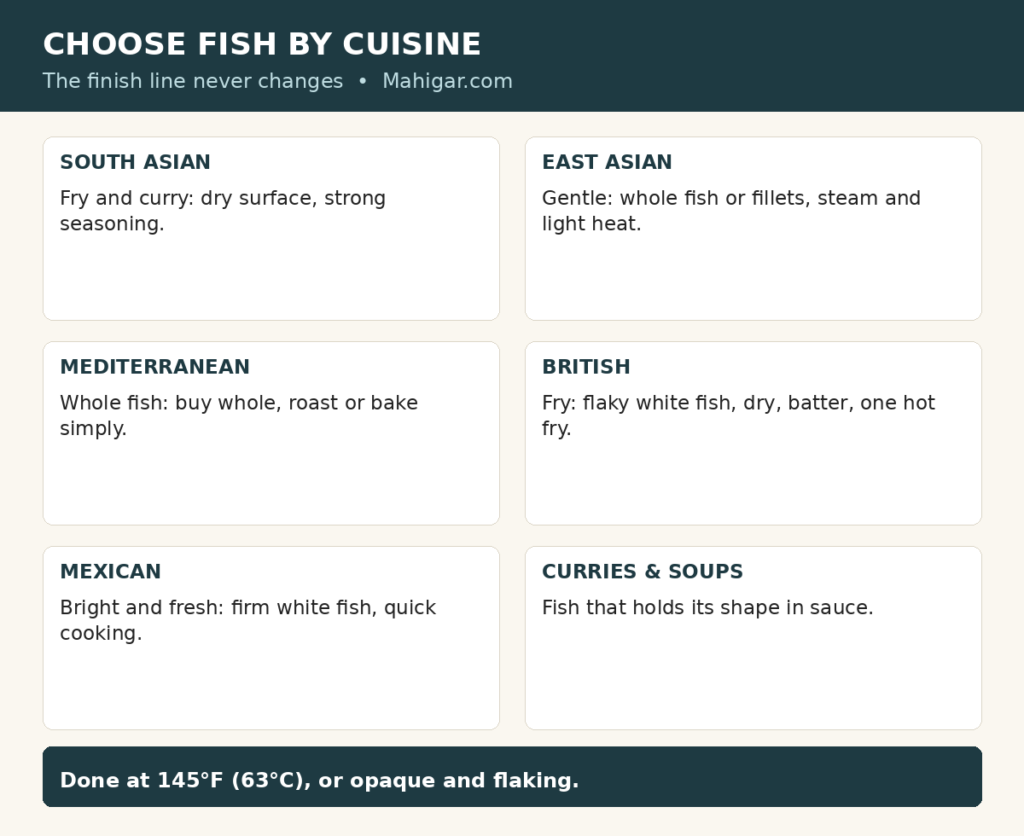
Fin fish is done at 145°F (63°C) in the thickest part, or when the flesh is opaque and flakes easily — in a Karachi curry, a Mediterranean oven, or a British fryer alike. The full chart, including ground fish and stuffed fish, lives in Safe Internal Cooking Temperatures for Every Type of Fish. Thick whole fish is always judged near the backbone, never by the tail or the skin.
Chill rules travel too: keep raw fish at 40°F (4°C) or below, use raw fish within 1–2 days, cooked fish within 3–4 days, and do not leave cooked fish sitting out for more than 2 hours — or 1 hour on a very hot day above 90°F (32°C). A dish’s origin never changes those numbers.
The last part of the frame is species choice. Some fish belong on the table often and a few large predators only rarely, whatever cuisine is cooking them; that FDA/EPA picture is set out in Mercury in Fish: Safe Levels by Species. No sauce, marinade, or cooking style cooks mercury out of a fillet. Choose the species first, then choose the cuisine.
The Kitchen Principles That Travel
Before the regions, here are the rules I carry from kitchen to kitchen. They matter more than any single recipe.
Freshness beats geography. A tired fish in an “authentic” recipe is still a tired fish. Bright eyes on whole fish, flesh that springs back, a clean sea smell — those checks work in every market on earth.
Dry surface, then heat. Wet fish steams instead of browning, whether the goal is a crisp Pakistani fry, a British batter crust, or a seared Mediterranean fillet. Pat the fish dry at the last moment, in every cuisine, without exception.
Thickness decides the cooking, not the country. A thick steak and a thin fillet never finish together in any kitchen. Even pieces, honest checks at the thickest part — that is the whole secret behind “perfect timing” in steamed, fried, and roasted fish alike.
One gentle turn, or none. Most fish dishes turn the fish once. Delicate fish may not be turned at all. The cuisines that steam, poach, or bake whole fish are not being fussy; they are protecting flesh that breaks when handled.
Colour is the weakest judge. Salmon-coloured fish can be done while still deeply coloured, and pale fish can hide a raw centre. Read flake and temperature, not tint — the full troubleshooting picture is in The Science of Cooking Fish: A Troubleshooting Guide.
Match the fish to the job, not the label. Firm fish holds in curries and on grills. Flaky white fish takes batter. Delicate fish wants gentleness. Rich, oily fish carries strong seasoning. Get that match right and almost any regional style will work in your kitchen.
South Asian Kitchens: My Home Ground
This is where my cooking starts, and it is the section of this hub most guides on the internet simply cannot write from the inside.
Our fish cooking is bold and practical at the same time. The everyday hero is the masala fry: fish dried well, coated in spice, and fried until the outside is crisp and fragrant. It is weeknight food and celebration food at once, eaten with our hands, argued over at the table. The regional guide that carries this properly is PaPakistani-Style Fish Fry: Authentic Desi Masala Recipee — written from firsthand family technique, not from a translated summary.
Around it sit the regional styles of the Punjab river towns, where the same fish is treated with local spice hands that visitors genuinely cannot copy from a generic recipe. Lahori and Multani Fish Recipes: A Regional Guide will walk those differences honestly, city by city, because on my table they are not the same dish wearing two names.
South Asia also teaches fish in sauce. Our curries simmer firm pieces in spiced gravies that would dissolve a delicate fillet, which is exactly why species choice matters here: the fish must hold its shape while it drinks the sauce. The wider subcontinent picture — how coastal and river traditions differ — belongs to Indian Fish Curry: Regional Styles Explained, which will treat Bengali, Goan, and South Indian styles as the separate kitchens they are, not one generic “curry.”
The home lessons travel well: dry the fish before spice touches it, let firm fish carry strong seasoning, and learn to manage honest bones at the table instead of fearing them.
East Asian Kitchens: Gentle Heat, Clean Flavours
If South Asian cooking is the bold end of my table, the East Asian styles I have learned are the gentle end — and they taught me restraint.
The heart of this cooking is whole fish treated with respect: scaled, gutted, and steamed or lightly cooked so the flesh stays silky and the flavour stays clean. Nothing is hidden under heavy sauce. That is why freshness matters here more than anywhere: gentle cooking forgives nothing. Chinese-Style Steamed Fish Guide will teach that whole-fish steaming technique step by step — the timing discipline, the backbone doneness check, and why this method punishes a cook who walks away.
The Japanese kitchen, for a home cook, is not about raw-fish mastery. It is about simple, kind techniques — gentle glazes, careful pan work, fish cooked just to the point — that any home kitchen can learn without special training. Japanese-Style Fish for Beginners will keep it exactly that honest: accessible methods first, no assumed sushi skill.
What travels from this section: steam and gentle heat are not weak cooking, they are precise cooking. A delicate fish that would shatter in a fryer stays perfect under steam. Check near the backbone, serve at once, and let clean fish taste like itself.
Mediterranean and Iberian Kitchens: The Whole-Fish Table
The Mediterranean table taught me how little a good whole fish needs.
Across the Greek and Italian coasts, the pattern repeats: buy the fish whole, keep the seasoning honest, and let the oven or grill do quiet work. The fish arrives at the table as it was caught, and the eating — lifting flesh from the frame — is part of the meal. Mediterranean Baked Fish: Greek and Italian Styles will separate those two neighbouring kitchens properly, because Greek and Italian hands do not treat a baked fish identically, and pretending “Mediterranean” is one style helps nobody.
Further west, the Spanish and Portuguese kitchens add a lesson in patience: salt-preserved fish, soaked back to life before cooking — a technique built by people who had to make fish travel before fridges existed. Spanish and Portuguese Fish Recipes: Bacalao and More will explain that soaking process honestly, since it is the step most quick recipes skip and the one that decides the dish.
What travels from this section: whole fish is not hard fish. Scale it, gut it, dry it, give it room and honest heat, and check it near the backbone. My Prep pillar teaches every one of those board skills, and a whole roasted fish remains the most generous plate I know how to serve.
British Kitchens: The Batter Fry, Done Properly
The British gift to the fish world is one dish done with total commitment: battered, fried white fish, crisp outside and steaming inside, eaten hot.
It looks simple. It is not careless. The fish must be the right flaky white species, dried properly, coated well, and fried once at honest heat — the same dry-surface and one-fry discipline my own masala fry demands, wearing a different coat. British Fish and Chips at Home will go deep on the batter itself, because the crust is where home versions usually fail: soggy, thick, or greasy instead of light and crisp.
This cluster also closes a loop on my site: the cod-versus-haddock question from the Species pillar is decided nightly in British fish shops, so the two pages will cross-link when both are live. Choose the fresher fish, dry it, batter it, fry it once, and serve it immediately. Fish and chips waits for nobody.
Mexican Kitchens: Bright, Fresh, and Fast
Mexican fish cooking, at its best, is the opposite of heavy: quick-cooked fish, fresh toppings, sharp and bright flavours, food built for warm weather and hungry people.
The famous plate is the fish taco — and it is not one dish. Coastal styles differ in how the fish is cooked and dressed, and lumping them together loses exactly what makes them interesting. Mexican Fish Tacos: Regional Styles Compared will separate Baja-style tacos from the other regional styles properly, with firm white fish cooked fast and served fresh as the shared rule underneath.
What travels from this section: speed is a technique. Fish for tacos is cut even, cooked quickly, and served at once while the contrast between hot fish and cool, fresh toppings is alive. Let it sit and the magic dies. A cook who learns that timing owns every quick fish dish on this page.
Curries, Soups, and the Cajun Table
Some kitchens build the sauce first and let the fish finish inside it. This is home ground for me — but the world does it in more accents than mine.
The Thai kitchen builds curries with a balance of heat, richness, and freshness that asks the fish to stay tender inside a bold sauce. Thai-Style Fish Curry Guide will adapt that honestly for home cooks, with the fish pieces added with the same respect our own curries teach: firm pieces, gentle simmering, no rough stirring. The Indian regional picture lives in the South Asian section above; together those two clusters cover the great curry belt without pretending it is one recipe.
Across the Atlantic, Louisiana’s Cajun and Southern kitchens bring spice-crusted, confidently seasoned fish — a style built on bold seasoning and hot pans that any lover of masala fry will feel at home with immediately. Cajun and Southern-Style Fish Recipes will cover that spice technique with proper respect for where the cuisine comes from.
And at the quiet northern end, Scandinavian kitchens preserve fish by curing and shape it into cakes — preservation cooking from cold coasts, where the technique itself is the flavour. Scandinavian Fish Recipes: Gravlax and Fish Cakes will explain the curing step carefully and honestly, with its safety handling spelled out, since cured fish allows no shortcuts.
The shared rule across all of these: sauce and seasoning can be bold, but the fish still finishes at the same opaque, flaking point. Bold kitchens do not get to overcook. They just make “done” taste louder.
The World Cuisine Hub: Read by Region
Twelve regional guides belong to this pillar. Each one is a full recipe guide in its own kitchen’s voice, and each will link back here. I will link down to each as it publishes.
- Your first stop, and my biggest home advantage? Go to Pakistani-Style Fish Fry: Authentic Desi Masala Recipe.
- The Punjab river-town styles, honestly separated? Go to Lahori and Multani Fish Recipes: A Regional Guide.
- Whole fish, simply baked, two coasts compared? Go to Mediterranean Baked Fish: Greek and Italian Styles.
- Gentle Japanese cooking without the intimidation? Go to Japanese-Style Fish for Beginners.
- Bold spice-crusted fish, Louisiana style? Go to Cajun and Southern-Style Fish Recipes.
- Tacos with their regional differences respected? Go to Mexican Fish Tacos: Regional Styles Compared.
- A rich curry that keeps the fish tender? Go to Thai-Style Fish Curry Guide.
- The great battered fry, crust and all? Go to British Fish and Chips at Home.
- The subcontinent’s curry kitchens, separated properly? Go to Indian Fish Curry: Regional Styles Explained.
- Cold-coast preserving and fish cakes? Go to Scandinavian Fish Recipes: Gravlax and Fish Cakes.
- Whole fish, steamed with discipline? Go to Chinese-Style Steamed Fish Guide.
- Salt cod brought back to life, step by step? Go to Spanish and Portuguese Fish Recipes: Bacalao and More.
Frequently Asked Questions
Which cuisine is best for a beginner cooking fish?
Start where the method forgives: a simple fry or a baked whole fish. The Pakistani-style fry and the Mediterranean baked fish in this hub both reward basic skills — dry fish, honest heat, one check at the thickest part — and neither needs special equipment.
Do different cuisines cook fish to different temperatures?
No. Styles change flavour, not safety. Fin fish is done at 145°F (63°C) in the thickest part, or opaque and flaking, in every cuisine on this page. What changes is how each kitchen gets there — steam, batter, curry, or oven.
What fish should I buy for curries and tacos?
Fish that holds its shape: firm pieces for curries so they survive the sauce, and firm white fish cut even for tacos so it cooks fast and stays whole. The Species Guide, when live beside this hub, matches species to jobs trait by trait.
How do I keep fish dishes from tasting “fishy”?
Buy fresher fish, keep it cold, and cook it on time. Strong “fishy” flavour is mostly age and handling, not cuisine — no spice blend honestly fixes tired fish. Fresh fish takes strong seasoning beautifully; old fish just tastes seasoned and old.
Which cuisine is best for a beginner cooking fish?
Start where the method forgives: a simple fry or a baked whole fish. The Pakistani-style fry and the Mediterranean baked fish in this hub both reward basic skills — dry fish, honest heat, one check at the thickest part — and neither needs special equipment.
Do different cuisines cook fish to different temperatures?
No. Styles change flavour, not safety. Fin fish is done at 145°F (63°C) in the thickest part, or opaque and flaking, in every cuisine on this page. What changes is how each kitchen gets there — steam, batter, curry, or oven.
What fish should I buy for curries and tacos?
Fish that holds its shape: firm pieces for curries so they survive the sauce, and firm white fish cut even for tacos so it cooks fast and stays whole. The Species Guide, when live beside this hub, matches species to jobs trait by trait.
How do I keep fish dishes from tasting “fishy”?
Buy fresher fish, keep it cold, and cook it on time. Strong “fishy” flavour is mostly age and handling, not cuisine — no spice blend honestly fixes tired fish. Fresh fish takes strong seasoning beautifully; old fish just tastes seasoned and old.
What to Check Next
Choose tonight’s kitchen first, then the fish, then the method. For whole fish, walk the Prep pillar before you light anything. If a piece comes out sticking, curling, or dry, the Cooking Science pillar reads those problems like a doctor.
Twelve regional guides will hang off this page, starting with the Pakistani-Style Fish Fry. Right cuisine, right fish, right heat: that is the whole world tour.
